

A national median asking rent of $1,844 for a two-bedroom unit in February 2026 still sat 15.9% above its level six years earlier, even after a 1.9% year-over-year decline, according to Realtor.com's February 2026 rental-market report. That combination of softer prices and still-high costs makes the search for 2 bedroom places to rent unusually difficult. Renters need enough space for roommates, a home office, or a growing household, but they also need to compare neighborhoods, concessions, commute times, and building quality before a suitable listing disappears.
The first search is rarely enough because inventory is fragmented. A desirable apartment may appear on one marketplace, a broker portal, or a building website, then attract inquiries before a renter repeats the same search manually. This comparison organizes seven rental sources around different search jobs, including broad discovery, commute filtering, NYC depth, listing quality, national applications, mobile speed, and cross-platform coverage.
Start with a realistic total monthly budget, rank must-have features, compare neighborhoods, and turn on persistent alerts where timing matters. Rental sites and apps are already central to the process, with 85% of renters saying they use or plan to use one and 87% beginning without a specific property in mind, according to the Apartments.com renter search survey. For one saved search across more than 20 sources, RentReboot is another option, with email or SMS alerts and NYC-specific rent context.
Table of Contents
- 1. RentReboot
- 2. Zillow Rentals
- 3. Apartments.com
- 4. StreetEasy
- 5. RentHop
- 6. Realtor.com Rentals
- 7. Zumper
- 2-Bedroom Rentals: Top 7 Platform Comparison
- Build a Two-Bedroom Search That Keeps Working
1. RentReboot
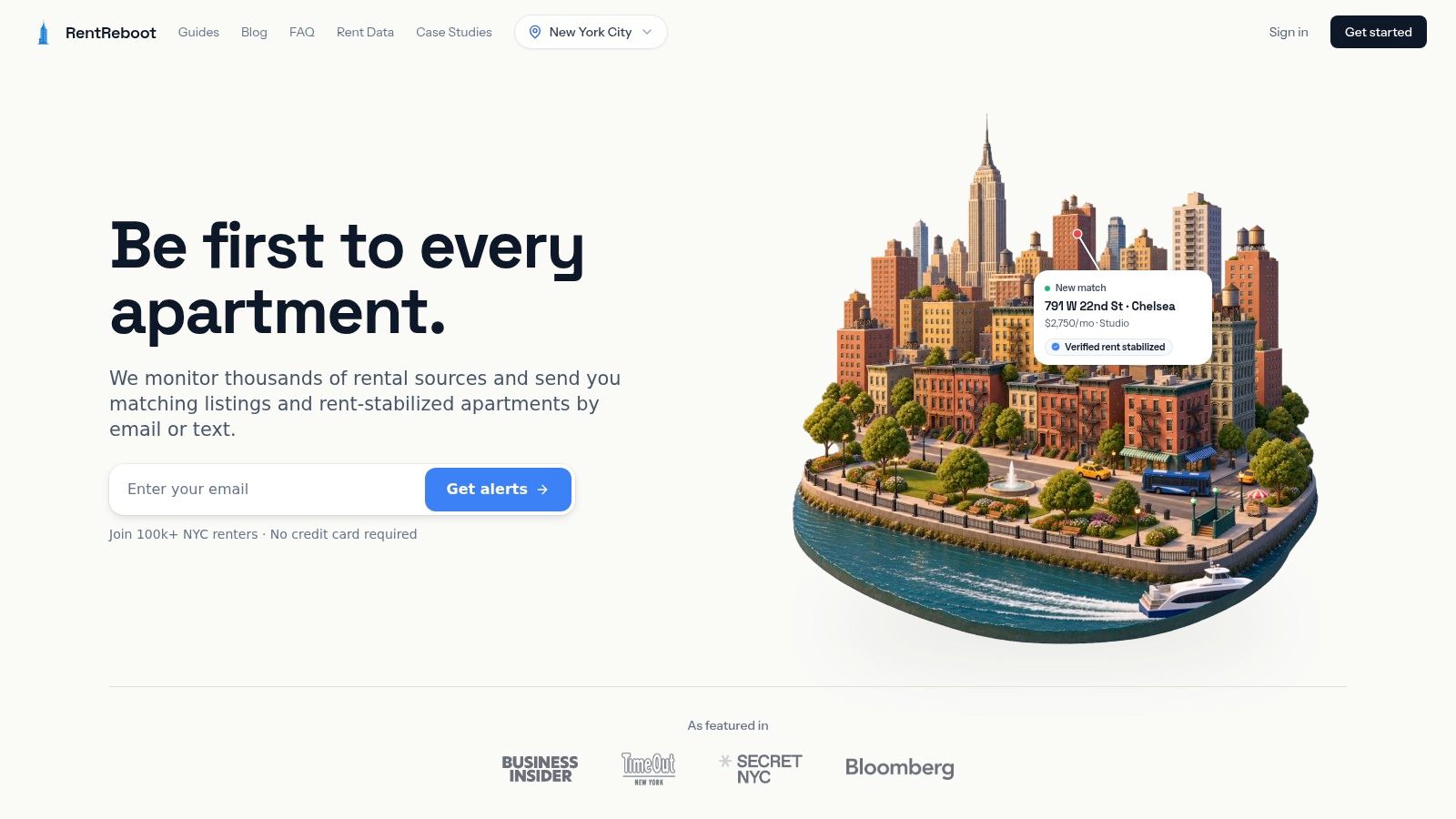
RentReboot is built for the renter who doesn't want to check seven sites repeatedly and still miss the right two-bedroom. The service monitors more than 20 rental sources, including StreetEasy, Zillow, Craigslist, broker portals, and building websites, then matches new listings against saved criteria. Its alerts can arrive by email or SMS, which turns a broad search for 2 bedroom places to rent into an ongoing monitoring process rather than a daily browsing routine.
That breadth matters most in NYC. RentReboot's Summer 2026 study matched 50,130 NYC apartments and found that 51.3% appeared on exactly one platform, while StreetEasy covered 77.1% of the studied listings and was the first observed source for 69.8%. Those findings point to a practical conclusion. StreetEasy may be essential, but relying on it alone can still leave gaps.
Why the context changes the search
RentReboot doesn't only send a listing link. Alerts can include a potential rent-stabilization signal checked against official NYC datasets, the asking price compared with neighborhood medians, price per square foot, a map location, transit and amenity walk times, building records, and scam-signal checks. That context helps a renter decide whether to contact a listing immediately, investigate the building, or reject it before spending time on an application.
The service also publishes neighborhood rent distributions for 150+ NYC neighborhoods, segmented by bedroom type. A renter comparing a two-bedroom in Astoria with one in Crown Heights can use that context to assess whether a lower asking price reflects a genuine neighborhood trade-off or a listing that deserves more scrutiny.
Practical rule: Use a persistent alert for discovery, but use the listing details and neighborhood context to decide how quickly to respond.
RentReboot is strongest for NYC renters seeking broad coverage, rent-stabilized opportunities, and faster first contact. Its deepest verification features depend on NYC public data, so the same level of stabilization and building-record context won't necessarily exist in another city. A free tier is available without a credit card, while advanced paid-plan details should be checked directly because plan features may change.
2. Zillow Rentals
Zillow Rentals fits renters who need broad national discovery and a connected workflow after finding a promising two-bedroom. Its marketplace supports listing searches, tour requests, applications at participating properties, and rent payments through Zillow Pay when a lease supports that option. A renter can often move from discovery to touring and application management without switching between unrelated tools.
That workflow is useful for households comparing several neighborhoods or relocating to an unfamiliar city. A couple moving for work could save a two-bedroom search, request tours from multiple property managers, and monitor application progress in one account. Persistent alerts also matter here: two-bedroom inventory can change while a renter compares commute, location, and total move-in costs.
Zillow works best as a broad first pass, not as proof that every available property follows the same process. Property managers must support Zillow Applications for the reusable application flow to apply, while some private landlords handle communication and screening elsewhere. Renters should confirm who controls the listing and where documents belong before submitting sensitive information.
Where the workflow stops
Zillow Pay can simplify rent payments for supported leases, but it does not make every rental a Zillow-managed transaction. Before applying, verify the advertised rent, required fees, lease terms, and payment route. Renters who want to watch market movement before committing can track Zillow rental signals alongside a saved search.
For an NYC search, compare Zillow with an NYC apartment app comparison, especially when a fixed move-in date makes early contact valuable. City-focused tools may offer stronger local coverage, while Zillow remains useful for national reach and application workflow. In practice, use Zillow for broad discovery, then reserve city-specific platforms for the final narrowing step.
3. Apartments.com
Apartments.com is a strong choice when the commute defines the search. Its map tools let renters draw a search area, while Travel Time filtering helps center results around an office, campus, hospital, or transit connection. That changes the question from “Which two-bedrooms are available in this city?” to “Which two-bedrooms keep my trip within an acceptable limit?”
This distinction is important because a cheaper apartment can become a poor value if it creates an impractical daily journey. A renter could draw a boundary around several neighborhoods, apply a commute filter, then narrow the results by bedrooms, price, amenities, and property type. The approach is more disciplined than choosing a neighborhood first and checking transportation later.
A better fit for managed buildings
Apartments.com draws from the broader CoStar network, including ApartmentFinder and ForRent. Its property information is supported by an in-house research operation that verifies details and availability, which can make the platform particularly useful for renters comparing professionally managed communities.
The trade-off is inventory style. Large buildings and professionally marketed properties are more prominent than small landlords or informal listings, and some applications move to an external property portal. A renter looking for a private-owner two-bedroom should supplement the search rather than assume every available unit will appear in the same format.
Use the San Francisco apartment search comparison if you're evaluating how a commute-centered tool fits alongside other sources. For a household that must reach work reliably, Apartments.com's Travel Time function may be more valuable than a larger but less structured list of apartments.
Best search job: Filter two-bedroom inventory around the commute first, then compare rent, amenities, and building type.
4. StreetEasy
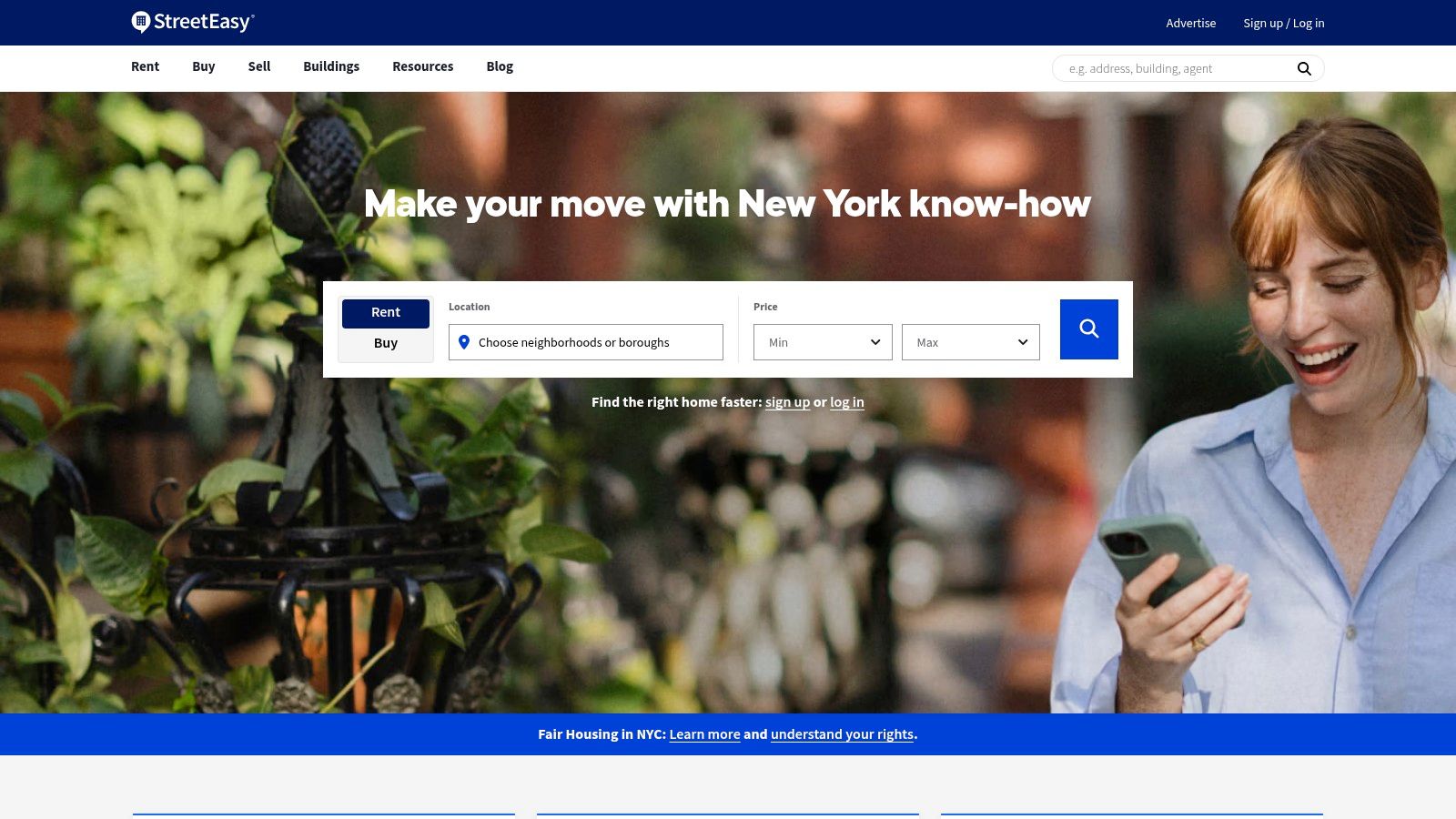
For NYC renters, StreetEasy offers local depth that broad national portals can't fully replicate. Its building pages bring together current and previous listings, floor plans, and building information, while saved searches can send email notifications for new matches and price changes. A renter searching in a specific neighborhood can also use filters for by-owner listings, sublets, and building requirements.
That building-level view supports a more informed comparison. If two two-bedroom apartments have similar asking rents, the renter can examine the buildings, prior listings, available layouts, and neighborhood position instead of evaluating each unit in isolation. When provided, StreetEasy's "total monthly price" display also helps separate headline rent from the recurring amount a household may need to budget for.
Speed inside a focused market
StreetEasy is especially useful when the geography is already clear. A renter targeting a particular part of Brooklyn or Manhattan can save a tightly defined search, add building alerts, and watch for price changes without repeatedly rebuilding the same filters. The platform's NYC focus is a strength in that market and a limitation everywhere else.
Local depth doesn't eliminate the need for verification. Confirm availability, fees, lease terms, and the application path with the listing contact. Tags and interface features can change, so the displayed filters should support the renter's decision rather than replace direct questions.
For neighborhood-specific planning, pair the platform with this guide to two-bedroom apartments in NYC. StreetEasy is the natural primary source for a narrowly defined NYC search, but persistent monitoring across other sources can reveal units that don't appear there first.
Best search job: Track NYC buildings and neighborhoods closely, especially when price changes or local listing depth matter.
5. RentHop
RentHop approaches the search through listing quality and freshness. Its HopScore ranking is designed to surface stronger listings earlier, giving renters a way to prioritize postings instead of opening every result in chronological order. That can help a renter looking for a two-bedroom in a fast-moving NYC neighborhood, where time spent sorting weak or incomplete results reduces time available for contacting credible listings.
A useful scenario is a roommate group with a narrow budget and a short move window. The group can browse neighborhood-level two-bedroom pages, save its criteria, and use updates to identify new matches. HopScore gives the first pass a quality signal, while the renters still need to check the address, lease terms, photos, fees, and availability.
Quality scores aren't a substitute for checking
RentHop has strong visibility in NYC and can include small-landlord and brokered units that may turn over quickly. Coverage and inventory vary by city, however, and user feedback about listing freshness is mixed. A score can help prioritize attention, but it cannot confirm that a unit remains available or that every detail is current.
Renters should cross-check a promising result against the contact information, building details, and the landlord or broker's responses. They should also be cautious if a listing pushes for payment or sensitive documents before a legitimate viewing and application process.
RentHop works best as a quality-focused complement to a broader search. It gives a renter a faster way to triage results, while another source can provide wider coverage or deeper pricing context.
Best search job: Prioritize higher-signal NYC listings when a two-bedroom search produces too many results to review manually.
6. Realtor.com Rentals
Realtor.com Rentals is useful when the next step after discovery is a tour request or application. Renters can request and schedule tours from listing pages, and participating properties may offer an “Apply Now” flow powered by Rental Beast. Where enabled, one application can be reused for 30 days, according to the Realtor.com rentals platform.
That workflow helps a renter who has already defined the search and expects to contact several properties. Instead of re-entering the same information for every participating listing, the renter can submit once and reuse the application during the stated period. The practical benefit depends on whether the specific two-bedroom includes the feature.
Participation determines the convenience
“Apply Now” isn't available on every listing. Some landlords and property managers use their own screening portals, require different documentation, or handle applications outside Realtor.com. Renters should read the listing instructions carefully and avoid assuming that an application submitted through one property will transfer to another.
The tour-request feature can also reduce friction, but a request isn't the same as a confirmed appointment. A renter should watch for the manager's confirmation, ask whether the advertised unit is still available, and verify the total recurring cost before paying an application fee.
Realtor.com Rentals is therefore best for a national search where tour scheduling and application reuse are central. It isn't the strongest choice for discovering every isolated listing, but it can make the conversion from “this looks suitable” to “I've requested a viewing” more straightforward.
Best search job: Move quickly from a promising national listing to a tour or reusable application when the property supports it.
7. Zumper
Zumper is a mobile-first option for renters who want new two-bedroom matches delivered quickly. Its saved searches, instant alerts, filters, verified tags, and tour and application workflows are designed for people who search from a phone rather than a desktop. That matters when a renter is commuting, sharing the search with a roommate, or watching several neighborhoods at once.
The platform also publishes rental-market reports and data tools that can help a renter add pricing context to the search. National figures don't describe every building, but they can help explain why two-bedroom results look different across metros or why a change in timing may produce a different set of options.
Useful for speed, not complete coverage
Zumper offers national coverage across major rental markets, but its inventory can lean toward larger professionally marketed buildings in some cities. Smaller-landlord coverage varies by metro, so a renter shouldn't treat a clean mobile interface as proof that the search is exhaustive.
Its alerts are most useful when the criteria are specific enough to be actionable. Set the bedroom count, acceptable neighborhoods, budget, and essential features before turning on instant notifications. Otherwise, frequent alerts can create noise rather than improve response speed.
Zumper is a good fit for a renter who wants to act from a phone and monitor market movement. Pair it with a broader or locally specialized source when a two-bedroom search depends on smaller landlords, exclusive listings, or building-specific information.
Best search job: Receive fast mobile alerts and keep a national two-bedroom search active while moving between locations.
2-Bedroom Rentals: Top 7 Platform Comparison
| Platform | Implementation complexity 🔄 | Resource requirements ⚡ | Expected outcomes ⭐📊 | Ideal use cases 💡 | Key advantages ⭐ |
|---|---|---|---|---|---|
| RentReboot | Low for users (save search & get alerts); backend is data‑intensive 🔄 | Minimal user setup; provider ingests 20+ sources and continuous monitoring ⚡ | High discovery rate and rapid alerts; strong NYC rent‑stabilization signals ⭐📊 | NYC renters who need minute-by-minute alerts and regulated‑unit checks 💡 | Comprehensive source coverage, real‑time context-rich alerts, NYC dataset verifications ⭐ |
| Zillow Rentals | Moderate, unified search → tour → apply → pay workflow 🔄 | Account recommended; landlord participation varies; national infrastructure ⚡ | Very broad inventory and end‑to‑end leasing tools; application/pay convenience ⭐📊 | Renters who want nationwide listings plus integrated touring/applying/paying 💡 | Consolidated workflow, largest national inventory, strong brand reach ⭐ |
| Apartments.com (CoStar) | Low, user-facing features are straightforward; research-backed data 🔄 | Minimal user effort; heavy in-house verification and research resources ⚡ | More accurate, less stale listings; good results for professionally managed properties ⭐📊 | Renters seeking verified listings and commute‑centric searches in major cities 💡 | Strong data verification, draw-on-map and travel‑time tools, robust filters ⭐ |
| StreetEasy | Low, NYC‑centric search and alert tools; intuitive building pages 🔄 | Minimal setup; benefits from local NYC data and building histories ⚡ | Deep NYC coverage; many local listings surface here first; timely alerts ⭐📊 | NYC-focused searches, building-specific monitoring, 2‑bedroom hunting in the city 💡 | Local depth, comprehensive building pages, advanced neighborhood filters ⭐ |
| RentHop | Low, standard search/save flows with HopScore ranking 🔄 | Minimal user setup; depends on listing metadata and freshness signals ⚡ | Higher‑signal listings surfaced; can reduce time on low‑quality posts ⭐📊 | NYC renters who want quality-ranked results and fast-turnover listings 💡 | HopScore ranking improves listing quality signal and prioritization ⭐ |
| Realtor.com Rentals | Low, simple tour request and ‘Apply Now' flows 🔄 | Account for applications; reuse applies only where enabled; national feed ⚡ | Quick tour access and reusable applications where supported; variable coverage ⭐📊 | Renters wanting fast tour scheduling and one-time reusable applications 💡 | Simple tour/apply flow, integrated apply features, solid national coverage ⭐ |
| Zumper | Low, mobile-first saved searches and instant alerts 🔄 | Mobile app recommended; verified tags and national feeds ⚡ | Fast mobile alerts, good two‑bedroom coverage in many metros; rent trend insights ⭐📊 | Mobile-first renters seeking quick alerts and trend data across metros 💡 | Fast personalized alerts, verified listings tags, strong mobile UX ⭐ |
Build a Two-Bedroom Search That Keeps Working
The right source depends on the job, not on a single universal ranking. Use Apartments.com when the commute should define the map. Choose Zillow Rentals or Realtor.com Rentals when you want tour requests and application steps tied closely to the listing workflow. Use StreetEasy or RentHop for NYC-specific depth, building research, and local inventory signals. Zumper fits a mobile-first search where speed and instant alerts matter.
RentReboot is the strongest option when cross-platform monitoring is the priority, particularly for NYC renters who want a single saved search watching multiple sources. Its research found that 51.3% of matched NYC apartments appeared on exactly one platform, which is a strong reason to treat any individual marketplace as a partial view rather than a complete market. A cross-platform alert can reduce the need to repeat the same search across separate sites.
Price context matters because national two-bedroom figures are not perfectly consistent across providers or dates. Realtor.com reported $1,896 as the national median asking rent in August 2026, down 0.9% year over year, while Apartment List reported $1,374 in September 2026 and Zumper reported a late-August two-bedroom increase of 0.5% annually, as summarized in the national rent report from Zumper. The difference doesn't make one source automatically wrong. It shows why renters should compare the date, methodology, metro coverage, and listing type behind each figure.
Write down your must-haves before searching.
- Total monthly-cost limit: Include required fees and any recurring charges, not only the advertised base rent.
- Commute ceiling: Define the longest acceptable trip and use map or travel-time tools to enforce it.
- Bedroom requirements: Decide whether the second room must fit a person, office, child, or flexible use.
- Acceptable compromises: Rank neighborhood, floor, amenities, outdoor space, and building age rather than treating every preference as equal.
- Application readiness: Keep required documents and references available, but verify the listing and application route first.
Rental vacancy tightened from 9.1% in 2024 to 7.5% in 2025 and about 7.1% in August 2026, according to the evidence summarized in Apartments.com's analysis of two-bedroom search demand. That pattern supports a practical strategy: don't wait for a perfect listing to appear through occasional browsing. Activate alerts on the most relevant sources, verify details before applying, and use neighborhood-level pricing to decide whether a compromise is sensible.
Before you begin, review neighborhood data for your target area, including Renton, Washington neighborhood information, when that market is part of your search. Then set a RentReboot saved search for your two-bedroom budget and preferred neighborhoods. The free tier is a useful starting point, and email or SMS notifications can put new matches in front of you without relying on repeated manual searches.
RentReboot monitors more than 20 rental sources, matches listings to your bedroom count, budget, and neighborhoods, and sends email or SMS alerts when relevant two-bedroom apartments appear. Visit RentReboot to create a saved search, compare NYC neighborhood rent context, and catch listings that may not appear on the same platform as every other apartment.