
The city's rental market is so tight that only 1.41% of apartments were vacant in the 2023 Housing and Vacancy Survey, which meant roughly 33,210 units were available across more than 2.3 million rentals (NYC Housing and Vacancy Survey fast facts). That's the right starting point for how to rent an apartment in NYC, because speed, paperwork, and cash on hand matter before you ever step into a showing.
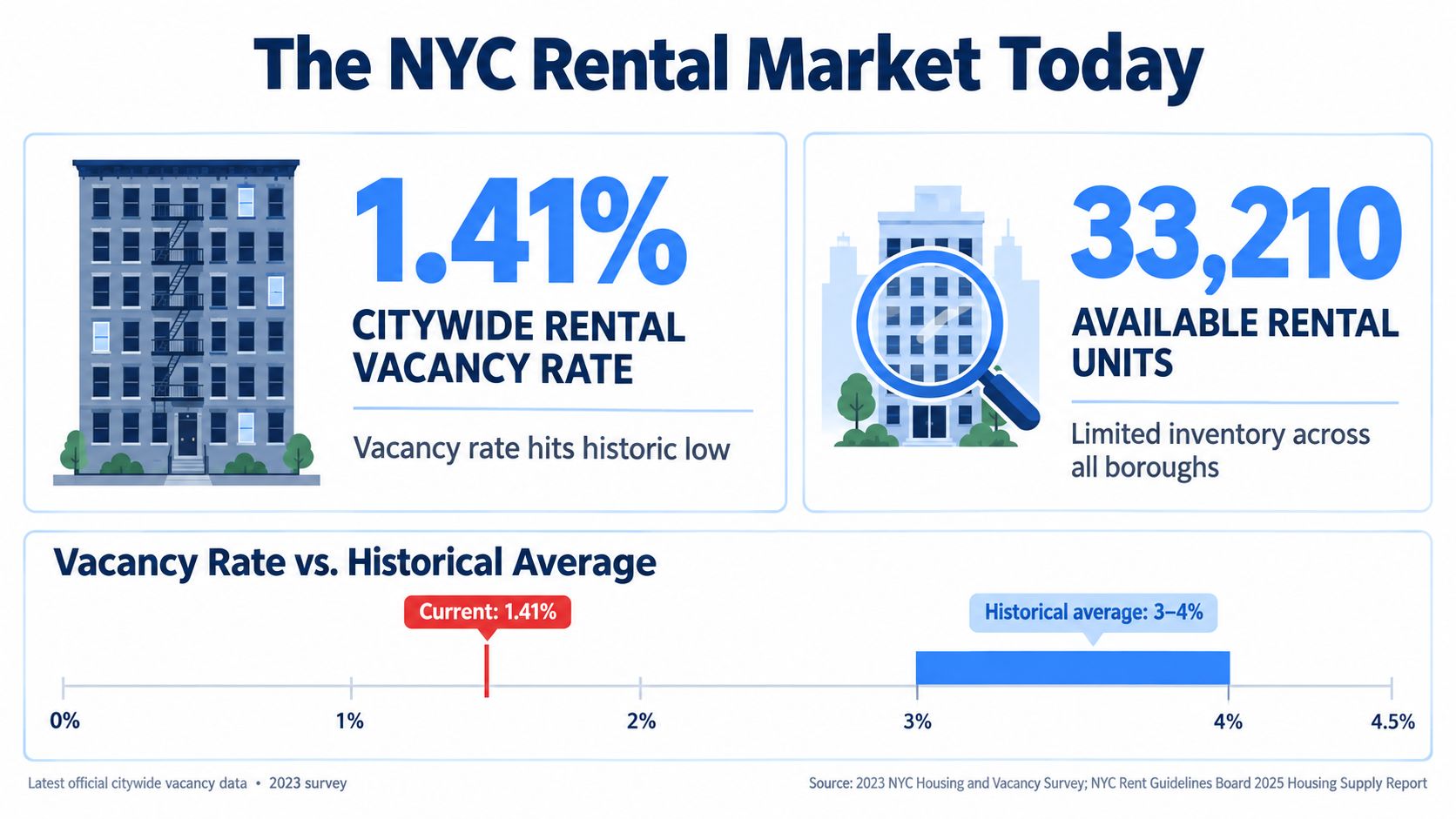
Table of Contents
- What Renting in NYC Looks Like Right Now
- Set a Realistic Budget Before You Search
- What the FARE Act Changed About Move-In Cost
- Search Across Multiple Platforms at Once
- Choose Between Market-Rate, Lottery, and Rent-Stabilized
- Build the Application Packet That Lands the Apartment
- Sign the Lease and Walk Through Move-In Day
What Renting in NYC Looks Like Right Now
NYC renting does not reward casual browsing. Listings can draw several applicants fast, and the vacancy rate explains the pressure. At 1.41%, there is little room to wait, because an apartment can be gone by the next day (NYC Housing and Vacancy Survey fast facts).
The basic jobs are simple, but the pace isn't
The work usually comes down to four jobs, set the budget, search across multiple sources, qualify cleanly, and move in without surprises. Each one sounds straightforward until you are juggling broker calls, document uploads, and a 6 p.m. tour after work.
The part that matters now is the full cash picture before keys, not just the monthly rent. After the FARE Act, broker-fee language changed, but move-in costs still need close attention because fees can shift and the upfront total can still sting. That is the situation first-time renters, new arrivals, and roommates have to plan for.
This section is for people trying to get a real apartment, not a theory of the market. If your situation is a sublet, an investor play, or a co-signer-driven search, the rules, paperwork, and timing are different enough that this checklist will waste your time.
Set a Realistic Budget Before You Search
A lot of NYC renters waste time by shopping from the rent number on the listing instead of the cash they can carry each month and the cash they need before keys. That mistake gets expensive fast.
Start with your real monthly limit
Set your ceiling before you open StreetEasy, not after you fall for a bright kitchen in Park Slope or a “flex” in Midtown. A workable starting point is one-third of gross income. Many landlords also screen using a 40x monthly rent rule, so your personal budget and the building's approval math need to line up. If you earn $120,000 a year, that rough formula points to about $3,000 a month, and that is before utilities and other recurring costs.
Use three numbers, max rent, stretch rent, and hard stop. I have found this matters more in NYC than almost anywhere else, because a good showing can make people rationalize a bad monthly payment in under ten minutes.
For a plain-English check on screening logic, this explanation of what landlords require for rent is a useful reminder that income rules stay strict even when the exact formula varies.
Know what rent does and doesn't include
The headline rent is only part of the monthly cost.
Some listings include heat and water. Many do not include electricity or internet. Laundry can be in-unit, in-building, or at the corner wash-and-fold you will start resenting by week three. Two apartments at the same rent can land very differently once the regular bills show up, so compare the full monthly carry, not just the advertised number.
Practical rule: build your budget around the full monthly carry, not the headline rent.
Renter's insurance belongs in that math too. It looks small on its own, then starts to matter once you stack it with the deposit, first month, any application charge, and other move-in costs. Get a quote before you tour seriously. Then check that total against your savings, because the market is full of renters who can qualify on paper but still come up short when it is time to pay.
What the FARE Act Changed About Move-In Cost
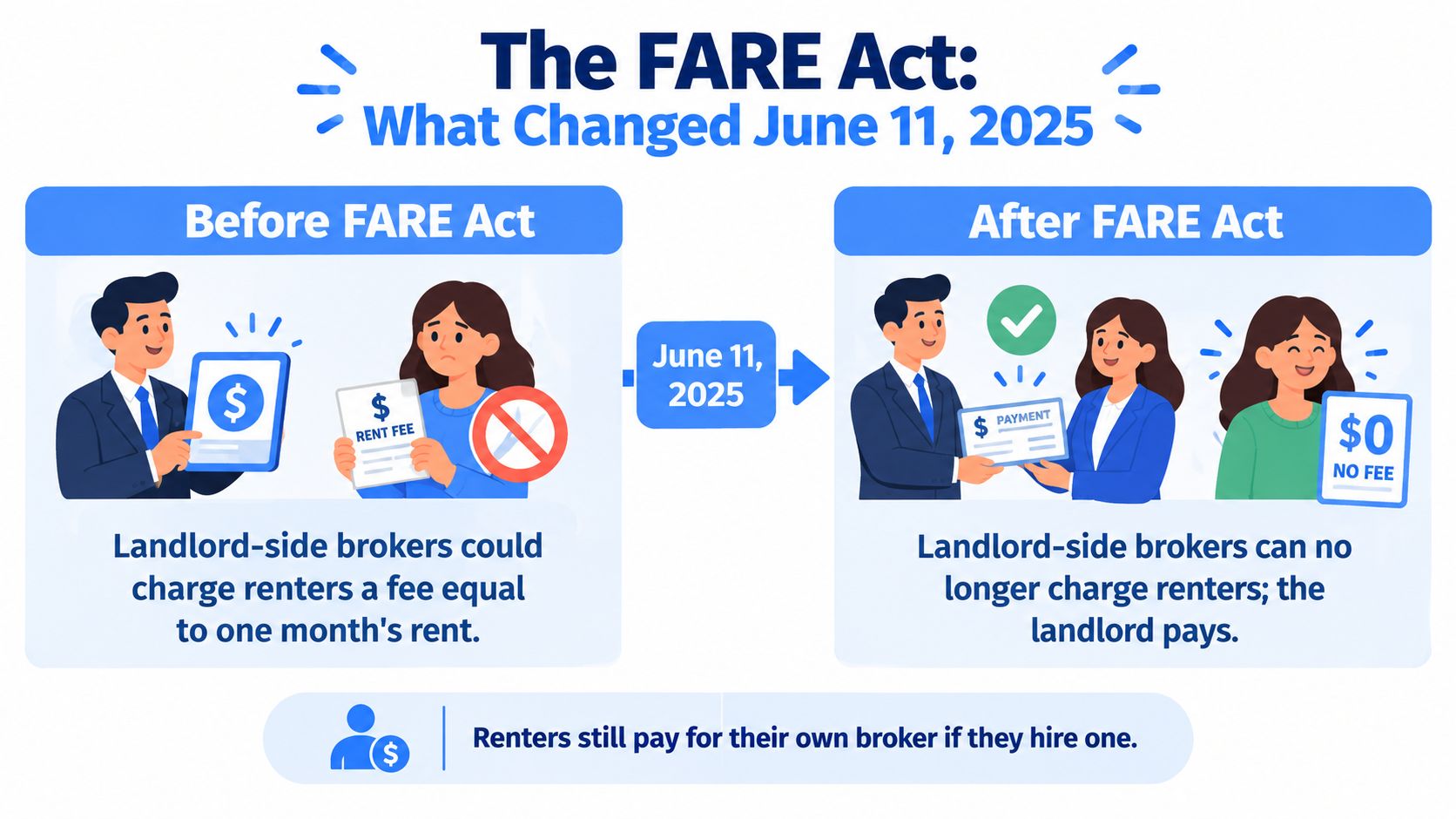
The FARE Act changed how NYC renters need to think about upfront money. Since June 11, 2025, a broker hired by the landlord cannot bill the tenant for that fee, which narrowed one old cost but did not make move-in cash simple (NYC IBO testimony on the FARE Act).
The fee mix shifted, it didn't disappear
The practical question now is not just rent. It is total cash before keys. Per the same IBO testimony, broker-fee language in listing descriptions fell from 2.2% in summer 2024 to 0.06% in summer 2026, while listings that named another required non-rent fee rose from 0.7% to 6.7%. That trade-off is the part many renters miss. For a fuller explanation, see this analysis of the FARE Act's impact on NYC renters.
Count the whole signing stack before you get attached to a place: first month's rent, security deposit, application fee, any move-in or amenity charge, guarantor cost if you need one, and renter's insurance. I have seen renters clear the income test, then stall because they budgeted for the monthly number and not the cashier's-check moment.
The lawful application fee for a background or credit check is $20. If another charge shows up, it should be clearly labeled and tied to something different, not buried as vague admin padding (NYC Tenants' Bill of Rights).
Lower broker-fee exposure changed where costs show up. It did not remove the pressure.
Search Across Multiple Platforms at Once
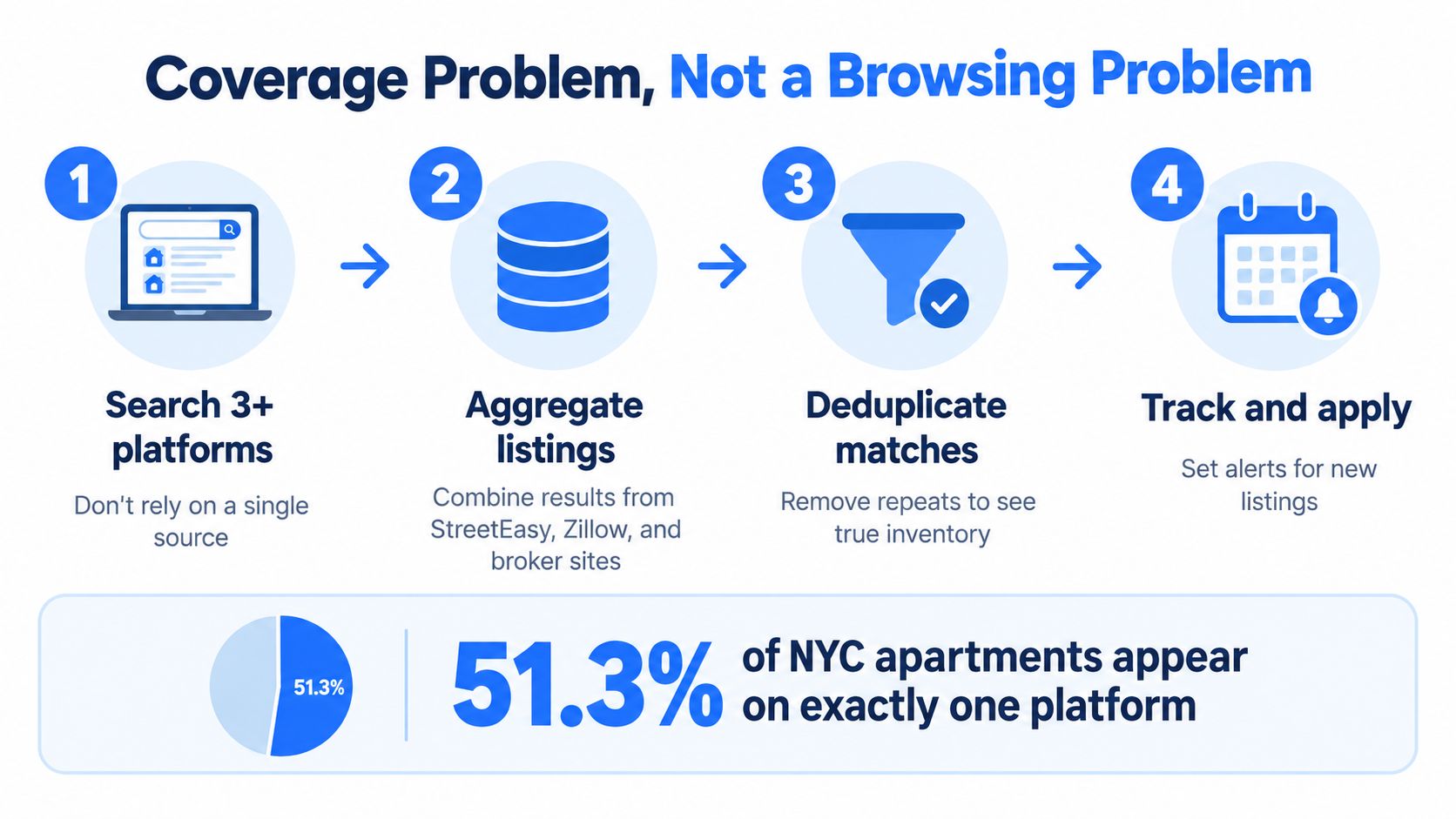
Single-site browsing misses too much inventory to count as a strategy. In a matched study of 50,130 NYC apartments in summer 2026, 51.3% appeared on exactly one platform, StreetEasy covered 77.1% of listings, and it was the first observed source 69.8% of the time (RentReboot's summer 2026 study of 50,130 NYC listings). StreetEasy matters, but it does not cover the whole city by itself.
Treat search as coverage, not scrolling
A workable setup starts with one saved search built around your budget, neighborhoods, bedroom count, and pet filter. Then you run it across multiple sources, not just one site you happen to check during lunch. The point is to catch a unit the moment it appears, whether it surfaces on a brokerage page, a building site, Craigslist, Zillow, OpenIgloo, RentHop, or somewhere less polished. To see how the major platforms stack up against each other, read our comparison of the best NYC apartment apps.
If you want one tool to keep that search from turning into a full-time job, RentReboot continuously monitors more than 20 rental sources and sends email or SMS alerts when a listing matches your criteria. The value is not magic, just coverage and speed.
Practical rule: a fast alert beats a perfect search tab.
What a real tour day looks like
Touring is where listings stop being marketing copy. Check water pressure, hot water timing, cell signal, window orientation, noise from the street or neighboring units, appliance condition, the hallway, and the lobby. If the apartment looks great but the hallway smells like neglect, that tells you something about the building.
Verification matters just as much. Confirm the landlord or management company through public records or a reverse address lookup, ask to see the certificate of occupancy, and make sure the broker or agent is authorized to show the unit. The standard scams are boring and persistent, deposits before viewing, fake owners, and overseas landlords who only communicate by message. Don't wire money, and don't hand over a deposit before you've signed and confirmed possession authority.
The on-the-spot questions are usually short and revealing, heat source, gas included, sublet policy, landlord response time, and any recent repairs. Good answers come fast. Weak answers wander.
Choose Between Market-Rate, Lottery, and Rent-Stabilized
There are three routes to a NYC apartment, and each solves a different problem. Market-rate gets you speed. Housing Connect gives you a shot at below-market rent if you can live with the waiting and the rules. Rent-stabilized units sit in the middle, but only if the specific apartment is stabilized, not merely in a building with some regulated stock (NYC Housing Connect).
Match the path to your timeline and budget
Market-rate is the cleanest path when you need to move fast and want the most predictable process. It usually means full documentation, standard lease terms, and a 12-month commitment. Lottery housing is slower and more conditional, because eligibility comes first and selection comes later, and that can take time even when the listing looks perfect.
Rent-stabilized apartments deserve a harder look because they can offer long-term protection, but they're not automatically cheap. The 2023 survey counted about 996,600 rent-stabilized units, equal to 27% of all housing units and 41% of rental units, with a vacancy rate of 0.98% in stabilized apartments, compared with 1.84% for market-rate rentals (NYC Housing and Vacancy Survey selected findings). The same survey reported a median stabilized contract rent of about $1,500 and a median gross rent of about $1,570, with nearly 60% of stabilized apartments renting between $1,100 and $2,399. Those numbers are real, but the vacancy rate tells you the harder truth: finding one takes persistence.
Verify the unit, not the label
A building can have regulated apartments without the unit you're viewing being stabilized. Ask directly, request the DHCR rent history and the most recent registered rent, review the lease rider, and check the renewal framework before you celebrate the number on the listing. Preferential rent, vacancy changes, and renewal language can all change the long-term picture.
The warning is worth repeating because the open market can distort regulated pricing. Publicly listed regulated apartments used to rent for only about 3% more than off-market units, but that premium rose to 18% after the FARE Act, which suggests that the cheapest regulated apartment is not always the one sitting in public listings (Community Partners NYC rent-regulated portfolio data).
Apply to a lottery while you keep searching market-rate if you qualify. Don't put your housing on hold waiting for one path to work. If you want the full walkthrough of deadlines and document requirements, our NYC Housing Connect lottery guide covers the process step by step.
Build the Application Packet That Lands the Apartment
The apartment usually goes to whoever sends a clean file first. That's boring, but it's how the city works when a landlord is sorting through multiple applicants for the same unit. I've lost a unit to someone who had their packet ready two hours before I did, and I've won one the same way.
Assemble the file before you tour
A strong packet includes government ID, two recent pay stubs, an employment letter, two years of tax returns or 1099s, three months of bank statements, landlord references, and a completed application. Scan everything into one PDF before your first viewing. If your income is irregular or you're self-employed, the landlord still wants a tidy story, not a pile of excuses, so write a short cover note explaining the numbers.
The application fee for credit and background checks is capped at $20 in New York City, so anything labeled processing, administrative, or priority deserves a skeptical look unless it's clearly itemized, as the tenants' rights guidance covered earlier makes clear. For market-rate apartments, ask for the landlord's written screening criteria before you pay anything or upload sensitive documents. A landlord who won't state the criteria is telling you something.
Know the fallback if your income is short
Landlords often use the rough 40x monthly rent test, meaning your annual income should cover the lease comfortably on paper. If it doesn't, a guarantor can bridge the gap, but that person faces their own documentation standards and paperwork. For affordable units the math is different, because the listing's income band, household size, non-wage income, and asset rules control eligibility through the program's own rules.
"The listing looks eligible" is not the same as "you qualify."
A good application is less about persuasion than completeness. If a landlord has to chase you for a bank statement, you've already slowed yourself down.
Sign the Lease and Walk Through Move-In Day
Read the lease like it's the last chance to catch a problem, because it usually is. Make sure it names the exact apartment, states the legal rent, lists any concessions or free-month terms, explains renewal rules, spells out security-deposit return conditions, and assigns maintenance responsibilities clearly.
Don't skip the boring pieces
Renter's insurance should be active when the lease requires it, and utilities need to be moved into your name on the correct day. If the landlord says “we'll handle it later,” treat that as a request for future confusion, not convenience. Move-in logistics matter too, elevator reservations, building hours, entry routes for movers, and mail forwarding can all turn a decent move into a miserable one if you leave them to chance.
For the actual relocation runbook, a checklist for your home relocation can be useful as a parallel moving-day reference, especially when you're juggling boxes, utilities, and lease dates at once.
Document the apartment on day one
Take timestamped photos of every wall, floor, fixture, and appliance before anything gets unpacked. Note existing damage in writing and send it to the landlord or management company right away. Keep every email, every receipt, and every rent payment record, because the first 30 days set the paper trail you'll need later if there's a dispute.
A simple red-flag list helps when the process starts feeling rushed, deposits before the lease, missing certificate of occupancy, and anyone asking for a wire transfer. Those three are enough to slow down, ask questions, or walk away.
In a 1.41% vacancy market, the apartment goes to the renter who is ready, not the renter who is still preparing. Keep monitoring listings, keep verifying regulated-stock claims, and keep your document packet current, because those two habits do most of the work once the search is underway.
RentReboot helps renters keep up with NYC listings without refreshing ten tabs all day. It monitors apartment sources, sends alerts by email or SMS, and helps you track rent-stabilized possibilities while you compare costs and timing. If you're serious about how to rent an apartment in NYC without missing fast-moving listings, visit RentReboot and set up a search that works while you're busy living your life.