
You've found an apartment advertised as “rent stabilized.” The broker says the building has regulated units, the listing repeats the phrase, and the landlord offers a lease that looks ordinary. You need to decide quickly, but the documents don't clearly answer the question: is my apartment rent stabilized?
That uncertainty is common because a building can contain both regulated and unregulated apartments. A listing, broker statement, or building-level record can help you identify a possibility, but it doesn't establish the legal status of the exact apartment you're considering. The reliable approach is to compare the lease, the apartment's official New York State Homes and Community Renewal history, and your payment records.
Table of Contents
- Why the Label Is Not the Proof
- Understanding Basic Eligibility Rules
- The Three-Stage Verification Workflow
- How Historical Changes Affect Your Unit
- Treating Verification as an Evidence Audit
- Troubleshooting Common Red Flags
Why the Label Is Not the Proof
A broker shows you a one-bedroom and describes it as rent stabilized. The listing says the same thing, so you assume the advertised rent will be governed by the Rent Guidelines Board and that renewal protections will apply. Then the lease arrives without a stabilization rider, or the landlord says the apartment is “market rate” despite the earlier representation.
That conflict isn't resolved by deciding which person sounds more credible. Marketing language is evidence of what was represented, not proof of the apartment's legal status. New York City's Rent Guidelines Board explains that a building list can indicate that a property contains stabilized apartments, but the definitive practical method is to contact HCR about the specific unit through its rent history process. You can review what to look for in a rent-stabilized lease, but a lease review is only the first checkpoint.
Building clues versus apartment proof
A property may appear on a public list of buildings associated with rent-stabilized housing while the advertised unit has a different status. The same building can contain apartments with different histories because units may have different registrations, tax-benefit connections, prior occupancy records, or legal deregulation histories.
That distinction matters in practical terms:
- A listing claim tells you what the broker or owner is presenting.
- A building-level record suggests that regulated apartments may exist at the property.
- A lease rider should identify the apartment's regulated status and explain the rent calculation.
- An HCR rent history supplies the unit-specific registration record that you need to evaluate the claim.
Practical rule: Treat “rent stabilized” in an advertisement as a question to investigate, not as the answer.
The city's guidance directs tenants toward official rent-history verification because a building name or neighborhood reputation can't resolve the status of one apartment. Preserve the listing, screenshots, emails, lease, rider, and any other stabilization documentation. If the unit address or apartment number differs across documents, stop and correct that mismatch before relying on any conclusion.
Understanding Basic Eligibility Rules
Eligibility rules can help you screen an apartment before requesting records. They can't replace unit-level verification, but they can tell you whether the claim is plausible.
Rent stabilization generally covers apartments in buildings with six or more units constructed between February 1, 1947, and December 31, 1973, according to the New York City Rent Guidelines Board's rent regulation guidance. Some apartments in older buildings may qualify, and units in newer buildings may be stabilized when the property receives qualifying tax benefits.
Building age and size are useful starting points because they narrow the possibilities. They don't conclusively establish coverage, though. Tax benefits, prior registrations, lawful deregulation history, and other legal facts can change the result, so a large pre-1974 building isn't automatic proof that every apartment inside it is stabilized.
Use the rules as a screening tool
A quick preliminary review should ask:
- How many units does the building contain? Six or more units can support a stabilization claim under the general framework.
- When was the building constructed? A construction date within the common eligibility period is a useful indicator.
- Does the property have a qualifying tax benefit? Newer buildings can contain stabilized units when tax incentives require or support regulated occupancy.
- Is the apartment's history consistent with the building? A plausible building profile still needs an apartment-specific record.
The system is much larger than the small number of classic rent-controlled apartments might suggest. The 2023 NYC Housing and Vacancy Survey counted approximately 960,600 rent-stabilized apartments and about 24,020 rent-controlled apartments. Those figures are reported in the Rent Guidelines Board's official materials, but they describe the citywide housing system, not the status of your unit.
Rent stabilization generally gives a tenant a lease renewal and limits rent increases to percentages set by the Rent Guidelines Board rather than allowing unrestricted increases based solely on market conditions. That protection is meaningful, but it only matters if the apartment is covered.
If you need help understanding housing paperwork or locating community support while checking your records, you can find local free assistance and ask what tenant resources are available in your area. Use outside assistance to support the verification process, not to substitute for the HCR history and lease documents.
The Three-Stage Verification Workflow
The most dependable approach is a three-stage reconciliation process. Each stage answers a different question, and none should be treated as sufficient by itself.
Stage one, inspect the lease
Start with the current lease and look for a Rent Stabilization Lease Rider. The rider should identify the apartment's regulated status, the prior legal rent, and the reasons for increases. It should also explain the tenant's rights under the applicable rules.
Check the exact address and apartment number first. Then compare the rider with the rent stated in the lease. If the lease describes a preferential rent, identify both that amount and the legal regulated rent. A lower amount paid by the tenant isn't necessarily the same as the legal rent used to calculate permitted increases.
A missing rider deserves follow-up, especially when the listing or landlord represented the apartment as stabilized. It doesn't automatically prove that the unit is unregulated, but it means you don't yet have the documentary explanation you need.
Stage two, request the HCR history
Request the apartment-specific rent history from New York State Homes and Community Renewal, the agency that administers New York's rent laws. Supply the complete building address, apartment number, and ZIP code. Omitting the apartment number can produce an incomplete or unusable result.
HCR registration history is the controlling practical record for evaluating whether the unit was registered as rent stabilized and whether the charged rent appears lawful. Confidentiality limits access, however. The history is generally released to the legal tenant, owner, or authorized representative, so a prospective renter may need to request documentation from the landlord or complete the verification after moving in.
A building-level database entry isn't enough. Public registration information may cover only the past five years, while an apartment-level history can include older records or gaps that affect the analysis.
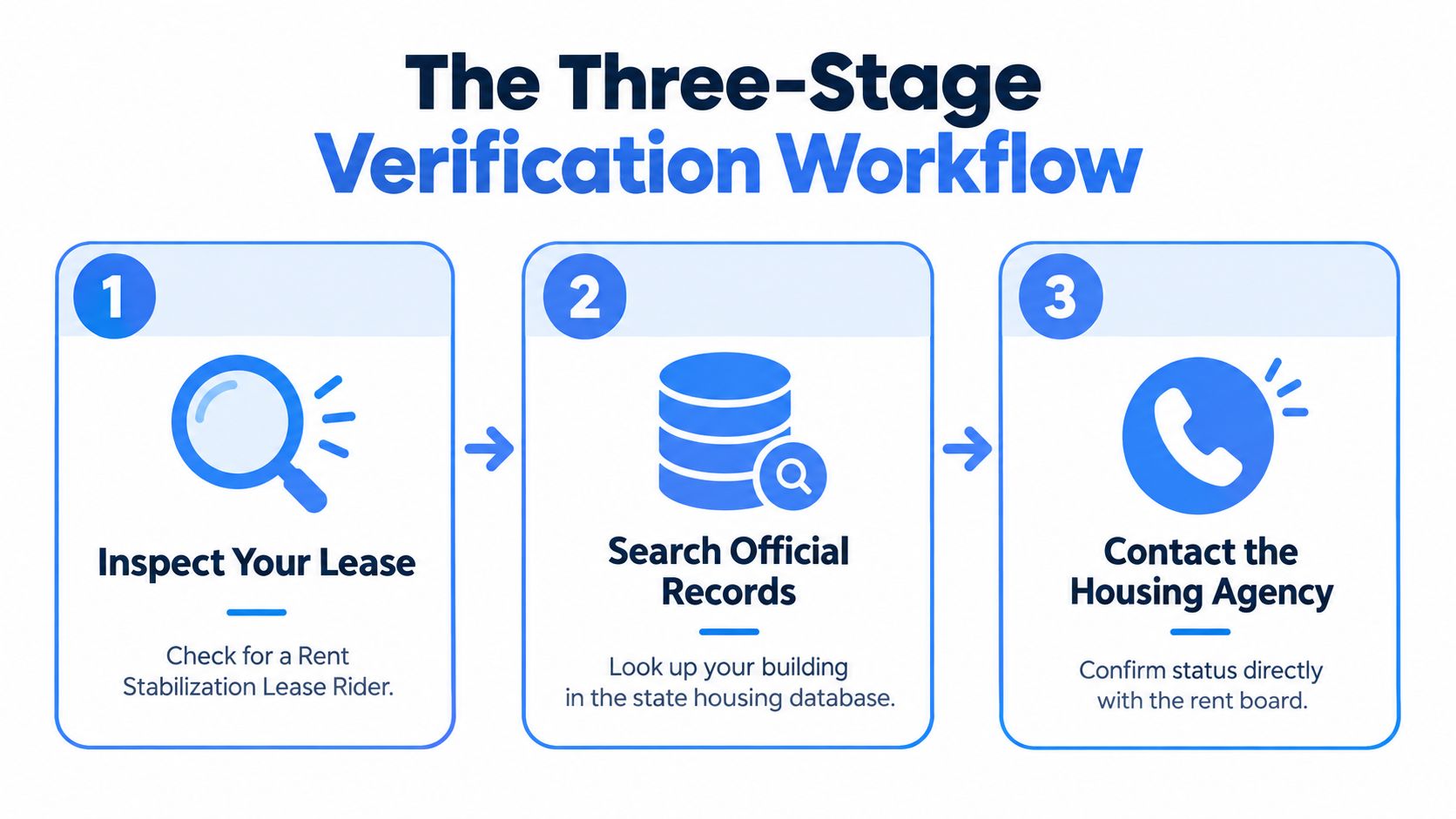
Stage three, reconcile the records
Place the lease, rider, HCR history, renewal notices, and payment records side by side. Match the unit identifier across every document, then compare the rent trail. Look for a coherent explanation of increases, preferential-rent treatment, claimed improvements, and the amount paid.
The apartment isn't verified until the documents agree, or until an unresolved discrepancy has been documented for agency review. Save the listing and every communication as well, particularly if the landlord's current statement differs from the original advertisement.
For a visual summary of the process, use the following walkthrough:
How Historical Changes Affect Your Unit
New York's rent-stabilization system has changed through several legal periods, so a current lease can't always be understood without considering when the apartment entered the system and what rules applied at the time.
The Emergency Tenant Protection Act of 1974 extended rent-stabilization protections to qualifying apartments beyond the earlier postwar framework. Later, the Housing Stability and Tenant Protection Act, enacted on June 14, 2019, substantially revised the system. Among its changes, HSTPA eliminated high-rent vacancy deregulation and high-rent deregulation based on a tenant's income. An apartment therefore can't be treated as deregulated solely because its legal rent exceeded a specified threshold or because a household's income became too high.
That history helps explain why older records may look different from current expectations. An apartment's past treatment can involve a prior registration, a claimed deregulation event, a tax-benefit program, or a rent calculation that requires closer review.
Why one building can contain different statuses
Tenants who began occupancy after June 30, 1971, in buildings with six or more units built before January 1, 1974, are generally covered under the framework described in the official background materials. Certain buildings constructed or substantially renovated after January 1, 1974, may also contain stabilized units because of tax incentives.
The result is a mixed building. One apartment may have a stabilized lease and registration history, while another may have a different legal status. A neighborhood assumption is even less reliable because nearby buildings can have different construction dates, ownership histories, and tax-benefit arrangements.
The practical consequence is simple: historical context helps you interpret a record, but it doesn't decide the case. If you want more detail about the city's building-notice requirements and what they do, review the 2026 rent-stabilized building declaration law. Notice that a building contains stabilized units improves transparency, but it still doesn't prove that your apartment is one of them.
Treating Verification as an Evidence Audit
A single document can be wrong, incomplete, or misunderstood. A stronger determination comes from document concordance, meaning the lease, HCR history, registration information, rent notices, and payment records tell the same story.
Build a year-by-year ledger instead of relying on memory. Start with the earliest available record and add each documented change. Include:
- Registered legal rent: Record the legal amount shown in the registration history.
- Renewal or vacancy increases: Note the stated reason and the lease period affected.
- Claimed improvements: Preserve invoices, notices, and explanations for any increase attributed to work.
- Preferential rent: Distinguish the legal regulated rent from the lower amount charged.
- Payments made: Compare receipts, bank records, and tenant ledgers with the lease terms.
The exact apartment identifier must match throughout. A history for the building, a lease for a different unit, or a rider with an incorrect apartment number can't establish the status of the apartment you occupy.
Missing records need interpretation
A missing recent registration doesn't automatically prove deregulation. Owners of regulated apartments must file annual registrations, and HCR says owners must provide registration copies to tenants. Nonregistration, incomplete records, or a defective rider may point to a compliance problem that needs investigation rather than a lawful change to market-rate status.
The same caution applies to a gap in the history. A gap can reflect incomplete records, a change in registration practice, or a disputed event. It may become important evidence, but it isn't a final finding by itself.
A defensible conclusion is not “the database looks right.” It is “the unit, rent calculation, and supporting documents agree.”
Escalate when the documents can't be reconciled. Preserve the complete file before contacting HCR, NYC tenant-protection resources, or qualified counsel. HCR materials describe six years as the general period for overcharge complaints, but the apartment's regulatory history and particular facts can affect how the issue is analyzed. Don't treat that period as a universal limit on every question involving the unit.
Troubleshooting Common Red Flags
Certain inconsistencies appear repeatedly in rent-stabilization reviews. They should prompt careful documentation, not an immediate accusation.
A lease that omits the rider is a starting problem. Ask the landlord or managing agent in writing for the missing rider and for the registration documents. If the listing called the apartment stabilized, save that listing before it disappears and keep the request with your records.
An unexplained jump in the HCR history requires comparison with renewal notices, vacancy paperwork, claimed improvement records, and the legal rules in effect at the time. A high figure alone doesn't automatically prove fraud. It does justify asking how the amount was calculated and whether the lease reflects the same explanation.
Read rent figures in context
Rent histories can show both a legal regulated rent and a lower preferential rent. If you compare only the advertised or paid amount with the registered legal figure, you may mistake a preferential-rent arrangement for an unexplained discrepancy. The distinction is explained in this guide to preferential rent versus legal rent.
Treat an unsupported “market rate” claim similarly. Ask for the legal basis and supporting documents rather than accepting the label. A landlord's statement may be relevant evidence, but it doesn't override an HCR record or explain away a conflicting stabilization rider.
When the timing is difficult
Prospective renters face a genuine access problem because the previous tenant's official rent figure may not be available until after move-in. That limitation can make a quick signing decision harder, particularly when the landlord won't provide the requested history before lease execution.
Before signing, obtain the lease, rider, written representations, and any available registration material. After signing, request the HCR history promptly and compare it with the rent calculation. Keep every renewal notice, receipt, email, text message, and repair or improvement document.
The New York Attorney General advises tenants to check rent history when they may need to challenge deregulation or the rent being charged. If the records suggest improper deregulation or an overcharge, contact HCR, NYC tenant-protection resources, or qualified counsel before making a legal conclusion on your own.
RentReboot helps renters monitor apartment listings across multiple rental platforms, identify potential rent-stabilized units using available city data, and receive email or SMS alerts when matching apartments appear. Visit RentReboot to set a search and use its guides as a discovery aid, then confirm any specific apartment through the lease and HCR records.