
Approximately one million NYC apartments are rent stabilized, almost half of the city's rental apartments, according to the New York City Independent Budget Office. Stabilization isn't a niche category reserved for unusually cheap listings. It's a system of rent and lease protections that can apply even when an apartment's advertised price looks expensive.
Understanding NYC rent stabilization rules starts with separating the listing price from the rent recorded in the lease and the amount used to calculate your renewal. Then you need the effective date of that renewal. Without those details, a promising listing is still an unverified claim.
Table of Contents
- Current Rent Increase Limits at a Glance
- Which Buildings and Apartments Qualify
- How Your Renewal Rent Is Calculated
- Myths That Mislead Stabilized Renters
- How to Verify a Stabilized Apartment Step by Step
- How Enforcement and Overcharge Claims Work
- Confirm Your Four Facts Before Applying
Current Rent Increase Limits at a Glance
For renewals taking effect between October 1, 2026, and September 30, 2027, the guideline adjustment is 0% for both one-year and two-year leases, according to New York City's rent-stabilization guidance. The previous period allowed different increases.
Renewal guideline adjustments by effective period
| Lease start or renewal period | 1-year renewal | 2-year renewal |
|---|---|---|
| October 1, 2025 to September 30, 2026 | 3% | 4.5% |
| October 1, 2026 to September 30, 2027 | 0% | 0% |
The percentage is tied to when the renewal takes effect, not when the landlord sends the offer or you sign it. An offer sent before a new guideline period may fall under that period if the renewal begins within it. Signing during a new period does not change the terms of a lease that is already in effect.
Read the table as a renewal rule
The Rent Guidelines Board sets these adjustments. The percentages do not determine whether an apartment is stabilized, and they are not a universal cap on every charge.
To check a proposed renewal, identify its effective date, the rent used as the calculation base, and the guideline for the term you choose. Any separately authorized adjustment needs its own explanation. A guide to understanding RGB annual increases explains how the annual cycle works.
The advertised price, regulated rent, and preferential rent are not necessarily the same amount. The guideline applies to a qualifying renewal, so match the lease's effective date to the correct row before checking the calculation. For broader context on renter protections, see Land-use rights for renters.
Which Buildings and Apartments Qualify
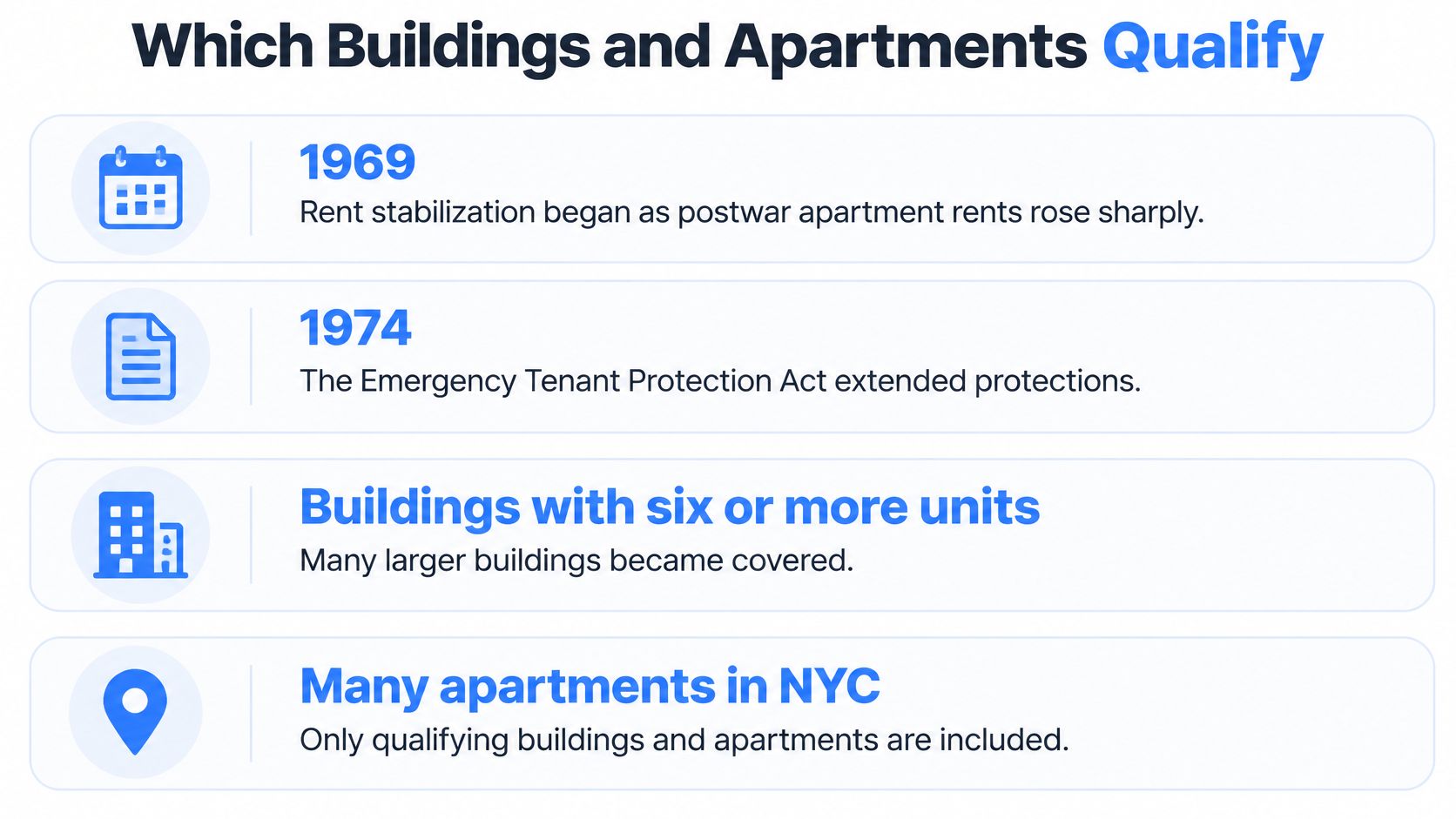
New York City introduced stabilization when rapidly rising postwar apartment rents prompted rent regulation; the Emergency Tenant Protection Act later extended coverage to many larger buildings in housing-shortage areas. The Independent Budget Office describes a system shaped by both building characteristics and subsequent laws, not by the appearance or asking price of an apartment.
Building age is a screening clue, not a final determination. The familiar older, larger apartment building is an important category, but tax-incentive programs created additional routes into stabilization.
Coverage categories by building type
| Building type | Typical status | What to check |
|---|---|---|
| Built before 1974 with six or more units | Generally stabilized | Registration history and rent records |
| Built 1974 or later under a tax-incentive agreement | Stabilized under the program's terms | Copy of the incentive agreement and its end date |
| Fewer than six units in a building | Generally not covered | Any prior registration that says otherwise |
| Government-regulated or government-financed housing | Separate program rules may apply | Program regulator's rules for the specific building |
These categories are starting points for investigation. Don't treat a building's construction record as a substitute for the apartment's regulatory history, especially when the building has received government benefits or undergone changes.
The visual checklist highlights the main eligibility questions.
An expensive apartment can still be covered
The Housing Stability and Tenant Protection Act removed the former high-rent and high-income deregulation framework. That means a covered apartment generally doesn't lose stabilization just because its rent is high.
Coverage also involves more than a restriction on rent increases. Stabilized tenants have procedural protections, including renewal rights and safeguards against certain unlawful increases. A landlord's description of an apartment as expensive, renovated, or newly available doesn't resolve those rights.
Check the paperwork for the rent actually charged
An apartment can have both a legal regulated rent and a lower preferential rent. Under New York State Homes and Community Renewal's lease guidance, tenants paying preferential rent on or after June 14, 2019 generally retain that preferential basis for the life of their tenancy; the same guidance says NYC owners generally must deliver the renewal form between 90 and 150 days before the existing lease expires.
That makes the lease and rider useful verification documents, not administrative extras. Check whether they identify a preferential amount, describe a regulatory program, or explain why the amount charged differs from the legal rent.
Before relying on a coverage claim, assemble these records:
- Building details: Construction history and apartment count.
- Apartment records: Registration history and the rent history for the specific unit.
- Program documents: Any incentive agreement, expiration provisions, and applicable notices.
- Lease documents: The proposed lease, stabilization rider, and any preferential-rent language.
If those records point in different directions, treat coverage as unresolved rather than choosing whichever document supports the lowest rent.
How Your Renewal Rent Is Calculated
Start with the rent base, not the percentage. The legal regulated rent is the apartment's lawful regulated figure; a preferential rent is a lower amount the owner has agreed to charge. The listing price is what the advertisement presents, and you need the lease to establish what that price represents.
Use the lease and renewal paperwork to identify those amounts before calculating.
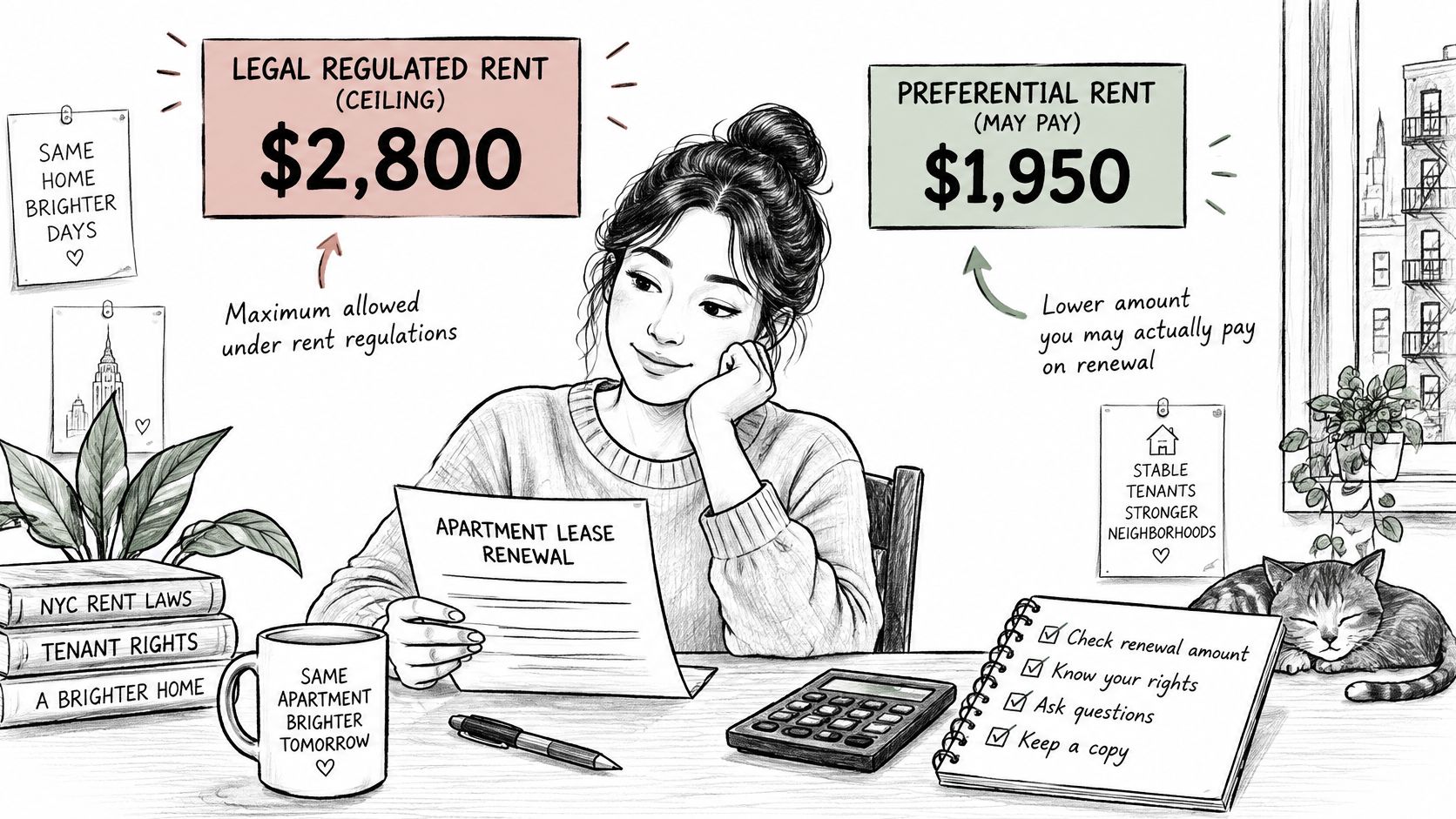
Compare the calculation bases
The following hypothetical calculations use the guideline percentages and preferential-rent principle described in New York City's rent-increase guide, including its example of a $2,000 rent becoming $2,060 or $2,090, before separately authorized adjustments.
Worked renewal rent examples
| Scenario | Legal regulated rent | Rent paid now | Renewal rent after increase |
|---|---|---|---|
| Full legal rent, 3% one-year renewal | $2,500 | $2,500 | $2,575 |
| Preferential rent, 3% one-year renewal | $2,500 | $2,200 | $2,266 |
| Full rent, 4.5% two-year renewal | $2,000 | $2,000 | $2,090 |
| Full rent, 3% one-year renewal | $2,000 | $2,000 | $2,060 |
In the full-rent scenarios, the amount paid and legal regulated rent are the same, so there's no competing base to resolve. Multiply the applicable base by one plus the permitted percentage.
The preferential-rent scenario is different. The landlord generally applies the increase to the lower protected amount, not by switching the tenant to the higher legal regulated figure. That distinction matters more than whether the arithmetic itself is correct.
For an additional walkthrough, compare the explanation below with the figures on your renewal offer.
Separate guideline increases from other adjustments
Major Capital Improvements and Individual Apartment Improvements are separate legal mechanisms. A landlord can't justify an unexplained charge merely by calling it renovation-related; ask for the legal or administrative basis and supporting calculation.
Likewise, choosing a longer term is not just about selecting a percentage. You're comparing the proposed payment and the length of the commitment, while future renewal guidelines may not yet be known.
Before returning the form, check the rent base, renewal term, effective date, and any additional adjustment separately. Keep the envelope or delivery record with the form so you can also check whether the renewal was offered within the required window.
Myths That Mislead Stabilized Renters
Myth: Stabilized means cheap. Stabilization is a regulatory status, not a promise that an apartment fits your budget. An expensive listing can still carry meaningful renewal protections, while a low advertised price doesn't prove coverage or legality.
Evaluate affordability and regulatory status as separate questions. You need a payment you can sustain and documents that support the protections being advertised.
A higher legal rent isn't automatically your next bill
Myth: The gap between preferential and legal rent is an imminent rent increase. According to NYC 311's preferential-rent guidance, tenants paying preferential rent on or after June 14, 2019 generally retain that basis for their tenancy, although certain government-regulated or financed housing programs can be exceptions.
The exception is why you should read program language rather than stop at the rent figures. Ask the owner to identify the specific program rule if they claim the preferential protection doesn't apply.
A high legal rent calls for careful document review. It doesn't, by itself, establish what you'll owe at renewal.
Myth: A stabilized label proves the listing is legitimate or a bargain. A listing is a claim made during marketing. It doesn't replace the lease, rider, registration records, or an explanation of the rent calculation.
Use this document test:
- Price match: Does the proposed lease identify the amount advertised and explain any difference?
- Rent basis: Is the amount you'll pay clearly distinguished from the legal regulated rent?
- Program exception: Does the rider identify special rules that could affect the tenancy?
- Record consistency: Can differences between the lease and rent history be explained with supporting documents?
A mismatch doesn't automatically establish wrongdoing. It does mean you haven't finished verification.
Don't let urgency turn an unanswered question into an assumption. The rent history and governing documents, not the listing's label, provide the evidence you need to assess the apartment.
How to Verify a Stabilized Apartment Step by Step
Build a small verification file before committing. Use a folder for the listing, correspondence, proposed lease, rider, and records so you can compare documents without relying on memory.
Ask for the commencement date and registered legal rent. Request both in writing from the landlord or broker. The date identifies the applicable guideline period, while the registered amount gives you a figure to investigate.
Identify any preferential rent. Ask whether the amount you'll pay is lower than the legal regulated rent and where that arrangement appears in the lease. A verbal discount is harder to evaluate than an identified lease provision.
Reconcile the advertisement. Save the listing and compare its price with the proposed lease amounts. Ask for a written explanation if the advertisement shows a different figure.
Request the official rent history from HCR. Use New York State Homes and Community Renewal's process to investigate the apartment's status and recorded rents. Ask HCR about access requirements if you're a prospective renter rather than the current tenant.
Calendar the renewal process. Record the lease expiration date and check the applicable offer window. Preserve the delivery information when a renewal arrives.
Ask about government regulation or financing. Request the program name and relevant rider or agreement. Special program terms need their own review.
Keep the complete record. Save signed documents alongside correspondence and payment records. You'll need the actual versions if a discrepancy later becomes a dispute.
The process begins with identifying the apartment and the proposed lease, not assuming a building-level match settles everything.
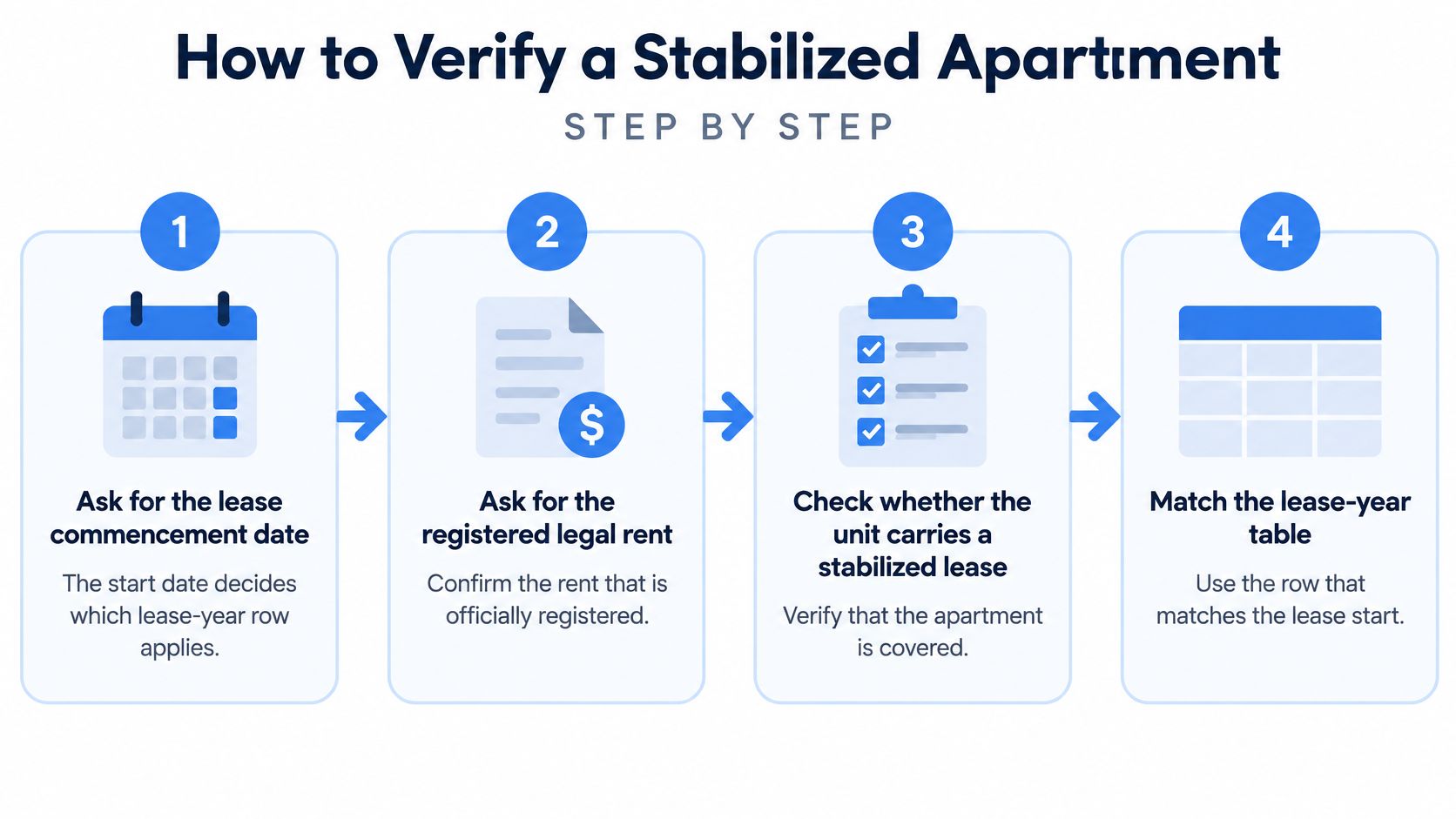
Route unresolved discrepancies
A rent-stabilized buildings map can help you identify addresses worth investigating. Use it as a screening tool, not a replacement for apartment-specific records.
Problems to resolve and where to act
| Problem found | First step | Agency |
|---|---|---|
| Advertised rent differs from the lease | Compare the lease with the rent history | HCR |
| No stabilization record for the unit | Request the official rent history | HCR |
| Renewal increase does not match the guideline | Ask the landlord for the calculation in writing | HCR |
| Suspected overcharge | Document payments and request the rent history | HCR |
A missing record or unexplained gap deserves follow-up, not an instant conclusion. Your completed file should establish the supported legal rent, the amount you'll pay, and the next renewal date.
How Enforcement and Overcharge Claims Work
The Rent Guidelines Board sets guideline adjustments. HCR is the state agency renters turn to for rent histories and questions involving regulated status and rent calculations. Those are different functions: a published guideline alone won't resolve a dispute about an apartment's lawful rent base.
Owners must support the increases they charge with an applicable legal basis. For a renter reviewing an unexplained increase, the useful question is specific: what rule authorizes this adjustment, and how was this amount calculated?
Reconstruct the payment record
Start with the documents rather than an accusation. Compare what the lease required, what the landlord billed, and what you paid.
Keep these materials together:
- Lease evidence: The signed lease, riders, renewal offers, and executed renewals.
- Payment evidence: Receipts, bank records, payment-portal confirmations, and the landlord's ledger if available.
- Calculation evidence: Written explanations of increases and documents supporting any separate adjustment.
- Communication evidence: Emails and letters showing when you asked about the discrepancy and how the owner responded.
Before escalating: Write a short chronology that distinguishes the rent demanded from the amount you actually paid.
If the problem appears to be a transcription or arithmetic error, send the landlord a concise written request for correction. Identify the disputed line, attach the relevant document, and ask for an updated calculation and account statement.
Know when an agency review is needed
An unresolved dispute about preferential rent, an unexplained rent-history jump, or competing claims about coverage requires more than a broker's assurance. Ask HCR about the appropriate process and consider qualified tenant legal assistance when the history is complicated.
The guide to filing a DHCR overcharge complaint can help you organize the next step. Review current filing instructions before submitting documents, and retain a complete copy of what you send.
Don't assume that every disputed payment is recoverable or that a particular penalty applies automatically. The relevant history, governing law, and agency or court findings matter.
A landlord may resolve a clear billing mistake directly. If the disagreement concerns lawful rent or regulatory status, preserve the evidence and seek a formal determination rather than treating an informal explanation as final.
Confirm Your Four Facts Before Applying
Before applying, compare three different rent figures: the advertised price, the amount the lease says you'll pay, and the legal regulated rent that may govern a later renewal. The lease commencement date helps determine which guideline period applies. The listing date does not.
Record these four facts:
- Lease commencement and guideline period: Copy the commencement date from the proposed lease and note the applicable guideline and lease term.
- Legal regulated rent and preferential rent: Write down both amounts if both appear, and identify the document showing what you'll pay. Flag any advertised discount the paperwork does not explain.
- Rent-history status: Note whether you have the official rent history, have requested it, or need help accessing it. Mark unresolved discrepancies as open questions.
- Renewal window: Record the lease expiration date and when you should expect the renewal offer. Set a reminder and keep evidence of when the offer arrives.
Turn the file into a decision
Separate confirmed facts from unanswered questions. If the owner has not explained the rent base or a program exception, account for that uncertainty before committing.
Apartment-search tools can help you find candidates; the lease and rent records help you assess them. Compare the proposed payment and terms with the documents, rather than treating the advertised price as the full picture.

Put your notes beside the listing and proposed lease before applying. Check that the payment, regulatory terms, and renewal timetable are supported by the documents.
RentReboot offers apartment discovery, saved-search alerts, and tools for identifying potentially rent-stabilized listings. Visit RentReboot to set your budget and neighborhood preferences, then compare matching apartments against the document checks in the verification section before you apply.