
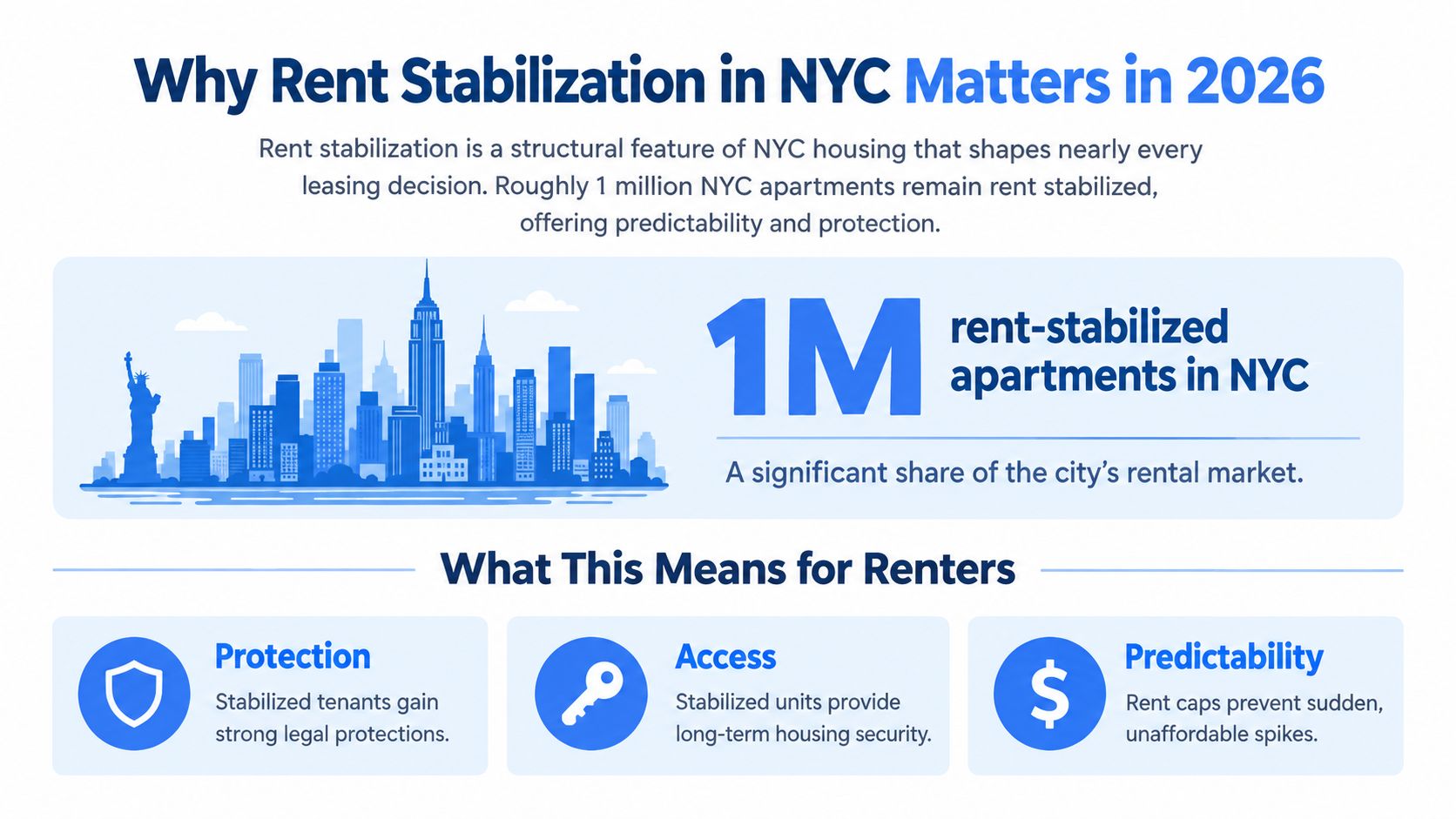
Nearly one million apartments in New York City remain rent stabilized, and that isn't a side issue in the rental market. It's a structural feature of city housing. The city's 2023 housing survey counted 996,600 rent-stabilized units, equal to about 27% of all housing stock and 41% of rental units according to HPD's 2023 NYC Housing and Vacancy Survey findings.
If you just signed a lease, or you're about to, that number should change how you read every listing. “Rent stabilized” isn't just a marketing phrase. It can affect your renewal rights, the way rent increases are set, what paperwork you should ask for, and whether a “good deal” is legally meaningful.
A lot of renters get tripped up in the same places. They assume a low asking rent means stabilization. It doesn't. They assume a rent freeze means move-in prices will also freeze. Not necessarily. They assume the lease will clearly say whether the apartment is stabilized. Sometimes it does. Sometimes it doesn't.
Table of Contents
- Why Rent Stabilization in NYC Matters in 2026
- What Rent Stabilization Actually Covers
- How the Rules Changed Under HSTPA and the 2026 Freeze
- Tenant Rights Inside a Stabilized Apartment
- Verifying Stabilized Status Using NYC Data
- Reading Listings and Asking the Right Questions
- Where Stabilized Units Are Concentrated in NYC
- Your Next Steps as a Rent Stabilization Renter
Why Rent Stabilization in NYC Matters in 2026
Nearly one in four homes in New York City sits inside the rent-stabilization system, and that scale changes how a careful renter should read the market. Even if a listing never uses the words "rent stabilized," the rules can still affect the lease you are offered, the renewal you may get later, and the records you should check before you sign.
Why this is a market-wide issue
Rent stabilization is not a side pocket of the city's housing market. It is part of the operating rules for a huge share of apartments, which means it shapes landlord pricing, broker language, renewal expectations, and tenant decision-making well beyond the units plainly labeled as regulated.
The stock has also been shrinking. As noted earlier, the city's 2023 housing survey found a decline in stabilized units from 2021 to 2023. For renters, that matters for a simple reason. When something is both common and getting harder to find, verification matters more.
A good comparison is title insurance when you buy property. You do not rely on the seller's description alone. You check the record. Rent stabilization works the same way. The label in the listing is a clue. The legal status comes from the apartment's actual regulatory history.
Practical rule: If a unit might be stabilized, verify that status before you sign. A listing that says "rent stabilized" is not final proof. A listing that says nothing is not proof in the other direction either.
Why 2026 changes the renter's questions
The headline many tenants will hear is that a 0% renewal increase has been approved for one- and two-year stabilized renewals for leases scheduled to start October 1, 2026 through September 30, 2027, as described in IBO's 2026 rent stabilization series.
That matters, but it answers a narrower question than many new renters assume.
A renewal freeze works like a cap on the next step of the staircase. It limits what can happen when an existing stabilized tenant renews. It does not automatically set the first step, which is the rent a landlord asks when the apartment is vacant and offered to a new tenant. So if you are comparing listings in 2026, a stabilized apartment can still come to market at a number that feels high, even though later renewals may be constrained.
That distinction leads to the renter-facing questions that matter at signing:
- Am I looking at a unit that is likely stabilized, or just priced below market for some other reason?
- What document or public record can confirm the apartment's status before I commit?
- If I sign now at a vacancy rent, how would the scheduled 2026 to 2027 renewal freeze affect me later, if at all?
- If the landlord or broker describes the unit one way, does the paper trail match that description?
Those are the questions that protect you. In New York, the smart move is not just learning the rule. It is tying each rule to an action: check the records, read the lease closely, ask about the legal regulated rent, and separate new-lease pricing from renewal pricing before you decide whether the apartment is a good deal.
What Rent Stabilization Actually Covers
Rent stabilization usually starts with the building, then narrows to the apartment.
That order matters because renters often judge the question by the listing price alone. A low asking rent does not prove stabilization, and a high asking rent does not rule it out. The first screen is whether the property falls into the kinds of buildings New York's rent-stabilization system generally covers. The classic pattern is a building with six or more apartments built before January 1, 1974. Some newer apartments can also be stabilized because the owner received tax benefits such as J-51 or 421-a that carried rent-regulation obligations, as explained by the New York State Homes and Community Renewal rent stabilization overview.
A practical way to read that rule is to treat it like a two-level check.
First, ask whether the building belongs in the stabilized universe at all. Then ask whether your specific unit is registered and handled as stabilized.
The building clues renters should check first
Three facts do most of the work:
Year built
Buildings completed before 1974 are the starting point for many stabilized apartments.Number of units
The usual threshold is six or more apartments.Tax-benefit history
A newer building, or a newer apartment in an older building, may still carry stabilization rules if the owner accepted J-51 or 421-a benefits.
A building is the container. Your apartment is the item inside it. If the container qualifies, that gives you a reason to investigate further. It does not end the analysis.
Here is a concrete example. You find a listing for a one-bedroom in a six-unit prewar walk-up in the East Village. The building profile shows it was built before 1974. That is a meaningful signal. If public records also show a J-51 or 421-a benefit period, that is another signal. Your next move is renter-facing and specific: ask for the exact apartment number, ask whether the unit is rent stabilized, and ask what the legal regulated rent is.
A stabilized building can still contain units with different histories
This point trips up a lot of renters.
A landlord or broker may say, “the building is stabilized,” and leave you with the impression that every apartment automatically gets stabilized treatment. That is too broad. Some apartments have different histories because of prior occupancy, registration issues, lawful changes in status, or tax-benefit timing. So the right question is never just “Is this a stabilized building?” It is “Is this apartment stabilized, and what record supports that answer?”
A stabilized address is not the same as a stabilized apartment.
That distinction matters even more in 2026 because the freeze people are hearing about applies to qualifying renewals, not automatically to the rent first offered to a new tenant. If you are signing a new lease, the action item is simple: separate vacancy pricing from future renewal rules before you decide the apartment is a bargain.
| What to check | General rule | Where renters can look | What to do |
|---|---|---|---|
| Building age | Often pre-1974 | DOB records, certificate of occupancy, building profile | Confirm the year built before you apply |
| Building size | Often 6 or more units | DOB records, property records | Verify the unit count instead of relying on marketing copy |
| Tax-benefit history | J-51 or 421-a may trigger stabilization | ACRIS, tax records, benefit filings | Ask whether benefits applied to the building and during what years |
| Apartment-specific status | Must be confirmed unit by unit | DHCR registration history | Request the rent history for the exact apartment |
What renters should do with the rule
If you already signed, compare your lease packet, rider, and rent figures against the building facts. If you are still shopping, get the full address and apartment number before paying an application fee. A vague listing makes verification harder, and that usually helps the other side, not you.
One more point. Rent control and rent stabilization are different systems. For nearly every renter signing a new lease today, question is rent stabilization. That is the system that controls how many NYC renters should read the lease, check the records, and judge what the 2026 to 2027 freeze may mean for their next renewal rather than for the rent they are being asked to accept today.
How the Rules Changed Under HSTPA and the 2026 Freeze
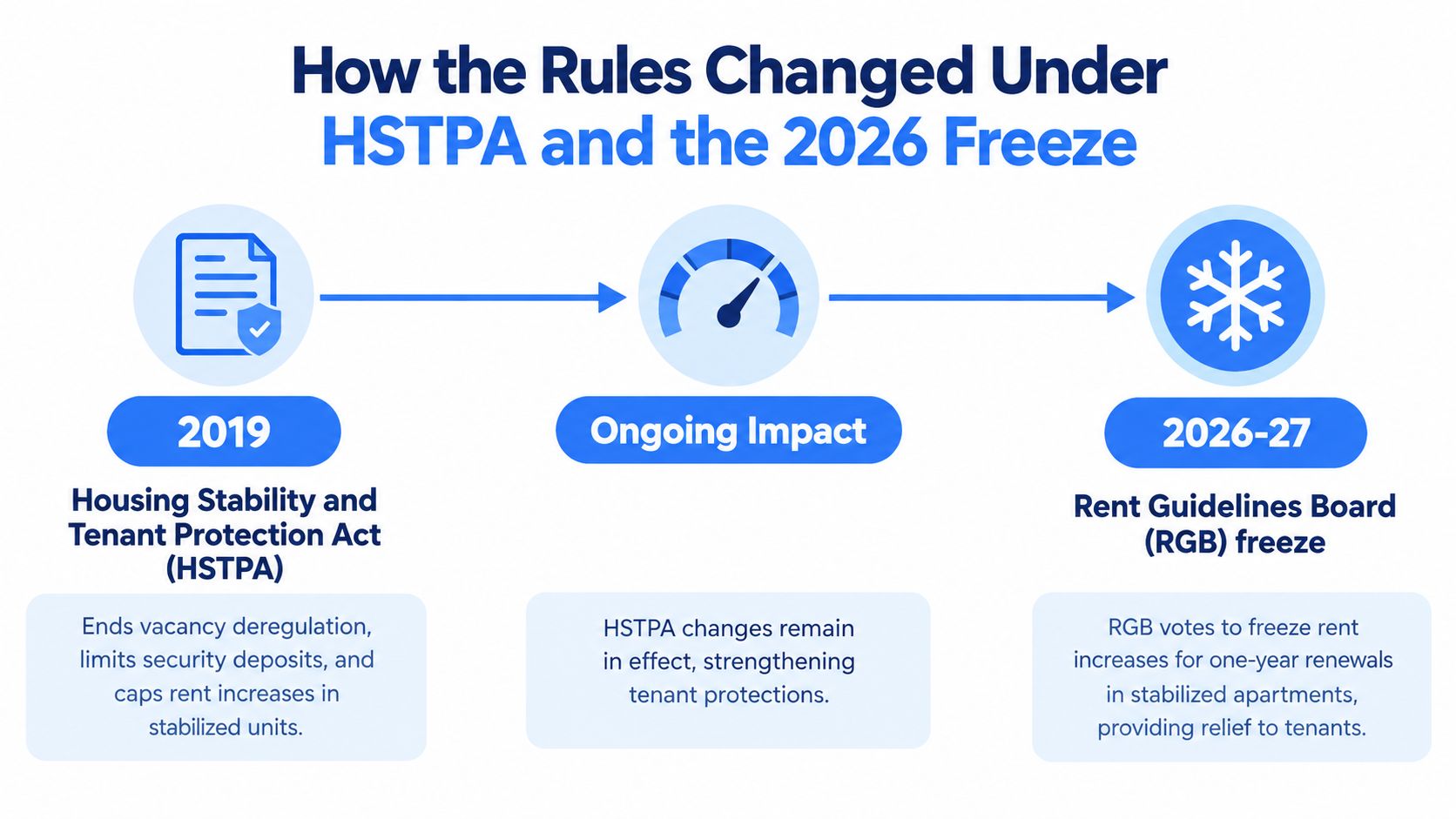
In a city with roughly a million stabilized apartments, one date changed the rules of the road for tenants and owners alike: June 14, 2019. That is when New York enacted the Housing Stability and Tenant Protection Act of 2019, or HSTPA.
What HSTPA changed in plain English
Before HSTPA, a vacancy could do more than change who lived in the unit. In some cases, it created a path to higher legal rents and eventual deregulation. After HSTPA, that path narrowed sharply.
As summarized in NYC RegWatch's HSTPA overview, the law made rent regulation permanent and cut off several common exit routes from stabilization. It ended high-rent vacancy decontrol, removed the vacancy bonus and vacancy longevity bonus, expanded the overcharge lookback period from four years to six, and tightened owner-use rules.
For renters, the practical takeaway is simple. A landlord usually cannot justify a rent jump by saying, in effect, “the last tenant left, so the apartment started fresh.” Vacancy still matters. It just no longer does the same legal work.
That distinction matters when you are reviewing a lease offer. If the asking rent seems high for a unit the owner calls stabilized, ask a targeted follow-up: what is the legal basis for this rent, and does the DHCR registration history support it?
A renter-focused way to read the freeze
The scheduled 2026 to 2027 freeze is approved to apply to renewal leases for stabilized tenants whose lease terms begin within that guideline period. Read that twice, because renters often get tripped up.
A freeze on renewals is like a cap on what can happen at the next checkpoint. It does not automatically control the price posted on a vacant apartment today. So if you are signing a new lease for a stabilized unit, separate two questions that often get blurred together:
- Is the initial rent lawful?
- What renewal rule is scheduled to apply when this lease ends?
Those are different questions with different documents. The first points you toward the rent history, the registration record, and the lease rider. The second points you toward the lease start date and the Rent Guidelines Board period that will govern your renewal.
Here is the practical example. If a broker says, “There's a freeze, so this is a great stabilized deal,” slow down and check what kind of lease you are being offered. A freeze scheduled for a later renewal period may help you at renewal time. It does not, by itself, prove that the new-lease asking rent is correct.
Read the lease start date before you read the headline. In rent regulation, effective dates do real work.
For a closer look at building-level disclosure questions tied to current regulation rules, this 2026 rent-stabilized building declaration law guide is a useful companion.
Tenant Rights Inside a Stabilized Apartment
Once you confirm that the apartment is stabilized, the key rights show up at three moments: when the lease is offered, while you're living there, and when the lease term ends.
When the lease is offered
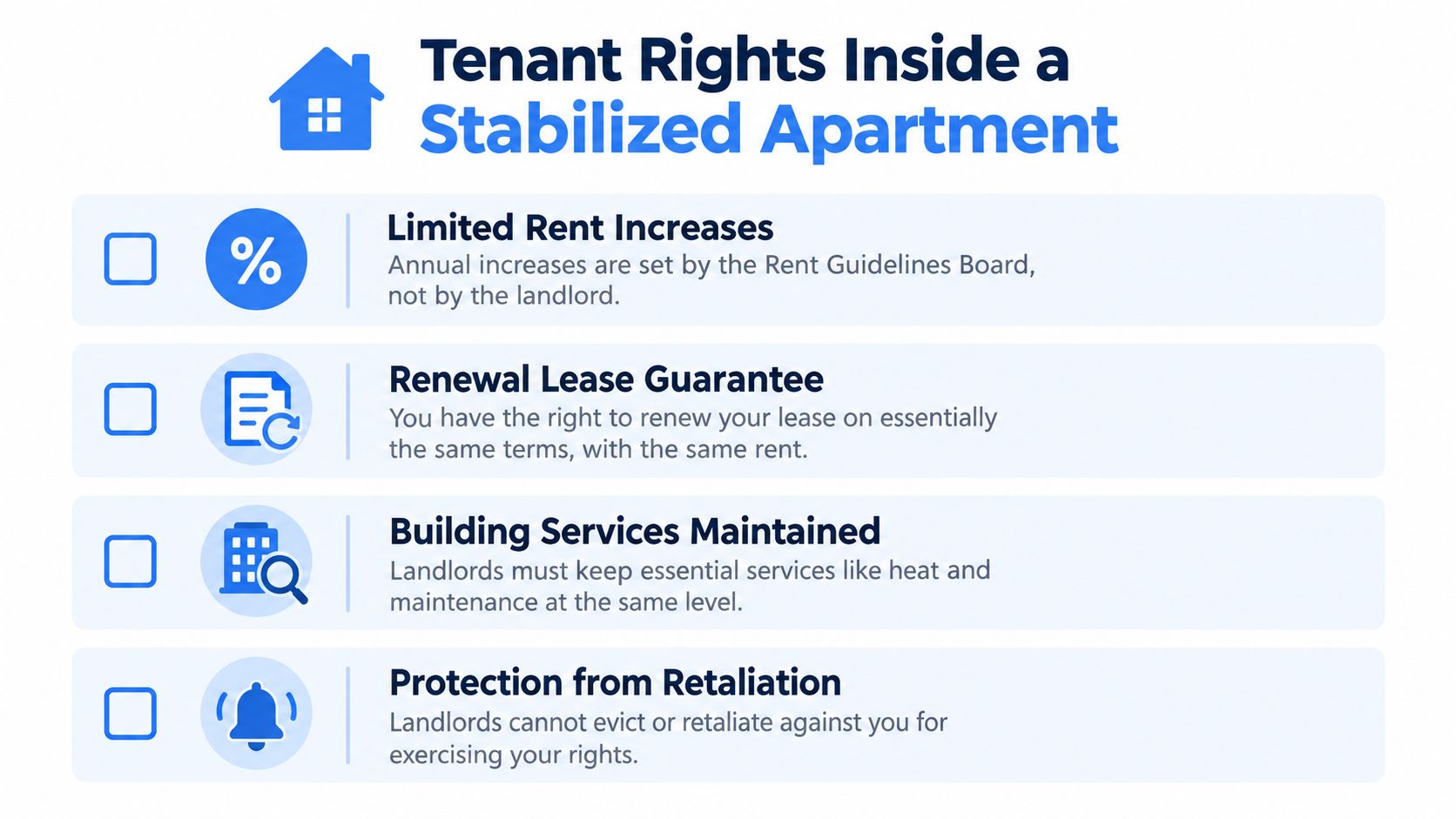
A stabilized tenant generally has the right to a renewal lease on the same terms, and the tenant can usually choose a one-year or two-year renewal where the law provides that choice. The rent increase is governed by the Rent Guidelines Board rules that apply to the relevant lease period, not by whatever number the landlord prefers.
That's why the lease packet matters so much. Look for the rider, the term dates, and whether the owner is describing the apartment consistently across the lease, rider, and any side documents.
During the lease term
A stabilized tenant can challenge overcharges and can file complaints when required services are reduced. If the building stops maintaining heat, repairs, or other required services, the issue isn't just “bad management.” In a stabilized apartment, service levels connect directly to enforceable rights.
This is a good point to pause for a practical explainer:
- Rent increases are limited: They must follow the applicable RGB rules.
- Services must be maintained: Owners can't reduce what the tenancy includes and expect no consequences.
- Paper trails matter: Keep the lease, riders, renewal offers, and rent receipts together.
When the lease ends
A stabilized lease doesn't expire into a blank slate where the owner can choose not to renew for convenience. Non-renewal and eviction require legal grounds. Succession rules can also matter for family members and some long-term household members who meet the legal standard.
Remember: In many situations, the rights attach to the apartment's regulated status, not to a landlord's current marketing language.
That's why roommates and later occupants should still care about the apartment history. If the unit remains stabilized, the legal framework continues to matter across lease cycles.
Verifying Stabilized Status Using NYC Data
Analysts at the Independent Budget Office estimated that New York City has roughly 928,000 rent-stabilized apartments across about 43,000 buildings, according to IBO's 2026 analysis of the rent-stabilized housing stock. That scale is exactly why renters should verify status with records, not assumptions. In 2026, the freeze affects what an owner can charge on a renewal, but your first question is still basic: is this apartment stabilized?
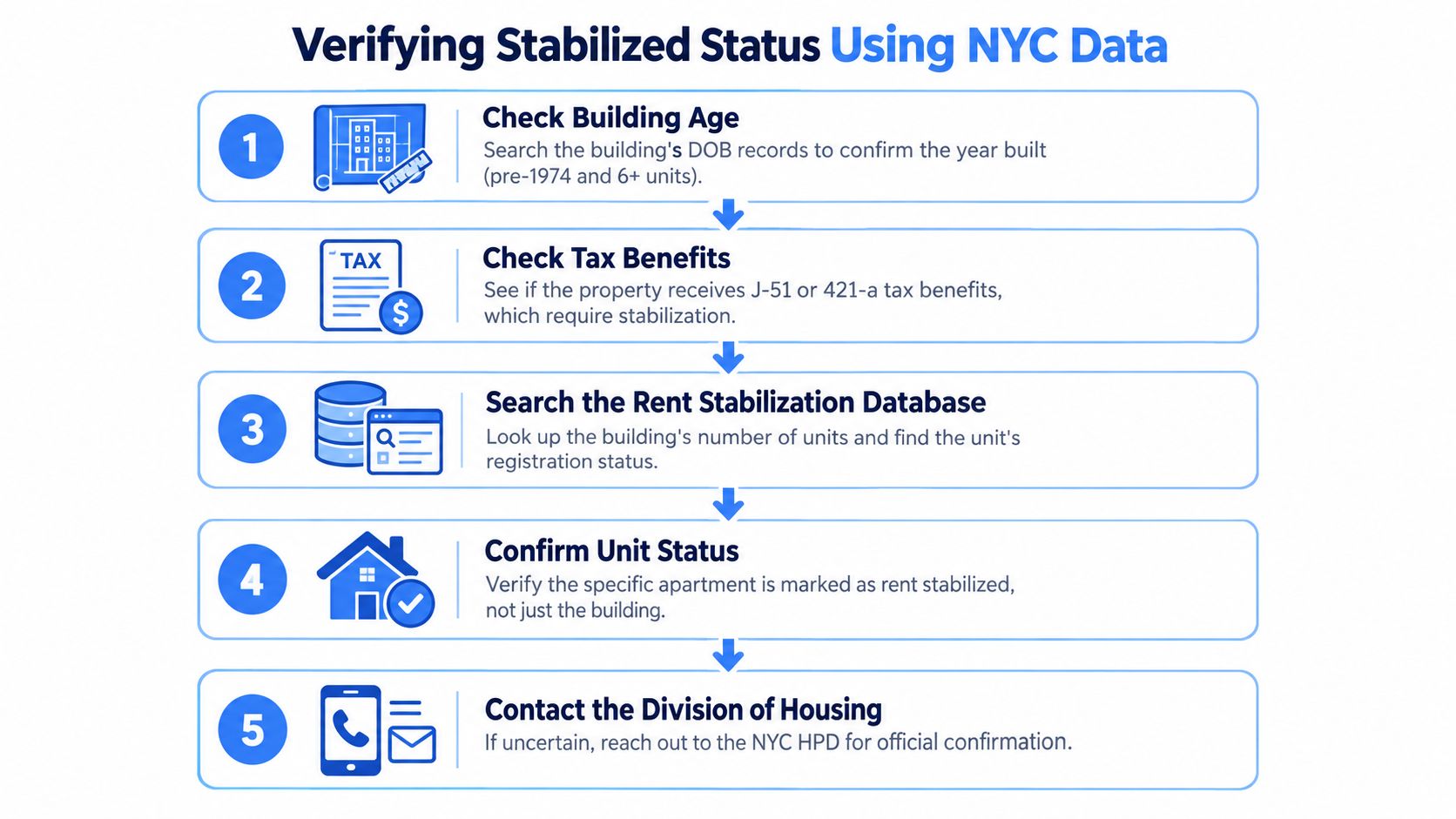
Start with the building, then narrow to the unit. That order matters for the same reason you would check a car's title before arguing about the mileage. The building records tell you whether stabilization is plausible. The apartment records tell you whether this specific unit was registered and how the rent history was reported.
A practical verification workflow
Check the building record first
Pull the Department of Buildings profile and confirm the basic facts: year built, number of units, and building class. If the address fits the familiar older multifamily pattern, stabilization becomes more likely. If it is newer, do not stop there. Newer buildings can still be stabilized during certain tax-benefit periods.Check tax-benefit history
Look for signs that the building received benefits such as J-51 or 421-a. For a renter, this is not trivia. It affects what follow-up question to ask: “Was this apartment stabilized through a tax-benefit program, and if so, when did that period start or end?”Get the apartment's DHCR rent history
This is the unit-level paper trail. You are checking whether the apartment was registered, how the rent was reported, and whether the history lines up with the lease you were offered or signed.Compare the records to the lease terms
The 2026 to 2027 freeze becomes practical. If the apartment is stabilized, a renewal increase is treated one way, while a vacancy lease or first lease after a status dispute raises different pricing questions. A lease labeled “market rate” does not settle the issue if the records point toward stabilization.Put your questions in writing
Email the broker, owner, or management company with the address, unit number, and the mismatch you found. Written questions create a timeline. Phone calls usually do not.
Mixed signals are common. A building may look like a textbook candidate, yet the unit history has gaps. Or the apartment may have a registration history, while the current lease packet says nothing about stabilization. Those are not minor paperwork quirks. They are the moments when renters should slow down, save documents, and ask for a clear explanation of status.
A good way to avoid confusion is to treat each source as answering a different question. Building data answers, “Could this property be covered?” Tax-benefit records answer, “Was there a program that may have brought it into stabilization?” DHCR history answers, “What happened with this apartment?” Put together, those records are much more useful than a listing description or a casual statement from a broker.
If you want a renter-friendly checklist for doing this in order, this step-by-step guide to checking whether an apartment is rent stabilized walks through the same process. One tool option in that workflow is RentReboot, which cross-checks listings against official NYC datasets for building age, tax-benefit status, and likely stabilization signals.
Reading Listings and Asking the Right Questions
A listing price by itself tells you almost nothing about legal status. I've seen renters ignore a promising stabilized unit because the asking rent looked “too high to be stabilized,” and I've seen others assume a bargain basement listing had to be regulated. Both instincts can be wrong.
Two listings, two very different stories
Take Listing A. The ad says “charming prewar one-bedroom,” gives a full address, includes the apartment number, and mentions a lease rider will be provided. It doesn't promise stabilization, but it gives you enough information to verify.
Now take Listing B. The ad says “luxury deal,” gives only the cross streets, avoids the apartment number, and says the owner “uses proprietary lease forms.” That doesn't prove the unit is market rate, but it does tell you the seller of the information isn't making verification easy.
| Listing Detail | Likely Stabilized Signal | Likely Market-Rate Signal |
|---|---|---|
| Full address shown | Easier to verify against records | Hidden or partial address makes verification harder |
| Apartment number disclosed | Lets you match unit-level records | Omitted unit number delays unit-level check |
| Lease rider mentioned | Suggests formal regulatory paperwork may exist | Vague “standard lease” language |
| Building described as prewar or older multifamily | May fit classic stabilized pattern | Newer condo-style language may point elsewhere |
| Tax-benefit info answered clearly | Strong sign owner knows the property history | Evasive answers about benefits or registration |
The questions to ask before you tour
Send the questions in writing. Keep them short, direct, and boring. That's the point.
- Ask about status directly: “Is this specific apartment currently rent stabilized?”
- Ask about registration: “Has the unit been registered with DHCR, and can you confirm that in writing?”
- Ask about the building: “Was the building built before 1974, and does it receive or has it received J-51 or 421-a benefits?”
- Ask about vacancy history: “When was the apartment last vacated, and was the current asking rent set after that vacancy?”
- Ask for the paperwork: “Will the lease include any rent-stabilization rider or regulatory notice?”
Put every answer into an email chain or portal message. If a broker says one thing on the phone and the lease packet says another, the written answer is what you'll want later.
If the landlord refuses to answer basic status questions before taking an application fee or deposit, slow down. Ambiguity benefits the owner, not you.
Where Stabilized Units Are Concentrated in NYC
Rent stabilization isn't spread evenly across the city. It clusters in older rental stock, and that matters because neighborhood search strategy should follow the actual footprint of the regulated housing stock.
What concentration really means
IBO's 2026 testimony says there are roughly 928,000 stabilized apartments across about 43,000 buildings, and it also notes neighborhood and borough variation in how much of the housing stock is fully stabilized, according to IBO testimony on rent guidelines and housing conditions.
That same testimony adds an important distress signal: 87 of the 100 buildings on the Certification Watchlist contained rent-stabilized units. So a high-concentration neighborhood can mean two things at once. You may have a better chance of finding a stabilized apartment there, and you may need to look more carefully at building conditions and compliance history.
| Borough | Approx. Share of Stabilized Units | Typical Building Era | Notable Neighborhoods |
|---|---|---|---|
| Manhattan | Significant concentration | Older multifamily stock | Prewar rental areas |
| Brooklyn | Significant concentration | Older multifamily stock | Established rental neighborhoods |
| Bronx | Meaningful concentration in specific areas | Older rental buildings | Riverdale and other older rental districts |
| Queens | Concentrated pockets | Mixed older stock near transit | Older transit-served neighborhoods |
| Staten Island | Lower apparent relevance in many searches | Mixed housing types | Case-by-case rather than assumption-driven |
The useful takeaway isn't that one borough is “best.” It's that older rental neighborhoods deserve more verification effort, not less. If you're searching in places with a deep pre-1974 building stock, use that as a reason to investigate status carefully.
For neighborhood-by-neighborhood search ideas, this guide to where to find rent-stabilized apartments in NYC is a practical starting point.
Your Next Steps as a Rent Stabilization Renter
Start with the apartment you have now, not the next one. Pull the rent history if you haven't done it. Compare the lease start date, the current charged rent, and any rider language. If something doesn't line up, flag it early.
Then build a routine for future searches. Save the building address, apartment number, lease term, and every written answer from the broker or owner. Keep those in one folder. The renters who handle these issues best aren't the ones who memorize statutes. They're the ones who keep records and verify before signing.
Here's a simple action list for this week:
- Run a status check on your current unit: Confirm building age, tax-benefit history, and apartment registration.
- Set a reminder before renewal season: Review the applicable RGB rule for your lease dates before you sign anything new.
- Escalate when the facts don't match: If an owner refuses to disclose status or the records conflict with the lease, speak with a tenant-side lawyer or a qualified tenant advocate.
Rent stabilization in NYC isn't a one-time topic you read about and forget. It's a habit of checking documents, matching them to public records, and asking better questions than the average renter asks.
RentReboot helps renters act on exactly that kind of information. It tracks new listings, flags likely rent-stabilized apartments using official NYC data cross-checks, and gives you tools to evaluate an address before you waste time on the wrong unit. If you want that kind of support in your search, visit RentReboot.