
You're at the kitchen table with a lease packet open in front of you. The listing said the apartment is rent stabilized and the price fits your budget, but the lease shows one rent, an attached form shows a higher rent, and a third page mentions improvements you can't see. You're being asked to sign quickly, and you don't know which number you'll pay next year.
That attached form is the rent stabilization lease rider. Don't treat it as proof on its own. Treat it as a claim you can check. Your decision to sign or ask questions rests on matching three things: what the rider says, what the lease charges you, and what the official rent history shows for that apartment.
Table of Contents
- What a Rent Stabilization Lease Rider Is and Why It Exists
- Reading Every Line of the Rider
- How the Rider Sets Your Rent and Renewals
- Expiration Dates and 421-a Riders
- Red Flags and Sample Rider Language to Question
- Reconcile the Rider Against HCR Rent History
- Challenging an Overcharge Step by Step
What a Rent Stabilization Lease Rider Is and Why It Exists
The rider works like the nutrition label stapled to a regulated lease. The lease sets your monthly payment. The rider shows the numbers and rules the owner says produced that payment.
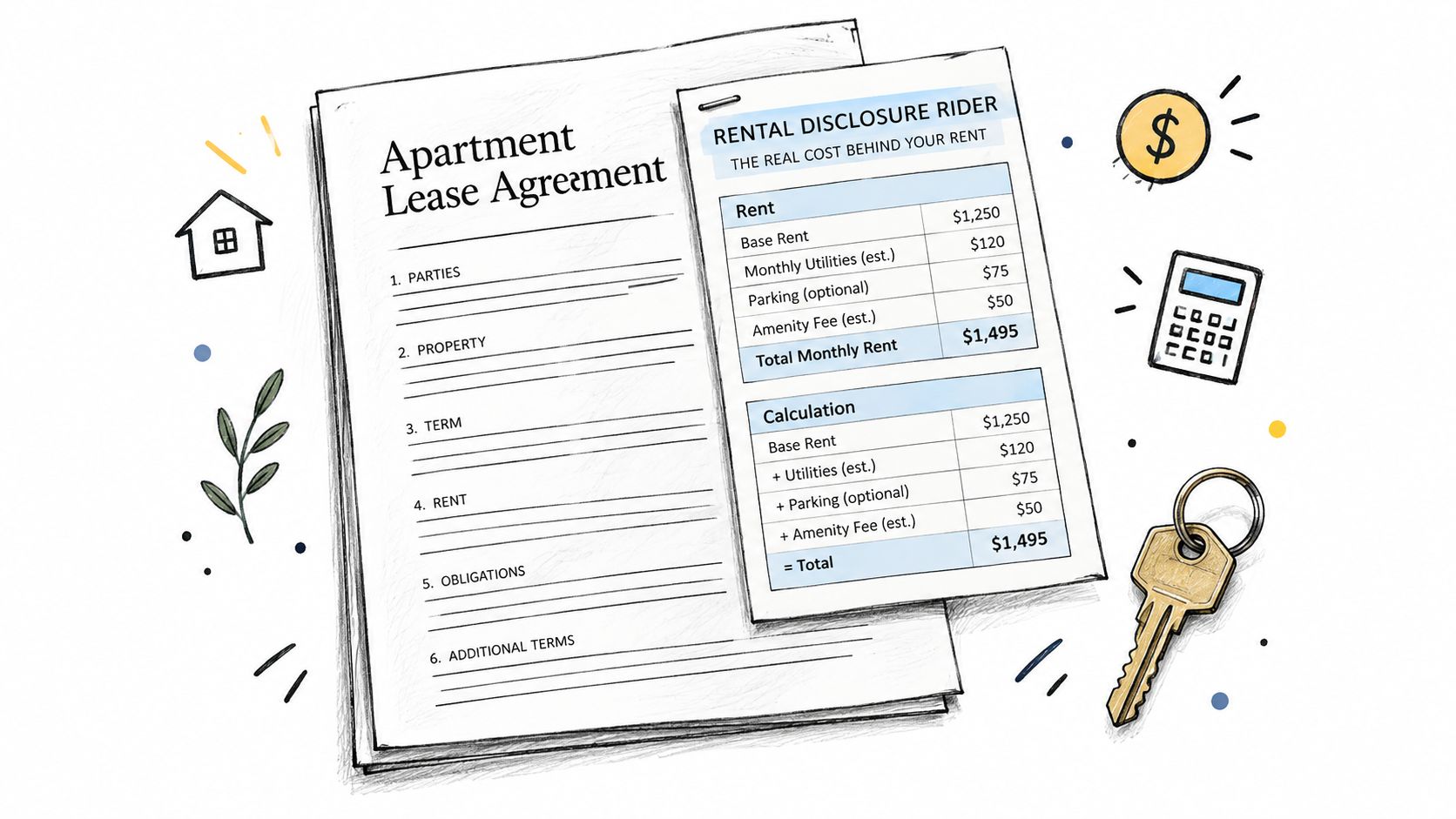
A rent stabilization lease rider is a standardized disclosure owners must attach to and serve with every vacancy lease and every renewal lease for a rent-stabilized apartment in New York City. New York State Homes and Community Renewal, called HCR, issues the official form and sets the lease-rider requirements under the Rent Stabilization Code, as described in HCR guidance on leases and required riders.
Three terms make the requirement easier to follow:
- Vacancy lease: The lease you sign when you first move into a vacant apartment.
- Renewal lease: The lease offered when your current term is ending and you stay.
- Legal regulated rent: The rent the owner is lawfully allowed to charge, built up through the apartment's registered history.
The rider is required again at renewal, not only at move-in.
Why the Form Exists
Rent stabilization covers a substantial share of the city's rental housing, and regulated rents are cumulative. Each vacancy, renewal, improvement, and permitted increase changes what the next tenant may be charged. Without a written accounting, a new renter would have no way to see how the owner arrived at the asking rent. The rider forces that accounting onto paper, in a standard format that can be checked line by line.
How to Spot It in the Packet
Look for the attached form that restates the apartment's rent history and ends at the rent you're being charged. The lease itself should note that a rider explaining tenant and owner rights and obligations comes with it. If the packet describes the apartment as stabilized but contains no such form, ask for it before you sign.
A rider in the packet helps distinguish a regulated tenancy from an ordinary market-rate lease, but the form itself is informational. It records the owner's version of events.
That last point matters. A disclosure can be accurate, incomplete, or wrong, and the form alone won't tell you which one you're holding. HCR keeps a registered rent history for stabilized apartments, and that official record is the standard the rider has to match.
Reading Every Line of the Rider
Read the rider in the order it tells its story. It starts before you arrived, with the rent the apartment carried before the last vacancy. It then moves through what the previous tenant paid, what work was done, what that work cost, and each increase that followed. It ends with the rent you're being charged now.
If you read it backwards, starting from today's rent, the numbers look arbitrary. Read forwards and you can test each step.
A Simple Reading Method
Take a pen before you sign anything.
- Circle every dollar figure: Don't skip a number because it looks like background information.
- Write the date beside each amount: A rent without a date can't be placed in the timeline.
- Rebuild the timeline on one page: Prior rent, each adjustment, then your rent, in chronological order.
| Rider item | What it tells you | What to check |
|---|---|---|
| Legal regulated rent before vacancy | The lawful rent cap the unit carried before the last tenant left | Match it against the HCR rent history |
| Previous tenant's rent | The rent the prior occupant actually paid | Confirm it matches the official history |
| Individual apartment improvements | Renovation work and its cost added to the rent | Request invoices or canceled checks within 60 days of signing |
| Rent increases and dates | Each adjustment, its date and its stated reason | Check each date and amount against the history |
| Preferential rent | A rent below the legal cap that the owner has agreed to charge | Confirm the lease rent and the terms for future renewals |
| Air-conditioner surcharge | Any extra charge tied to a window air conditioner | Confirm whether it is listed and how it is billed |
| Renewal rights | The tenant's right to renew and the rules for renewal increases | Note renewal timing and any notice requirements |
| Program and expiration date | Tax-benefit program, such as 421-a, and its approximate expiration | Ask how expiration would affect rent and renewals |
| Tenant and owner duties | Obligations for repairs, notices and other responsibilities | Confirm both parties' duties are written out in full |
The Items That Confuse People Most
Individual apartment improvements, often shortened to IAIs, are renovation work inside your specific apartment, not work on the whole building. If the rider adds money to the rent for that work, you're entitled to ask for the paper behind it, such as invoices or canceled checks. Don't accept a round cost figure with no documents.
Preferential rent means the owner is charging you less than the legal regulated rent, which is the maximum lawful rent for the apartment. That's not automatically a trick, but you need both numbers in writing because the gap between them matters later.
Two smaller items deserve a clear answer before you sign. If there's an air-conditioner surcharge, confirm whether it applies to you and how it's billed. If the rider describes renewal rights, note the timing and notice rules so a renewal offer doesn't surprise you.
When you've finished, you should be able to trace every change from the prior rent to today's rent without a missing step. Any gap in that chain becomes a written question, not a guess.
How the Rider Sets Your Rent and Renewals
A renter signs a lease charging $2,600 a month, then spots $2,850 on the rider attached to it. Which number is real? Both are, and they answer different questions. The rider works like a reconciliation sheet: its figures have to line up with the amount you pay and with the official rent history on file.
Three numbers appear again and again in this paperwork, and renters get into trouble when they treat them as one number.
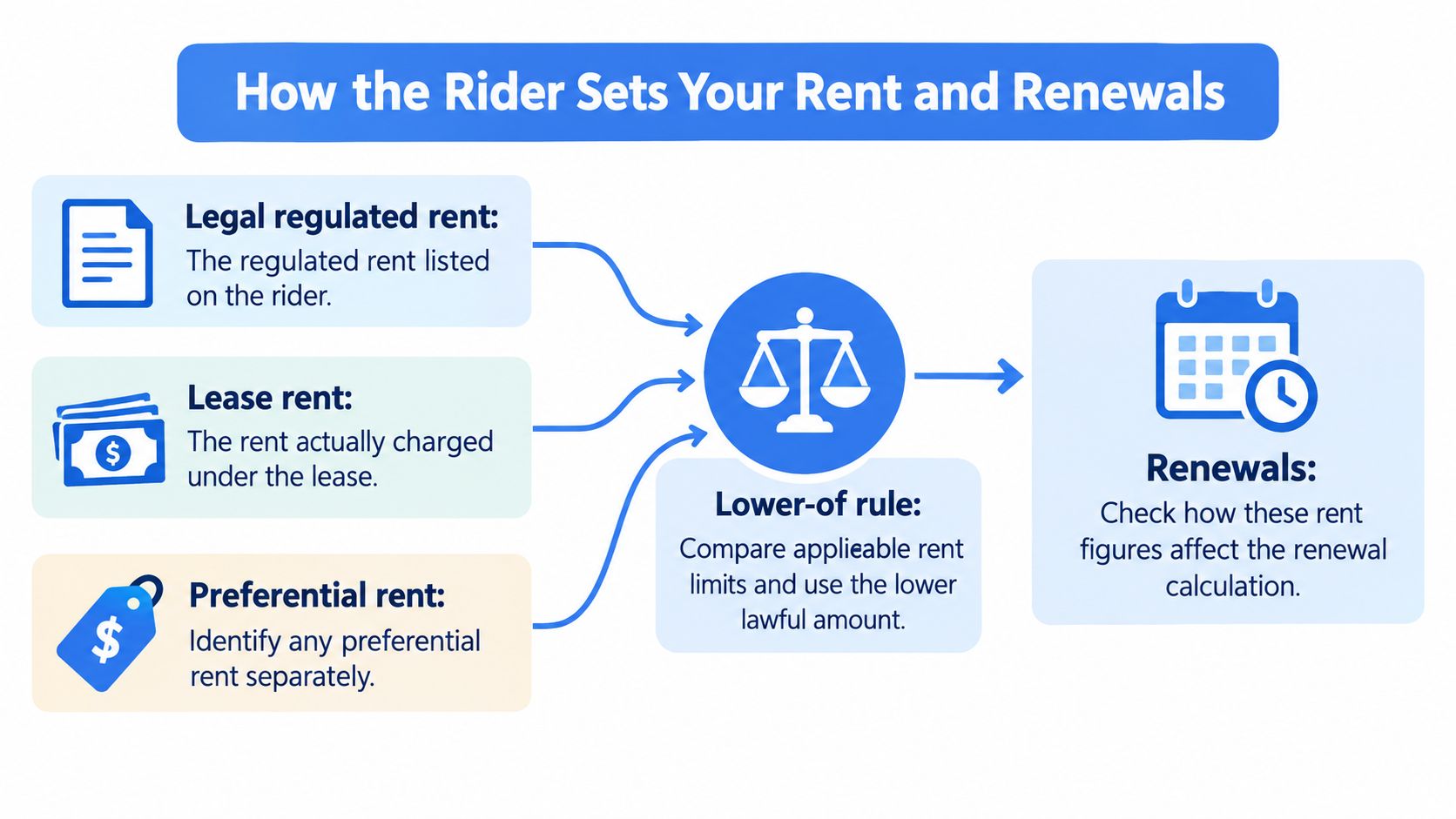
- Legal regulated rent: The regulated rent listed on the rider, and the ceiling the owner claims the law allows.
- Lease rent: The rent charged under your lease, and the amount tied to what you pay.
- Preferential rent: A lease rent that sits below the legal regulated rent.
The official rider for a vacancy lease identifies the legal regulated rent immediately before the vacancy and explains how the current rent was computed, including the previous tenant's rent, improvement work, costs, and increases, according to HCR Fact Sheet 2 on leases. Read it as an auditable timeline. Each figure should connect to the next, and each one should be checkable against records outside the rider itself.
One Worked Example
Suppose, as an illustration, the rider lists a legal regulated rent of $2,850. Your lease charges $2,600, identified as a preferential rent. You pay $2,600 today.
The same HCR fact sheet treats the legal regulated rent as the maximum the owner may charge. That produces the lower-of rule: your monthly obligation is whichever of the two figures is smaller, so a preferential lease rent controls what you owe. That settles today's payment. The $2,850 figure still shapes what a later renewal can lawfully become under the rules applying at that time, which means confirming it is correct is a separate task of its own.
Practical rule: The rent you pay today and the rent history on the rider are two separate questions, and both matter.
Why Renewals Are Not One Percentage
Rent increases can result from several distinct components rather than a single annual percentage. Guideline increases are one component. Improvement costs can be another. That's why a renewal amount can't be checked by applying one percentage and stopping there. If you want the guideline piece on its own, work through how the Rent Guidelines Board sets annual increases and then return to the rider for the other components.
The request window for improvement records is short, so mark it on a calendar. You may ask for supporting documentation for individual apartment improvements when the lease is offered or within 60 days after it is signed. No fixed response deadline is guaranteed in the rider or the fact sheet, so confirm the expected turnaround with HCR or a tenant attorney, and put your request in writing early, while you still have bargaining power before or just after signing.
Expiration Dates and 421-a Riders
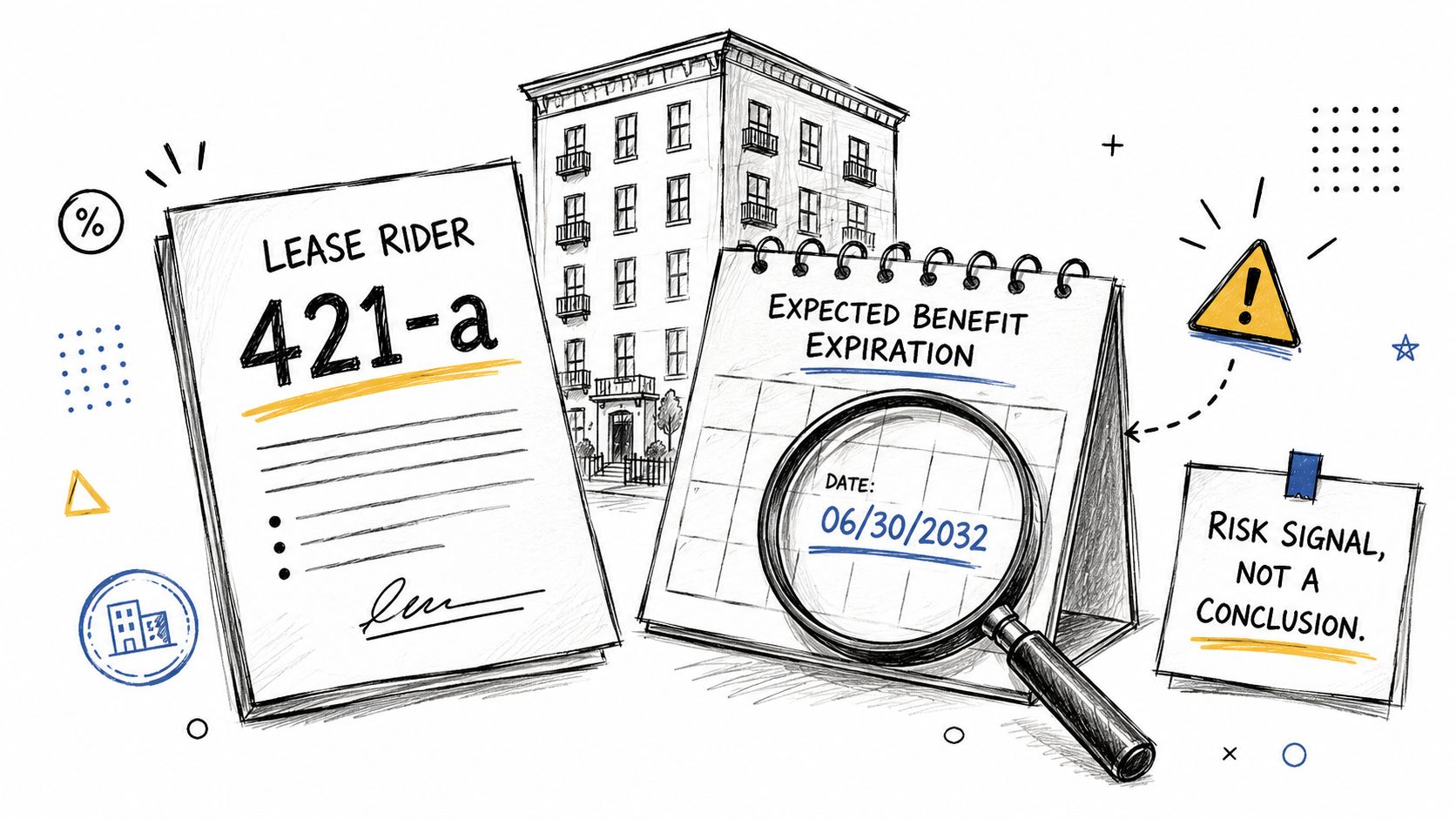
Some riders name a tax-benefit program. A 421-a property must include a rider identifying the tax-benefit program and the approximate date those benefits are expected to expire, as explained in NYC's 421-a tenant fact sheet.
Consider two listings, both described as stabilized. The first rider contains no expiration language. The second names a program and a year. They're not the same risk, and you shouldn't evaluate them the same way.
Five Questions for an Expiration Date
- Which program applies: Get the exact program name, not a general assurance.
- What is the approximate expiration date: Confirm the date stated in the rider.
- What happens to the rent after that date: Ask for the answer in writing.
- Does the lease state it too: Check that the lease language matches the rider.
- What are the renewal rules: Confirm your renewal rights and any transition rules.
An expiration date is a risk signal, not a prediction of your exact future rent and not a standalone reason to reject the apartment. The rider is a disclosure document. It doesn't substitute for checking the unit's legal status and rent history.
Verify the building's tax-benefit status, read the lease language on expiration, and ask about applicable transition rules before you sign. For the program-specific detail, see the NYC 421-a tax abatement guide for rent-stabilized apartments.
Don't flatten all stabilized apartments into one category. The program named on the rider changes what you must check, and that's separate from whether the advertised rent looks attractive today.
Red Flags and Sample Rider Language to Question
Here's an illustrative paraphrase, not official form text: "The legal regulated rent for this apartment immediately before the vacancy was $2,850."
Your job isn't to accept that sentence. Your job is to check whether $2,850 matches the apartment's HCR rent history. A confident sentence on a form can still contain a wrong number, and a wrong starting number can carry through every increase built on it.
A red flag is a question to put to the owner in writing, not automatic proof that you should walk away.
| Red flag | Why it matters | What to request |
|---|---|---|
| No rider attached to the lease | The rider is required with vacancy and renewal leases | A written copy of the official rider before signing |
| Rider printed no larger than the lease | The form must be printed in a larger type size than the lease | The official HCR form in the required format |
| Lease lacks the statement about the rider | The lease must prominently say the rider explains rights and obligations | A corrected lease with that statement |
| Rider omits the previous tenant's rent or prior history | Removes the audit trail from prior rent to current rent | The HCR rent history for the apartment |
| Lease rent above the legal regulated rent on the rider | The legally payable rent is the lower of the two figures | A written reconciliation and an explanation from the owner |
| Improvement increases with no supporting records | Improvement costs cannot be verified without invoices or canceled checks | Invoices or canceled checks, requested within the 60-day window |
| Expiration date with no explanation | Rent and renewal terms may change when a program ends | A written explanation of what happens at expiration |
| Listed as stabilized but no rider offered | The unit may not be regulated as advertised | Confirmation of the building's status from HCR records |
How to Raise a Flag Calmly
Keep each question narrow and document based. Say which line you're asking about, which record you compared it with, and what you need. For example, you might write that the rider lists an improvement increase but includes no invoices, and you're requesting invoices or canceled checks within the window the rider describes.
That tone does two things. It gives an owner who made an honest error a clear way to correct it. It also creates a dated paper trail if the answer never comes or the numbers still don't reconcile.
Don't sign away the question because you're worried about losing the apartment. If an owner won't produce a required rider or explain a basic mismatch, that refusal is itself useful information about the tenancy you're being offered.
Reconcile the Rider Against HCR Rent History
A rider records the owner's calculation of your legal rent. Reconciliation means checking that calculation against outside records before you rely on it, the same way you'd compare a restaurant check against the menu prices before paying.
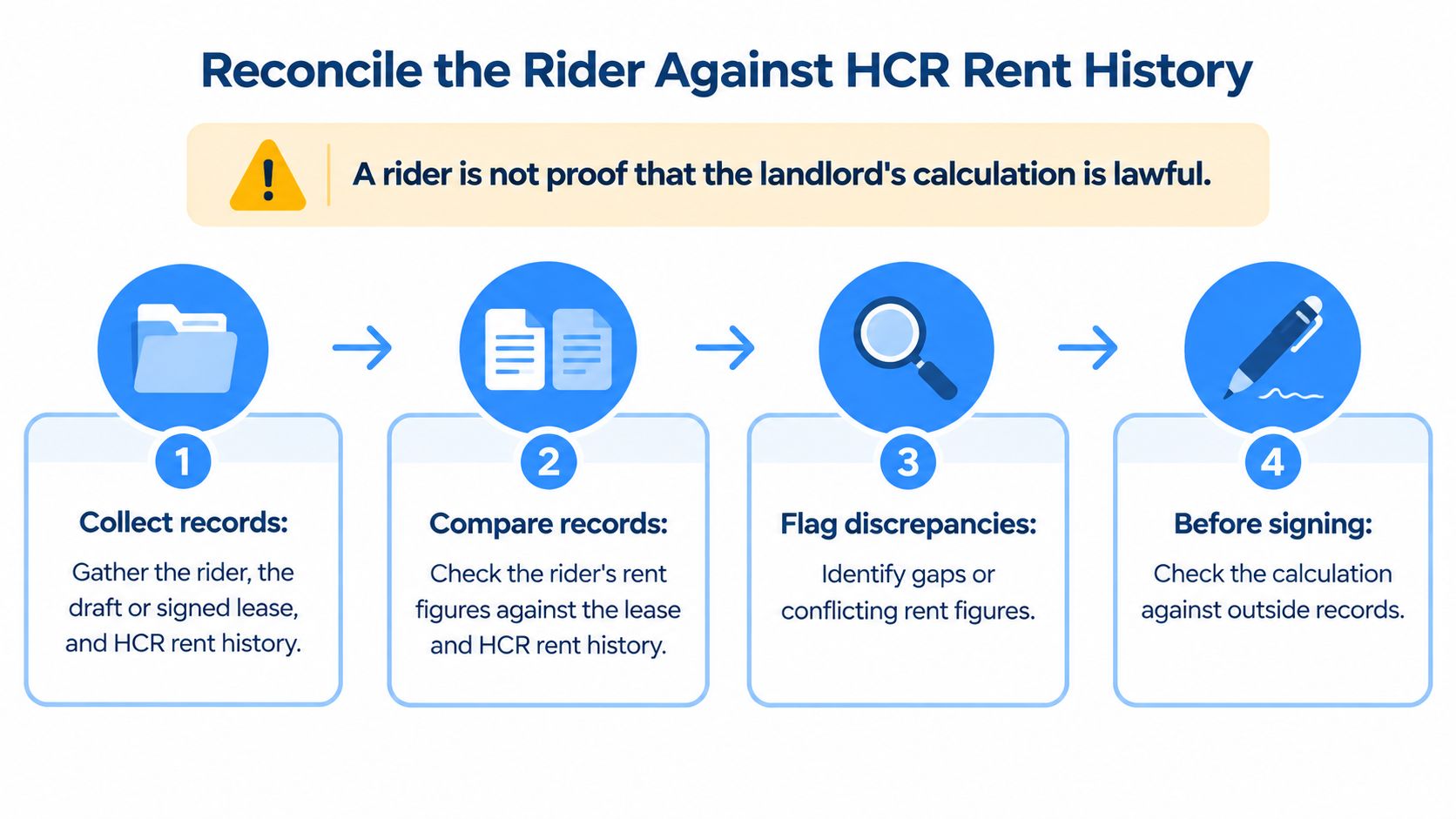
New York courts state that the legally payable rent in a stabilized apartment is the lower of two figures: the legal regulated rent or the rent the lease charges, as set out in court guidance on improper rent amounts in rent-stabilized apartments. Using that rule requires both numbers in front of you. The rent charged sits in your lease. The legal regulated figure comes from the apartment's official HCR rent history, which you should request whenever the rider is missing, unclear, or inconsistent with the rent you're being asked to pay.
The Seven Step Workflow
- Collect everything first: Gather the rider, the draft or signed lease, the listing or advertisement, and every payment record you have. Screenshots and emails count, so save them with dates.
- Request the HCR rent history: Ask for the official history for the specific apartment and keep HCR's reply in the same folder. That reply is the outside record you're checking the rider against.
- Compare the legal regulated rent: Put the rider figure beside the history figure for the same date. If they differ, write down the exact difference rather than noting that the numbers look off.
- Compare the lease rent: Confirm which lease figure is the rent charged and whether it's identified as a preferential rent. Then apply the lower-of rule to see what you should pay today.
- Check each increase in order: Go date by date and amount by amount. For any improvement cost, request invoices or canceled checks within the 60-day window described earlier.
- Put every mismatch in writing: List each discrepancy, name the two conflicting documents, and ask the owner to explain or correct it before you sign.
- Keep copies of everything: Store the rider, lease, advertisement, HCR history, requests, replies, and payment records together. Your future self at renewal will need exactly this folder.
The video below covers rent-stabilization riders and rent history records, the same documents this workflow uses.
The Hard Case You Will Probably Face
The rider lists a high legal regulated rent. The advertised rent and the lease rent are lower. Skipping the high figure feels reasonable because it isn't what you're paying.
Resist that. The lower charged rent may control today, possibly as a preferential rent, but the increase history behind the high figure still carries information. It can reveal an unlawful calculation, and it can shape a renewal dispute years from now. A simple stabilized or not stabilized label won't explain the gap on its own.
Sign-or-ask rule: Sign when the rider, the lease rent, and the HCR history reconcile. Ask in writing when they don't.
RentReboot's listing alerts can flag possible rent-stabilized apartments against official NYC datasets while you search. Treat the flag as a starting point for your shortlist. The rider and the history for the specific apartment still need your own comparison.
Challenging an Overcharge Step by Step
Say the HCR history shows a lower registered rent than the rider claims, while your canceled checks show you paid the lease amount each month. Start with the paper trail, not the complaint form. A clean folder lets HCR or a tenant lawyer see the gap in minutes.
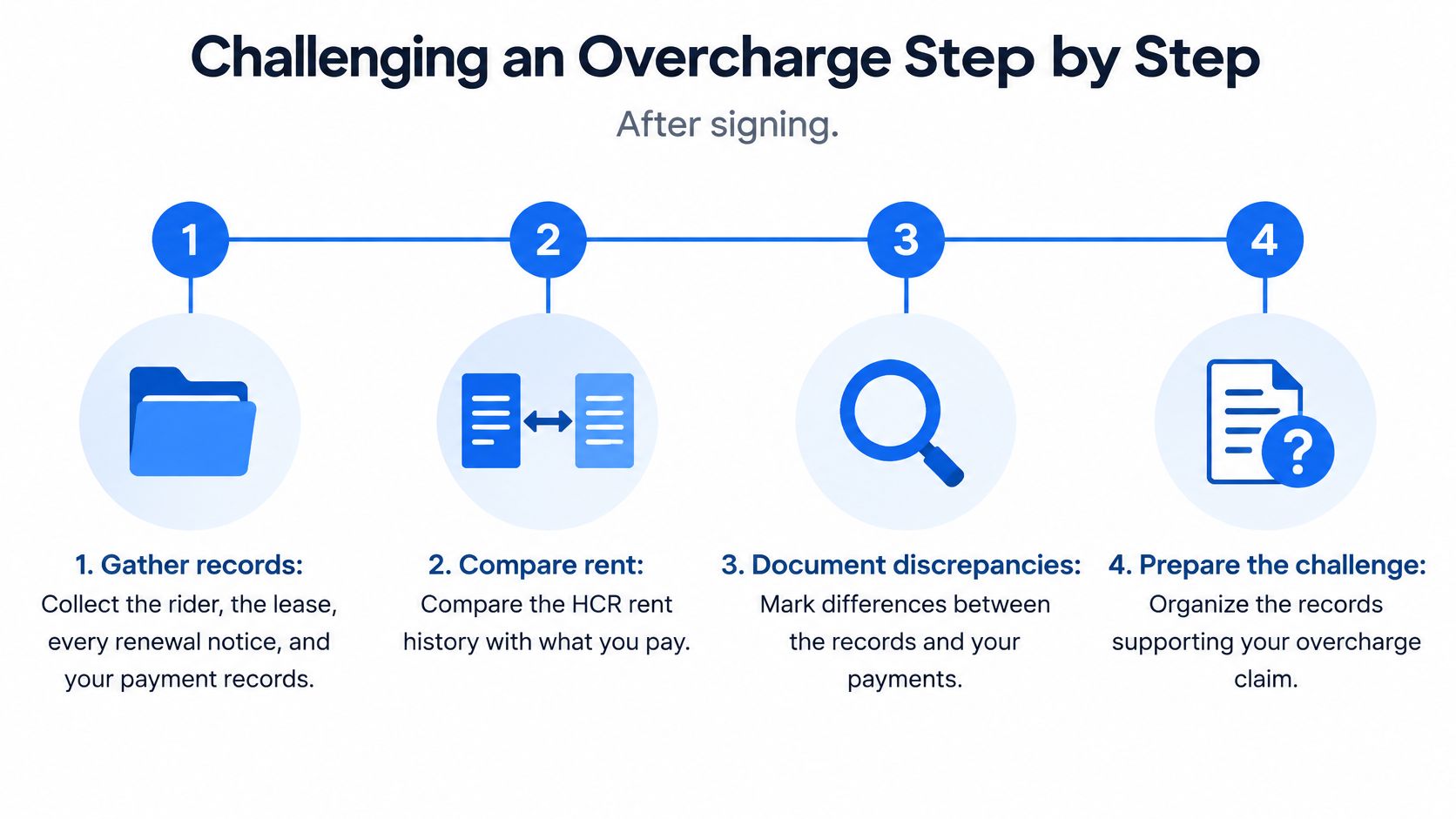
- Gather your records: Put the rider, signed lease, renewal notices, rent receipts, bank statements, and canceled checks in one folder.
- Compare history with payments: Repeat the reconciliation workflow: rider figures, HCR rent history, advertised rent, and the amount charged.
- Calculate the difference: State the monthly gap first, then total it across the disputed months so the claim has a clear dollar amount.
- Write to the owner: Cite the exact mismatch, ask for an explanation and correction, and keep a dated copy of everything sent.
- File with HCR if it stays unresolved: New York guidance points tenants to complaint procedures, including complaints about a missing signed lease or required rider. The mechanics are covered in how to file an overcharge complaint with DHCR.
- Get New York advice on timing: Ask a New York tenant attorney or legal aid organization which lookback period applies, because the rules have changed over time. For contrast in how firms elsewhere describe landlord-tenant work, rental dispute help from Olson & Sons is an out-of-state example; a New York stabilized lease needs New York counsel.
- Keep paying as the law requires while you dispute: Do not withhold rent without advice, since withholding can create eviction risk even when the overcharge claim looks strong.
Steps 6 and 7 are where generalized guidance stops and individualized advice starts. The evidence that matters stays consistent throughout: the rider, the signed lease, canceled checks, renewal notices, and dated correspondence kept together.
Before your next lease packet lands on the table, set up alerts with RentReboot to monitor listings across platforms and flag possible rent-stabilized apartments against official NYC datasets. Bring that shortlist to each viewing, then use the rider and HCR history checks in this guide before you sign anything.