
Ordinary rent-stabilized apartments in NYC generally have no tenant income ceiling or minimum-income test merely because they're stabilized. Income limits apply when the unit is also tied to an affordability program, such as certain 421-a apartments, Mitchell-Lama housing, or an HPD/HDC-financed lottery.
The popular advice to check whether you earn “too much” before pursuing any stabilized listing starts with the wrong question. First, identify the apartment's legal and program status. Otherwise, you could discard an apartment you're eligible to rent, or spend time applying for an income-restricted unit whose requirements you don't meet.
Table of Contents
- Why Rent Stabilized Apartments NYC Income Requirements Confuse So Many Renters
- What Rent Stabilization Actually Is
- The History of Income Rules in Rent Stabilization
- When Income Limits Do Apply to Stabilized Units
- How AMI Bands and Household Size Shape Eligibility
- Tools and Approaches for Finding and Verifying Stabilized Units
- How to Verify Your Eligibility Before You Apply
- Your Next Step Toward a Rent Stabilized Apartment
Why Rent Stabilized Apartments NYC Income Requirements Confuse So Many Renters
A stabilized apartment isn't automatically an income-qualified apartment. Renters encounter both categories under the broad label of affordable housing, but the labels answer different questions. Stabilization concerns the apartment's regulatory status; income restrictions concern who qualifies under a particular affordability program.
The distinction also changes how you evaluate the advertised rent. The city's Independent Budget Office explicitly notes that stabilized status doesn't necessarily mean a household can afford the apartment, an important qualification in its analysis of the rent-stabilized housing stock.
Separate the questions before screening yourself out
Use a separate question for each decision:
- Legal status: Is this particular apartment rent stabilized?
- Personal affordability: Can your household comfortably pay the advertised rent alongside other expenses?
- Program eligibility: Does an affordability program impose income or household-size requirements?
The relationship between those questions is easier to see visually.
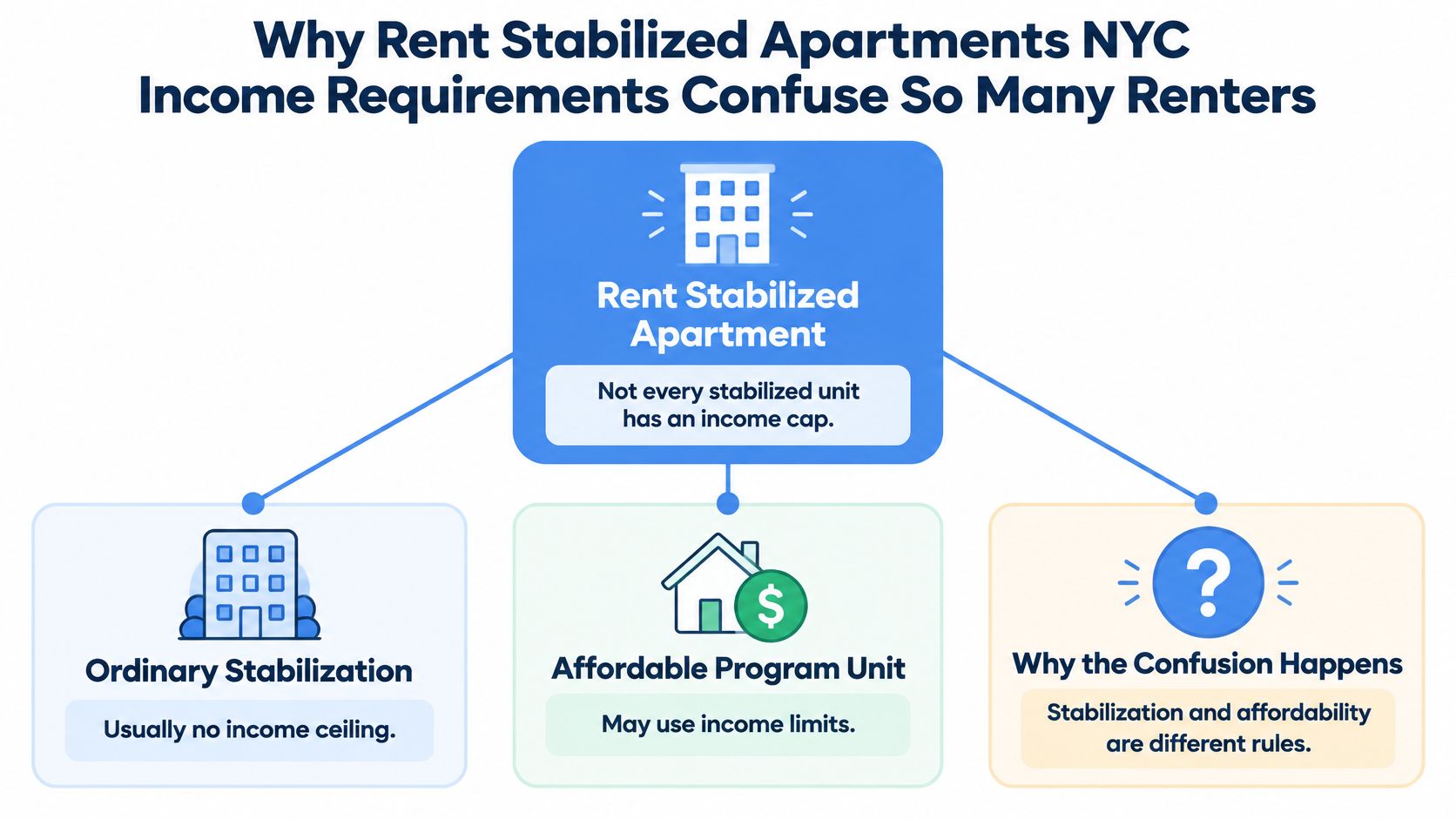
A listing can pass one test and fail another. An apartment might be legally stabilized but too expensive for your budget. An income-restricted apartment might have an appealing rent but an eligibility band that excludes your household.
Practical rule: Don't use an affordable-housing income chart to reject yourself from a listing until you know that the chart governs that apartment.
This matters especially if you're new to New York, moving with roommates, or earning freelance, commission, or bonus income. Your household arrangement and income calculation may matter greatly to a program administrator, but they don't establish whether an ordinary apartment is legally stabilized.
Treat an ambiguous listing as a request for clarification, not an automatic rejection. Ask the advertiser to identify the program behind any stated income limit. A clear answer should distinguish a requirement of the apartment's affordability program from a separate application-screening request.
What Rent Stabilization Actually Is
Many qualifying buildings contain six or more apartments and were built before January 1, 1974, but those characteristics are starting points, not a complete determination of an individual apartment's status; NYC's rent-stabilized apartment guidance describes stabilization as a building-and-unit regulatory category rather than an income-restricted housing program.
That distinction explains why your salary isn't the right tool for identifying a stabilized apartment. Start with the address, building characteristics, and unit-specific information. Then investigate whether another program adds affordability restrictions.
Building clues aren't unit-level proof
An older building can be a useful search lead. It isn't a substitute for checking the apartment itself. Likewise, the presence of affordability language in a newer development should prompt questions about the applicable program rather than assumptions based on construction age alone.
Keep the evidence organized:
- Building evidence: Record the address, construction information, and apparent building size.
- Apartment evidence: Save the listing and ask for written confirmation of the particular unit's claimed status.
- Program evidence: Identify any tax-benefit, financing, or affordability designation mentioned in the advertisement.
The useful analytical distinction is between finding a candidate and confirming a legal status. Building characteristics help with discovery. Unit-specific documentation addresses the apartment you're considering.
Why the citywide housing context matters
The modern system developed after the Rent Guidelines Board was established in 1969, following falling vacancy rates and rising rents; state law uses a net rental vacancy rate of 5% or less to support the city's housing-emergency determination, and NYC has remained below that benchmark for decades, according to the NYC Comptroller's review of stabilized housing vacancies.
Those are housing-market conditions, not applicant-income conditions. The system's foundation concerns the availability and regulation of rental housing across the city.
For an applicant, the practical consequence is straightforward: investigate the apartment before analyzing a program income chart. Reversing that order confuses a citywide regulatory framework with a household-level qualification process.
The History of Income Rules in Rent Stabilization
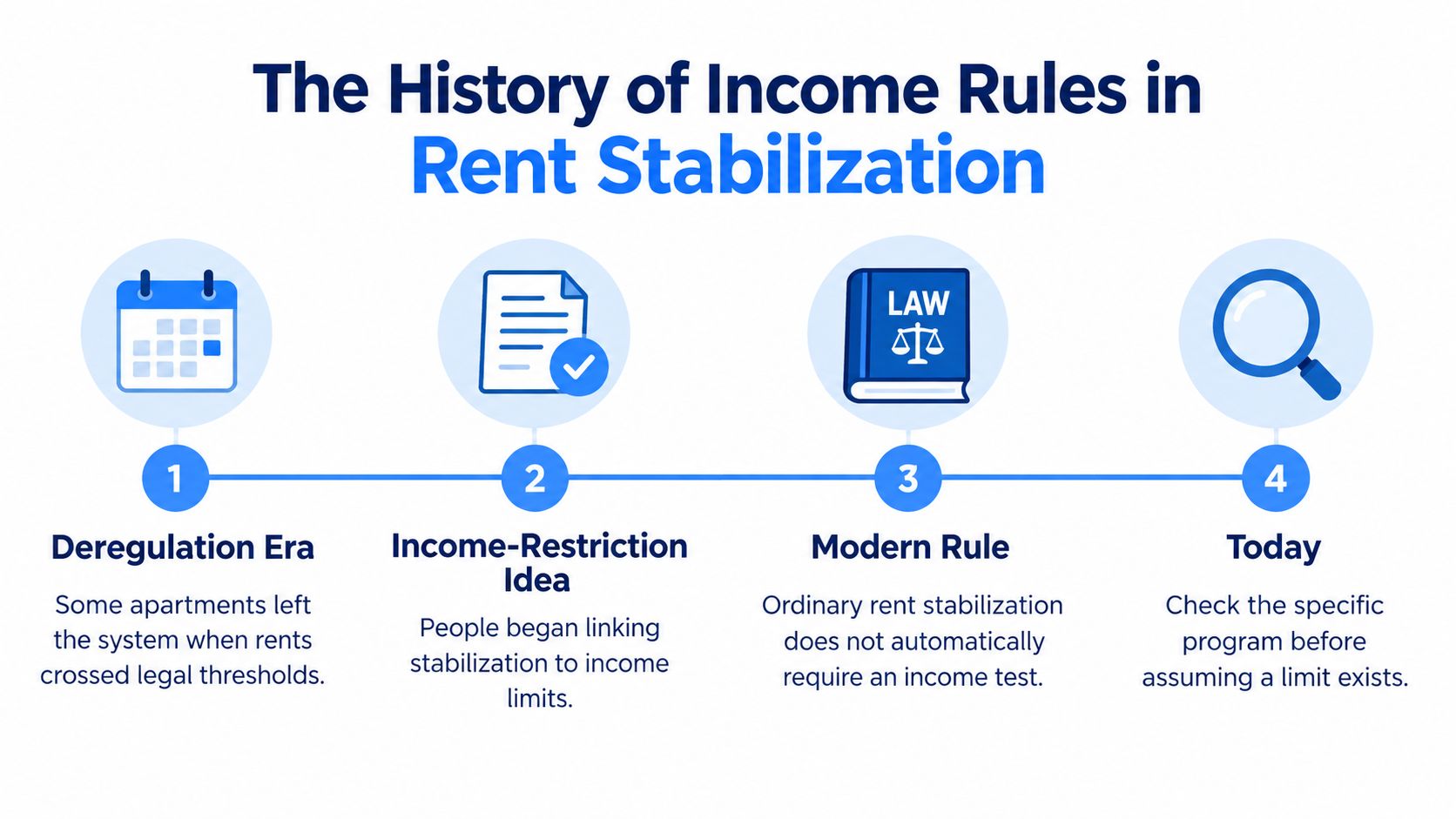
June 14, 2019, is the dividing date that matters most: the Housing Stability and Tenant Protection Act repealed nearly all forms of deregulation, including high-income/high-rent deregulation, although certain 421-a(16) apartments remain subject to specialized rules; HCR's Fact Sheet 36 on historical high-rent and high-income deregulation also documents the earlier thresholds of $250,000 under the 1993 framework, $175,000 following the 1997 amendment and from July 1, 1998, through June 30, 2011, and $200,000 for proceedings filed from July 1, 2011, through June 13, 2019.
Those figures explain why older advice still associates stabilization with an income ceiling. But the historical mechanism wasn't a general application rule telling prospective tenants how much they were allowed to earn.
The former test required income and rent conditions
Before repeal, high-income deregulation depended on a combined income-and-rent test, not earnings alone. As HCR explains in the fact sheet linked above, the household's federal adjusted gross income had to exceed the applicable threshold for two consecutive years, and the apartment's legal regulated rent also had to exceed the applicable rent threshold.
| Historical condition | Why it mattered |
|---|---|
| Household income exceeded the applicable statutory threshold | Supplied the income component of the former test |
| Legal regulated rent exceeded the applicable rent threshold | Supplied a separate required component |
| Both conditions were satisfied | Could support a deregulation proceeding under the former framework |
The timing and purpose of the rule are as important as the threshold. It concerned whether an apartment could leave regulation under the law then in effect, not whether every new applicant had to qualify below a universal income maximum.
The historical progression helps explain today's misleading search results.
Read old thresholds as historical information
An old article can accurately describe a former rule and still give you the wrong answer for a current application. Check whether its discussion concerns deregulation, initial eligibility, or a specific affordability program.
A historical deregulation threshold isn't a current income ceiling for an ordinary stabilized apartment.
If someone invokes the former threshold during your search, ask which current rule applies to the apartment. For a specialized tax-benefit unit, request the specific program designation rather than assuming that either the ordinary rule or the historical exception settles the question.
When Income Limits Do Apply to Stabilized Units
Program designation is the dividing line. An apartment can be stabilized and also belong to an affordability program. In that situation, the program supplies the income restrictions, while stabilization describes a different aspect of the unit's legal status.
Programs aren't interchangeable. Certain 421-a apartments, Mitchell-Lama housing, and HPD/HDC-financed developments require their own eligibility review. Don't assume that a rule attached to one listing applies to another just because both advertisers use the word affordable.
Which Program Applies to Your Stabilized Unit
| Program type | Does an income test apply | Key threshold or rule | Who it affects |
|---|---|---|---|
| Ordinary rent stabilization | Not solely because of stabilization | Confirm the unit's status and distinguish separate screening requests | Applicants seeking a conventional stabilized apartment |
| Income-restricted 421-a apartment | Where the applicable program requires it | Specific affordability designation and advertised eligibility rules | Applicants for designated restricted units |
| Mitchell-Lama | Program-specific review applies | Check the development's applicable requirements | Applicants seeking participating housing |
| HPD/HDC-financed affordable apartment | Yes, under the relevant program | Advertised income band, household size, and income definition | Households applying for designated affordable units |
| SCRIE/DRIE rent freeze | A separate benefit eligibility test applies | Income, rent burden, age or disability, and unit requirements | Tenants seeking a rent-freeze benefit |
For HDC-financed affordable developments, prepare to distinguish gross household income before taxes, net business income for self-employed applicants, and any required treatment of interest income from assets. Those distinctions belong to the program calculation, not to a universal definition of eligibility for stabilized housing.
Rent-freeze eligibility is a separate decision
NYC's Rent Freeze Program generally uses a $50,000 combined household-income ceiling, requires rent to exceed one-third of monthly household income, and considers age or disability and other unit requirements, according to the city's Rent Freeze Program frequently asked questions.
The same city guidance explains that a 2023 legislative change simplified the calculation for new applicants, primarily using federal adjusted gross income minus the taxable portion of IRA or annuity distributions, with income drawn from the prior calendar year.
That timing can matter if your earnings have recently changed. A current reduction in income doesn't necessarily produce the same eligibility result as the prior-year figure used by the program.
Keep the decisions separate: qualifying to rent an apartment and qualifying for help freezing its rent aren't the same application.
How AMI Bands and Household Size Shape Eligibility
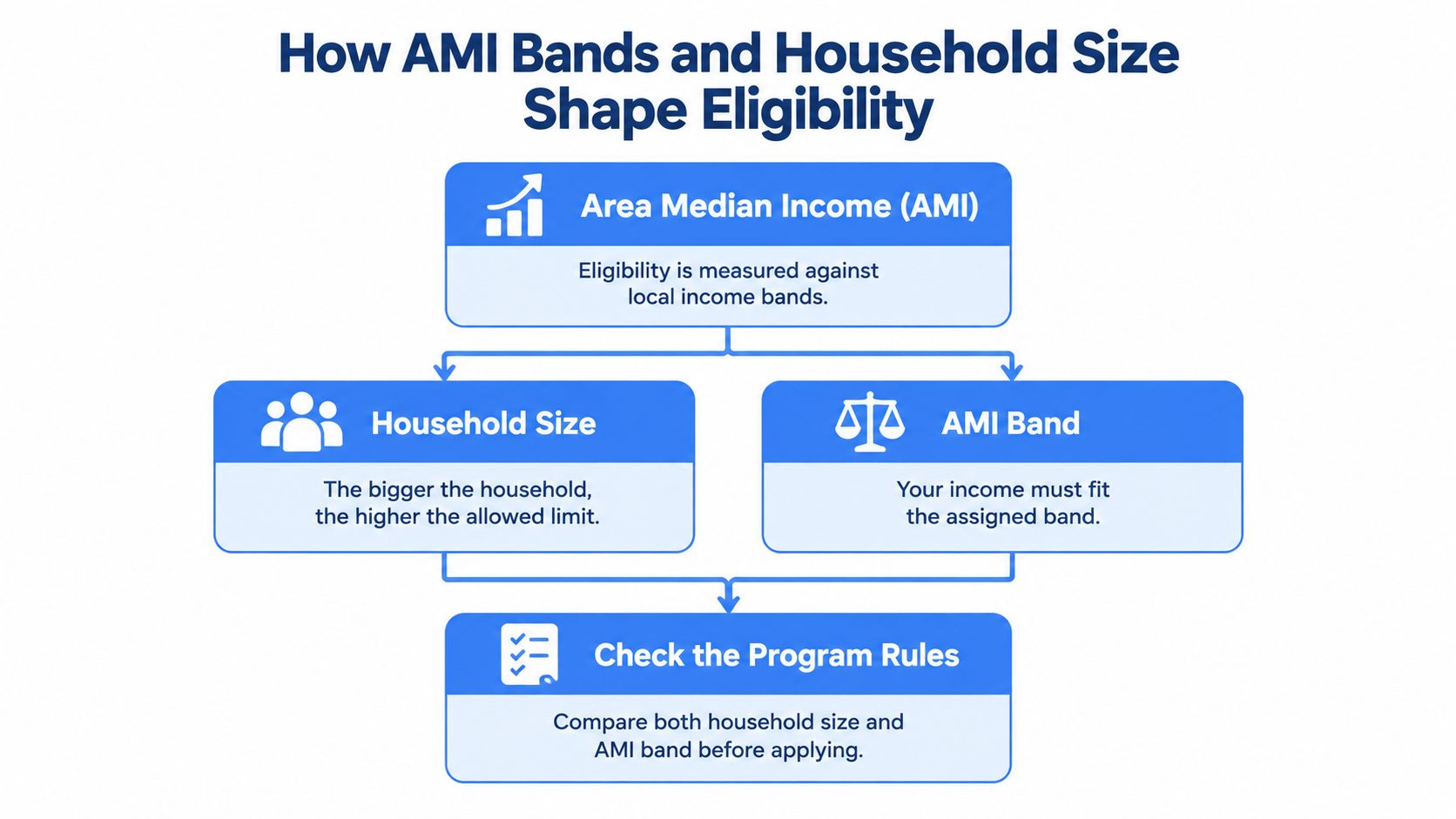
The exact advertised income band matters more than a generic NYC income limit. HDC bases maximum eligibility on HUD-derived Area Median Income limits and household size, and qualifying rental subsidies can change how a minimum-income requirement is applied, as explained in HDC's affordable-housing eligibility guidance.
Area Median Income, or AMI, is a reference used by affordability programs. Your task isn't just to locate an AMI figure for New York. It's to identify the band assigned to the apartment, select the appropriate household-size category, and calculate income using that program's definition.
The relationship between those inputs is shown below.
Compare the same kinds of income
Don't compare take-home pay with a listing that asks for gross annual income. Don't substitute a freelancer's total client receipts for net business income when the program requires the latter.
Use this worksheet before deciding whether you fit:
- Identify the household: List everyone who intends to occupy the apartment.
- Classify earnings: Separate wages from self-employment income and other potentially countable income.
- Check assets: Follow the program's treatment of interest or other asset-related income.
- Match the advertisement: Compare the calculated total with both boundaries, if the listing states a minimum and maximum.
- Flag subsidy treatment: Ask how a qualifying rental subsidy changes the applicable minimum-income review.
The NYC housing lottery income requirements guide can help you organize the questions to ask when a listing belongs to a lottery program.
Household examples without invented income limits
For a renter applying alone, start with that person's countable annual income and the listing's applicable household category. An attractive rent doesn't remove the need to check the upper boundary.
For a couple, calculate the income the program requires for the household rather than checking each person independently. A qualifying individual income doesn't establish that the combined household falls within the advertised band.
For a household that includes a child or another non-earning occupant, don't count only wage earners when identifying household size. Occupancy and countable income are separate inputs.
Application insight: Passing the maximum-income test doesn't establish that you satisfy the minimum, and meeting either boundary doesn't establish complete eligibility.
No responsible worked example can supply an actual eligibility result without the listing's income limits. Use the advertisement's figures rather than borrowing limits from another development or an outdated chart.
Tools and Approaches for Finding and Verifying Stabilized Units
Discovery tools and verification tools serve different purposes. A listing website helps you find an available apartment. Building records and program documents help you assess what the advertiser's stabilization claim means.
An alert-based search is another discovery option alongside manual browsing and direct review of official information.

Choose an approach by the work you want to do
| Approach | What you do | What still needs checking |
|---|---|---|
| Manual browsing | Search StreetEasy, Zillow, Craigslist, OpenIgloo, RentHop, and landlord or brokerage sites | Whether each promising listing's status and eligibility language are accurate |
| Official-record review | Compare the address and apartment information with applicable public records | Whether building-level information resolves the particular unit's status |
| Saved searches and alerts | Set location, budget, and bedroom preferences and review matching listings | Whether an alert identifies a candidate or confirms a legal conclusion |
RentReboot is an option for consolidated discovery: it monitors rental listing platforms, matches apartments to saved criteria, sends email or SMS notifications, and identifies potentially stabilized apartments through cross-checking against official NYC datasets. Treat the stabilization indication as a reason to investigate, not as a substitute for unit-level confirmation.
The NYC rent-stabilized buildings map can support an address-based search. Its most useful role is helping you identify buildings to investigate while keeping the apartment-level question open.
Keep a small evidence file
Save the listing text, the apartment identifier, the advertised rent, and any program language. Record what the advertiser says about stabilization and income restrictions so you can compare the answers with subsequent documents.
That approach also helps when the same apartment appears across different websites. Compare the address and unit details rather than treating every advertisement as a different opportunity.
For an additional visual resource, watch the embedded video below.
Choose tools for discovery, then verify deliberately. If you prefer manual control, maintain a shortlist and revisit your chosen sites. If repeated searching is difficult to sustain, use saved alerts, but apply the same documentation standard to every candidate.
Neither a polished listing nor a stabilization flag answers the affordability-program question by itself. Ask for the designation behind any advertised eligibility requirement.
How to Verify Your Eligibility Before You Apply
Ask for the program name before assembling an income calculation. A useful message is specific: Is this an ordinary rent-stabilized apartment, or does it have income restrictions under an affordability program? If restrictions apply, ask for the applicable advertisement and written eligibility instructions.
Next, identify what the income figure means. An upper limit, a minimum requirement, and a request to document earnings address different questions. Don't let an unexplained income figure stand in for a complete answer.
Use the checklist below to keep those questions in order.
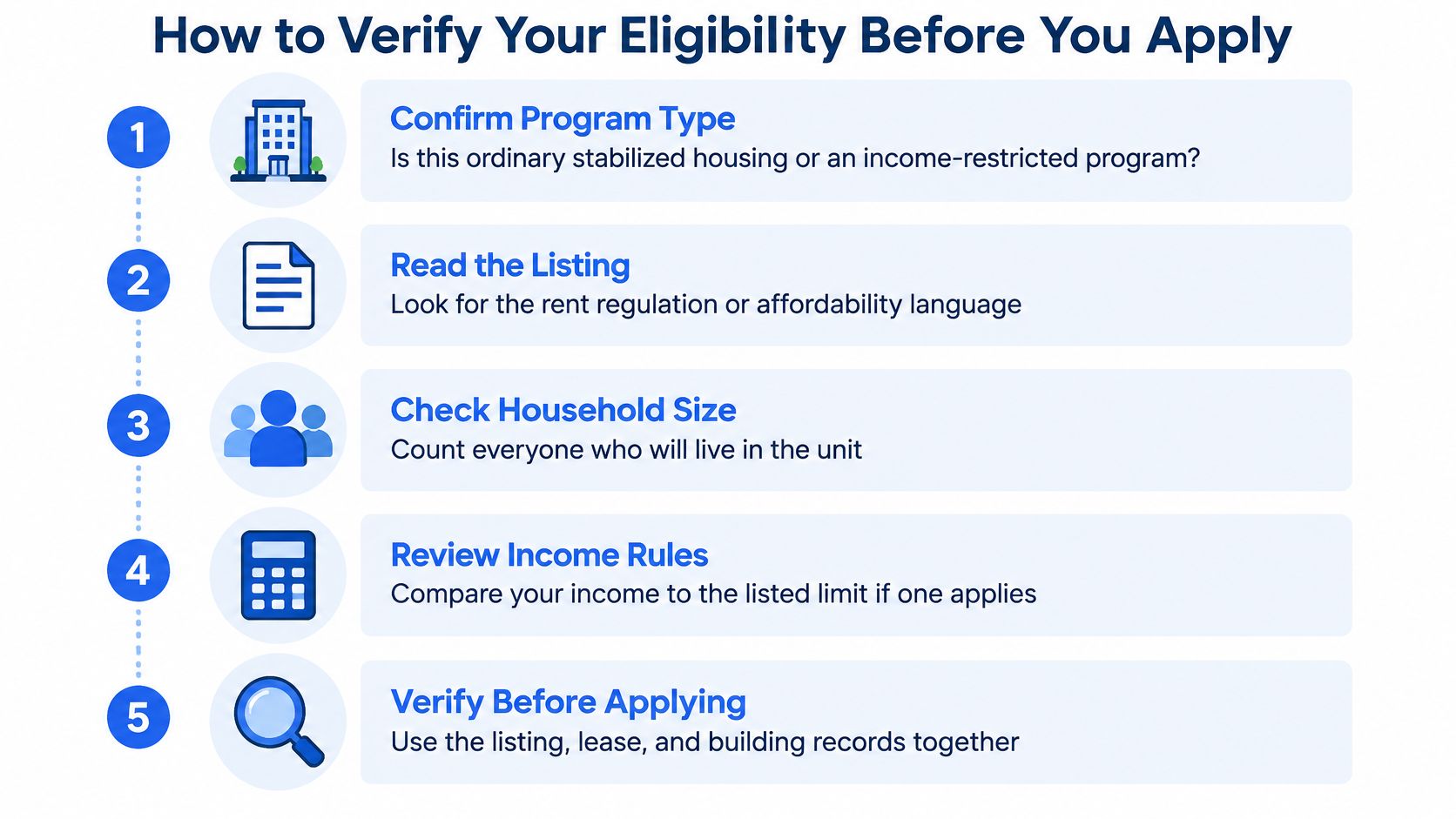
Match documents to the actual review
Ask the landlord or program administrator which records they require rather than assuming a universal document package. Clarify whether they want tax information, current earnings documentation, self-employment records, asset-income information, or documentation concerning a rental subsidy.
For a rent-freeze application, the prior-year timing discussed earlier deserves particular attention. For an affordability-program application, confirm its own measurement period rather than importing the rent-freeze calculation.
If your household has gained or lost an income-earning roommate, disclose the intended household arrangement and ask how the administrator wants it reflected. Likewise, if freelance earnings or commissions have changed, request instructions for documenting the change.
Keep this checklist open while applying
- Status confirmed: You've identified the particular apartment, not merely a potentially stabilized building.
- Program named: You know which affordability rules, if any, apply.
- Band checked: You've read all advertised income boundaries and household categories.
- Calculation aligned: Your income total follows the relevant definition and period.
- Documents requested: You have written instructions for the application materials.
An income match isn't an approval. It resolves one part of the review. Conversely, exceeding a lottery band tells you about that restricted opportunity, not your eligibility for unrelated ordinary stabilized listings.
Your Next Step Toward a Rent Stabilized Apartment
Verify status, assess your budget, then apply the relevant program rules. That order prevents a high income from becoming a false reason to reject an ordinary stabilized listing, while preventing an appealing rent from becoming a false promise of program eligibility.
Create a saved search using the rent you can sustain, your preferred neighborhoods, and the bedroom arrangement your household needs. Use continuous monitoring if it fits your search habits, and keep a separate verification checklist for every promising apartment.
Budget for living there, not just qualifying
Newcomers should keep program names and listing terminology in their search notes. Roommates should agree on intended occupancy before checking household eligibility, while variable-income households should organize records around the calculation the administrator requests.
Use free neighborhood rent distributions and neighborhood guides as budgeting aids, not eligibility tests. After identifying a viable apartment, consider practical setup expenses too; Water Filter Advisor can help you find renter-friendly water filters as part of planning for the home.
Your next action is concrete: save a search today, select a promising listing, and ask the advertiser to confirm its stabilization status and any affordability-program designation in writing.
Visit RentReboot to set up a saved apartment search, receive email or SMS alerts, and identify potentially rent-stabilized listings for further review. Use its building-search tools and neighborhood rent data to narrow your options, then verify each apartment's program designation before deciding which income requirements apply.