
New York City's median monthly rent was $1,641 in 2023, according to the Mayor's Office to Protect Tenants. That citywide figure doesn't tell you what an available apartment will cost today, or what protections come with it. An apartment's legal status, not just its advertised price, determines whether you may have regulated increases, renewal rights, or defenses against eviction.
Start with two questions: What kind of apartment do I occupy, and what document did I receive? A renewal offer, rent demand, nonrenewal notice, and court petition require different responses. This guide explains how to organize those documents, identify what needs verification, and recognize when a lawyer should review your case. It's general information, not individual legal advice.
Table of Contents
- Core Tenant Rights NYC at a Glance
- Which NYC Apartments Are Rent-Stabilized
- Lease Renewal Rights and Preferential Rent
- Good Cause Eviction and Market-Rate Tenants
- How to Spot and Challenge a Rent Overcharge
- Getting Repairs and Heat Fixed in NYC
- The NYC Eviction Process From Notice to Lockout
- Free Legal Help and Where to Find It
- First 72 Hours After a Notice or Court Papers
Core Tenant Rights NYC at a Glance
| Situation | Core right | First action | Where to act |
|---|---|---|---|
| Rent-stabilized renewal offer | Renewal protections and preservation of substantive lease terms | Compare the offer with your prior lease and rent history | State Office of Rent Administration |
| Rent above the legal regulated rent | Regulated charges must have a lawful basis, including applicable preferential-rent protections | Request the rent history and document the difference | State Office of Rent Administration |
| Nonpayment or holdover court papers | Opportunity to answer and request free counsel if eligible | Respond promptly and attend every court date | Housing Court and the Tenant Helpline |
| Notice to leave or nonrenewal | Advance-notice requirements and potentially other renewal protections | Preserve the notice and verify the applicable deadline | Legal services provider |
| Heat or hot water outage | Required building services must be maintained | Report the outage and keep a dated record | City complaint services and HPD |
| Lockout or removal of belongings | A landlord can't substitute a private lockout for lawful eviction proceedings | Request urgent assistance and legal advice | City services and Housing Court |
Find your document before deciding what to do. If you received court papers, responding to the case takes priority over completing a rent-history investigation. If you received a renewal offer, focus on the proposed rent, lease terms, and apartment status. A maintenance complaint follows a different path from either of those disputes.
The table identifies the first action, not the final legal answer. Building age, building size, tax benefits, tenancy length, and occupancy history can affect the rules. Even when neighbors have similar apartments, their tenancy histories may differ.
Build a usable document file
Keep these materials together so a housing counselor or attorney can review them:
- Lease documents: Your signed lease, riders, renewal offers, and any agreement changing the tenancy.
- Rent evidence: Payment confirmations, receipts, landlord ledgers, and rent-history records.
- Notices: Every page, the envelope, and a note describing how and when the papers arrived.
- Condition records: Repair requests, photographs, complaint confirmations, and communications about access.
Don't rely on a landlord's verbal description of your rights or on an advertisement's label. Those statements can help identify questions, but they don't resolve coverage.
Practical rule: Treat the document's title as a clue, not a conclusion. A landlord's notice is not the same thing as a court judgment.
Which NYC Apartments Are Rent-Stabilized
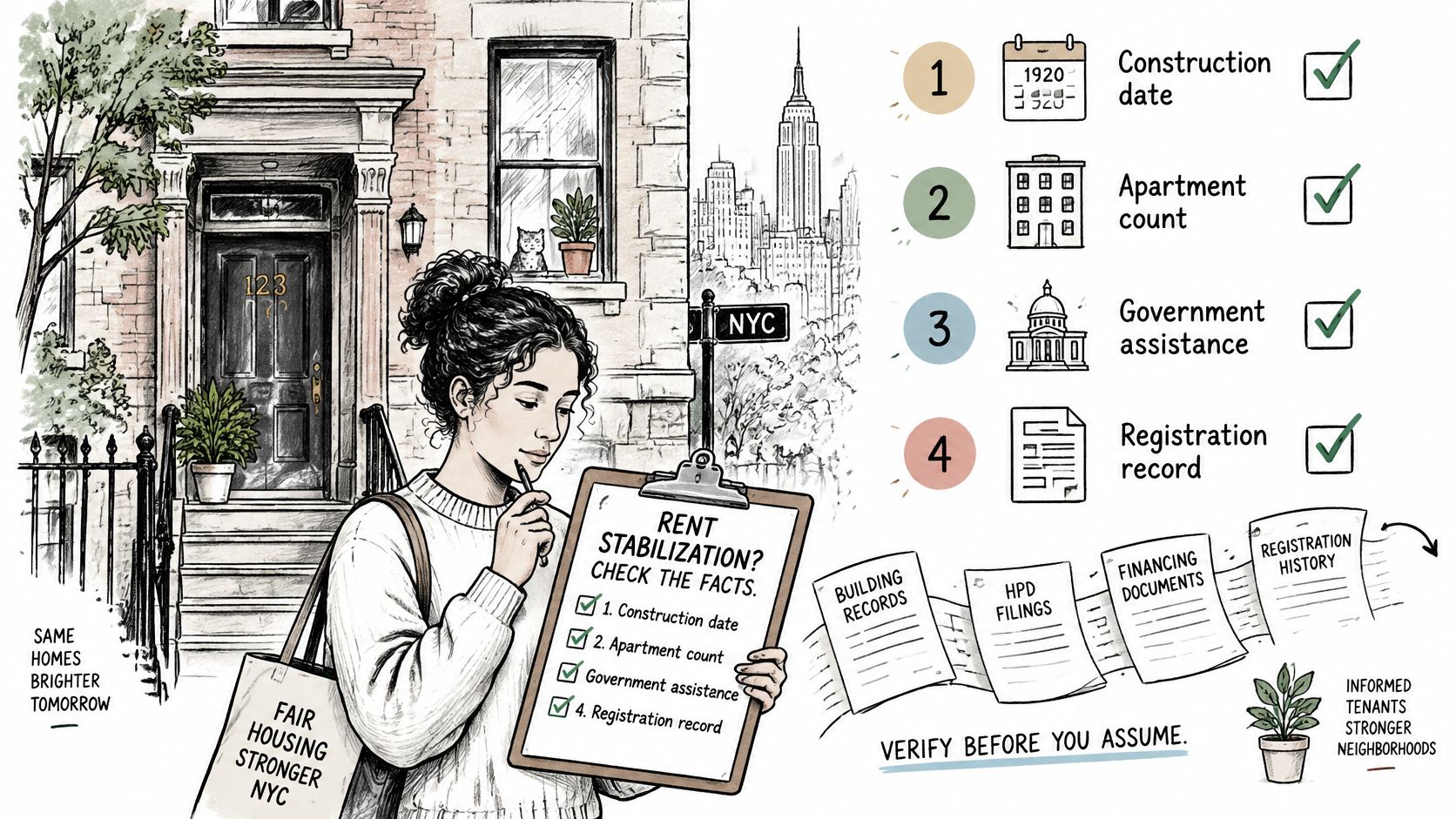
Check construction date, building size, registration, and occupancy history, in that order. These facts help you screen for stabilization without mistaking a promising listing for a verified legal status.
The records matter as much as the building's appearance.
Run the coverage checklist
- Check when the building was built. Under the framework described in the Rent Guidelines Board's rent-regulation history, buildings with six or more apartments built before 1974 generally fall within stabilization coverage. Construction date is a screening fact, not proof by itself.
- Confirm the apartment count. Look for official building information rather than counting doorbells. Building configurations and records can require closer review.
- Request the unit's registration information. Make sure the address and apartment identifier match your lease, especially if the owner uses a different unit designation.
- Examine occupancy and rent history. Gather the lease, riders, and available state rent history so you can identify gaps, unexplained changes, or statements about regulatory status.
A renovated kitchen doesn't establish that an apartment is unregulated. Neither does a high asking rent. Tax benefits and occupancy history can affect coverage, so a building that doesn't fit the usual screening pattern still deserves investigation when its documents suggest regulation.
Separate evidence from assumptions
Registration information is evidence to examine, not a substitute for a legal determination. A missing record, inconsistent apartment number, or unexplained change should prompt questions rather than an immediate conclusion that the unit is either covered or exempt.
Rent control and rent stabilization are different systems. Don't apply stabilized renewal rules merely because someone describes a home as rent-controlled. Ask which regulatory system applies and obtain the documents supporting that answer.
Use this guide to checking whether an apartment is rent-stabilized to organize the verification process. Before signing, request the proposed lease and riders; if you already live there, preserve the versions you signed.
If the owner's explanation conflicts with the records, ask a tenant attorney or the state housing agency to review the discrepancy. Your goal is a documented answer about your apartment, not a general assumption about the neighborhood.
Lease Renewal Rights and Preferential Rent
For a verified rent-stabilized apartment, a renewal offer is not just an invitation to negotiate an entirely new arrangement. The city's rent-stabilization guidance explains that tenants generally may choose a one- or two-year renewal, with the same substantive terms, and that the Housing Stability and Tenant Protection Act of 2019 generally preserves preferential rent during the tenant's continued occupancy.
An owner can't end a stabilized tenancy merely because the lease expired or wasn't renewed. That doesn't mean every dispute about renewal is straightforward. A tenant should get advice if the owner claims an exception or refuses to provide a proper offer.
Understand the two rent figures
Legal regulated rent and preferential rent aren't interchangeable. A preferential rent is a lower rent charged below the apartment's legal regulated rent.
Say your lease lists both figures and you've been paying the lower preferential amount. A renewal that suddenly substitutes the higher legal regulated amount deserves scrutiny; the existence of that higher figure doesn't, by itself, justify charging it during your continued occupancy.
Authorized increases may still apply. The question is whether the owner used the correct starting rent and the applicable Rent Guidelines Board adjustment, not whether a preferential rent can ever change.
Review the offer before returning it
- Match the tenancy: Confirm the tenant names, apartment designation, and proposed lease period.
- Compare substantive terms: Flag new restrictions, unexplained riders, or changes to obligations that weren't in the previous lease.
- Identify both rent figures: Check whether the owner has distinguished the legal regulated rent from the preferential amount.
- Ask for the calculation: Request an explanation of how the proposed payment was derived.
- Preserve delivery evidence: Save the offer, envelope, correspondence, and a copy of anything you return.
If the offer is improper or the rent changes without explanation, preserve the documents and seek review through the state Office of Rent Administration. Don't assume that refusing to engage with the offer will resolve the problem.
A higher rent printed on a renewal form isn't proof that the increase is lawful.
Good Cause Eviction and Market-Rate Tenants
Market-rate doesn't necessarily mean unprotected. NYC's Department of Housing Preservation and Development explains that Good Cause Eviction can protect some previously unregulated homes, subject to statutory requirements and exemptions.
Coverage depends on the property, landlord, and tenancy, not the label used in an advertisement.
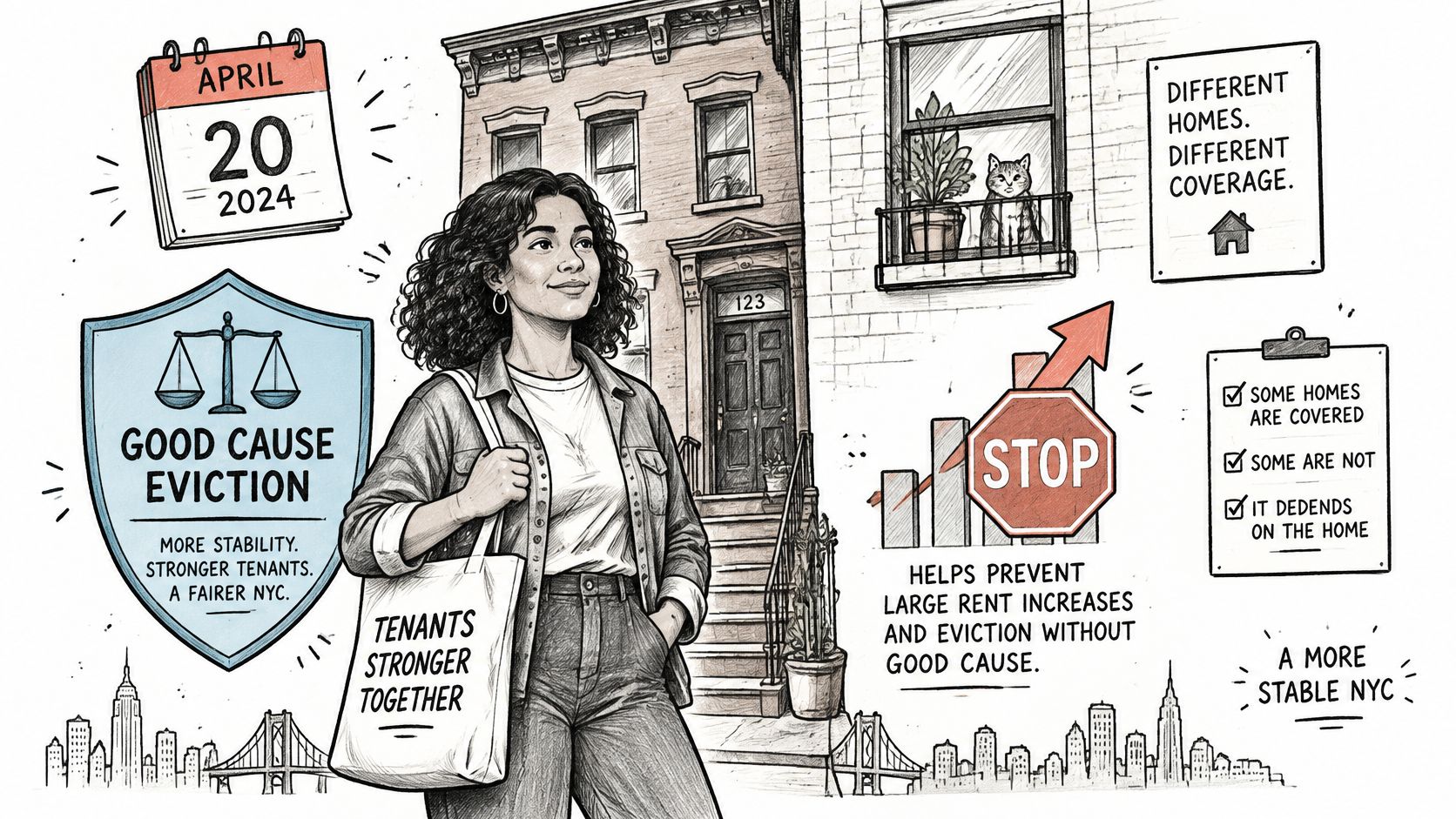
Good Cause can provide a defense against certain evictions or unreasonable rent increases. It isn't rent stabilization, and it doesn't guarantee that every tenant can renew regardless of the circumstances. A lawyer needs to examine both coverage and the landlord's asserted reason for ending the tenancy.
Check the issue at each stage
- Before signing: Ask whether the landlord considers the apartment covered and, if not, what exemption the landlord claims. Preserve the response with the proposed lease and disclosures.
- When a rent increase arrives: Keep the existing lease, proposed terms, and the owner's explanation. Ask counsel whether the increase raises a Good Cause issue.
- When a nonrenewal arrives: Identify the stated reason and collect documents that support or contradict it.
- When court papers arrive: Request legal assistance promptly and ask specifically whether a Good Cause defense should be raised.
For example, a newcomer might assume a nonrenewal is automatically valid because the apartment isn't stabilized. Another renter might make the opposite mistake and assume Good Cause prevents any eviction. Neither conclusion is safe without reviewing the exemption question and the alleged grounds.
This video offers additional context while you organize the documents for a coverage review.
Ask a specific coverage question
Instead of asking only whether the law applies, ask: What facts determine coverage, what exemption is being claimed, and what evidence supports it? That gives a legal services provider a clearer starting point.
The Tenant Helpline can connect renters with information, enforcement assistance, mediation, and legal referrals. This Good Cause Eviction guide for NYC tenants can also help you prepare questions, but an actual nonrenewal or court case needs individual review.
How to Spot and Challenge a Rent Overcharge
An overcharge claim starts with a comparison, not an accusation. You need to identify what the owner charged, what you paid, and why you believe a different amount was lawful.
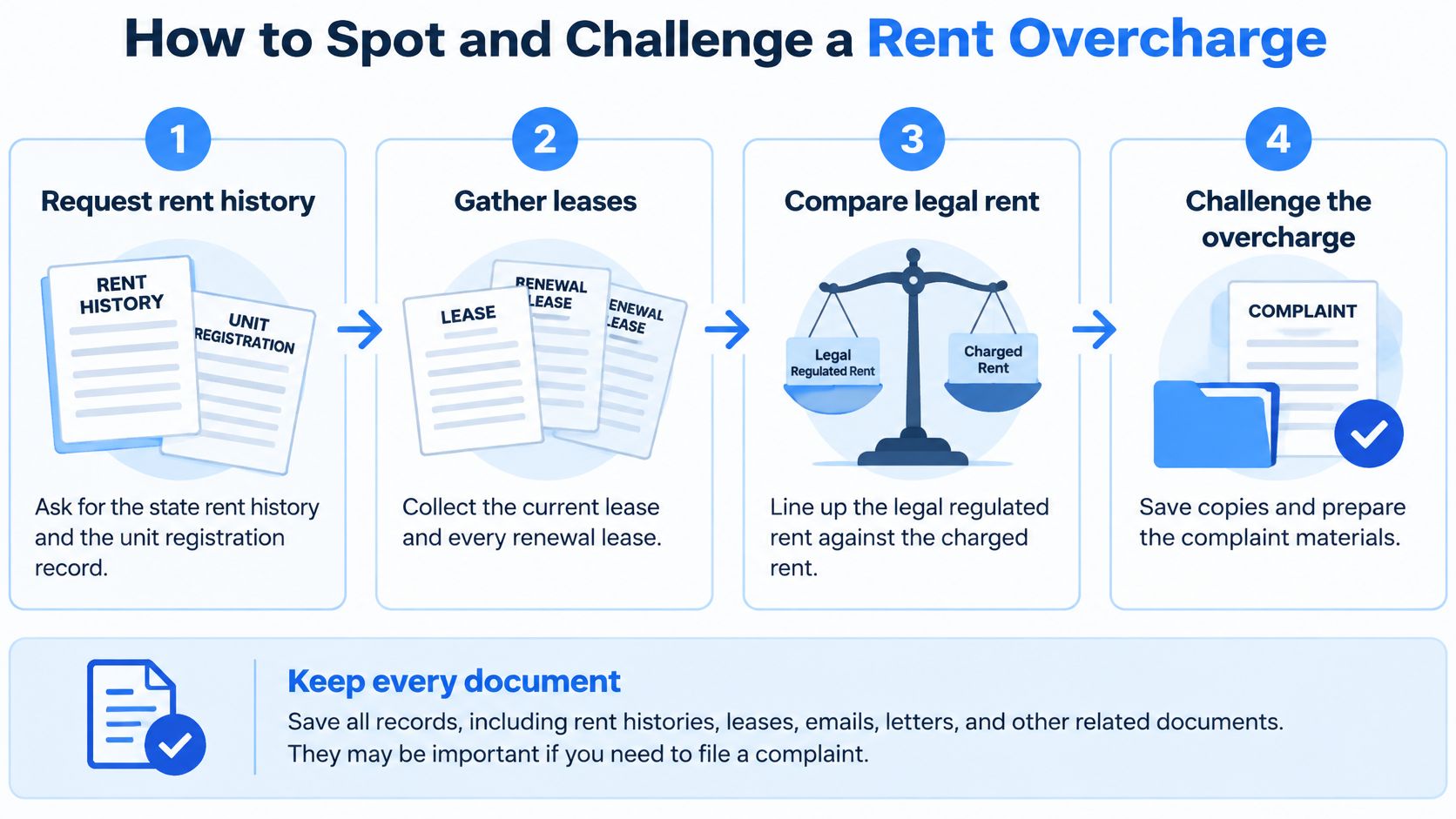
Use the document sequence below to prepare a reviewable file.
Assemble the claim materials
- Request the state rent history and registration information. Check the apartment identifier carefully so you don't compare your lease with another unit's records.
- Gather the current lease and renewals. Include riders and written explanations of increases because a ledger alone may not show the claimed basis.
- Separate the rent figures. Put the legal regulated rent, any preferential rent, and the amount billed in different columns.
- Calculate the apparent difference. Record each rental period separately and attach proof of payment rather than assuming you paid every amount billed.
- Review additional charges. List fees and surcharges separately, then ask what legal authority permits each disputed charge.
- Prepare the complaint and retain copies. Follow the state Office of Rent Administration's current filing instructions and keep the submission, attachments, and delivery confirmation.
Overcharge checks and red flags
| Check | Where to find evidence | Red flag |
|---|---|---|
| Legal regulated rent | Rent history and registration record | Charged rent exceeds the registered figure without an explanation |
| Preferential rent | Current lease, riders, and rent history | Owner replaces the preferential amount without identifying a lawful basis |
| Authorized increases | Applicable Rent Guidelines Board order and renewal | Calculation appears to exceed the applicable adjustment |
| Fees and surcharges | Lease, invoices, and rent ledger | Owner can't explain the authority for a charge |
| Registration status | Building and unit registration records | Listing claims stabilization but records are missing or inconsistent |
A red flag is a reason to investigate, not a final overcharge finding. Records can contain errors, and a registered figure may require interpretation alongside the lease and applicable rules.
Don't choose a claim period or calculate a refund based on an assumed look-back rule. Ask counsel to confirm the rules that apply to the dates and circumstances of your claim before estimating recovery.
The guide to filing a rent-overcharge complaint with DHCR can help you organize the submission. Keep your explanation factual: identify the disputed charge, the supporting document, and the correction you're requesting.
A clear paper trail lets the reviewer reconstruct the dispute without guessing. Don't alter original documents or combine several unexplained discrepancies into a single total.
Getting Repairs and Heat Fixed in NYC
| Problem | General standard | Where to report |
|---|---|---|
| No heat during heating season | Required heat must be maintained under applicable seasonal and temperature rules | City complaint services or HPD's online complaint system |
| No hot water | Required hot water must be provided | City complaint services or HPD's online complaint system |
| Roaches or mice | Landlord must address pest conditions | City complaint services or HPD's online complaint system |
| Leaks and mold | Repairs should address the underlying source | City complaint services or HPD's online complaint system |
| Broken entrance door or lock | Required entrance security must be maintained | City complaint services or HPD's online complaint system |
Describe the condition, not just your frustration. A report that identifies the affected room, when the problem began, and what the landlord has already done is more useful than a general statement that the apartment is unlivable.
Notify the landlord in writing and preserve the message. Report unresolved conditions through the city's complaint system, and keep the service-request information so you can follow up.
Make the record specific
- For heat problems: Log when the apartment feels cold and record indoor readings if you have a thermometer. Ask the complaint service to confirm the applicable requirements.
- For leaks: Photograph the source if visible, the affected surfaces, and any recurrence after a repair.
- For pests: Record sightings and conditions that may allow entry, such as gaps or persistent leaks.
- For access: Save appointment messages and note whether someone arrived, what work they performed, and whether the problem continued.
An HPD inspection can create an official record if the inspector finds a violation. Keep that record alongside your own evidence; a complaint confirmation and a violation finding are different documents.
Say a landlord paints over a stained ceiling, but water returns after the next rain. Photograph the recurrence and report that the condition persists rather than treating the cosmetic work as a completed repair.
Escalate without creating a new dispute
If the owner doesn't correct the condition, ask a tenant attorney or Housing Court help center about a repair-related court action. Bring the complaint history, photographs, correspondence, and any inspection records.
Before withholding rent: Get legal advice about the risks, documentation, and possible court consequences. A repair problem doesn't make every response legally safe.
Keep repair records separate from rent-payment records, even if both issues involve the same landlord. That makes it easier to explain the condition without losing track of payment obligations or a pending court deadline.
The NYC Eviction Process From Notice to Lockout
A demand to leave is not a completed eviction. The New York State courts' NYC eviction guidance explains that physical eviction requires a court judgment, an eviction warrant, and execution by an authorized marshal or sheriff; in a nonpayment case, a tenant generally has 10 days after service to answer, and a tenant who isn't ready may request a postponement of at least 14 days.
The sequence matters because each document serves a different purpose.
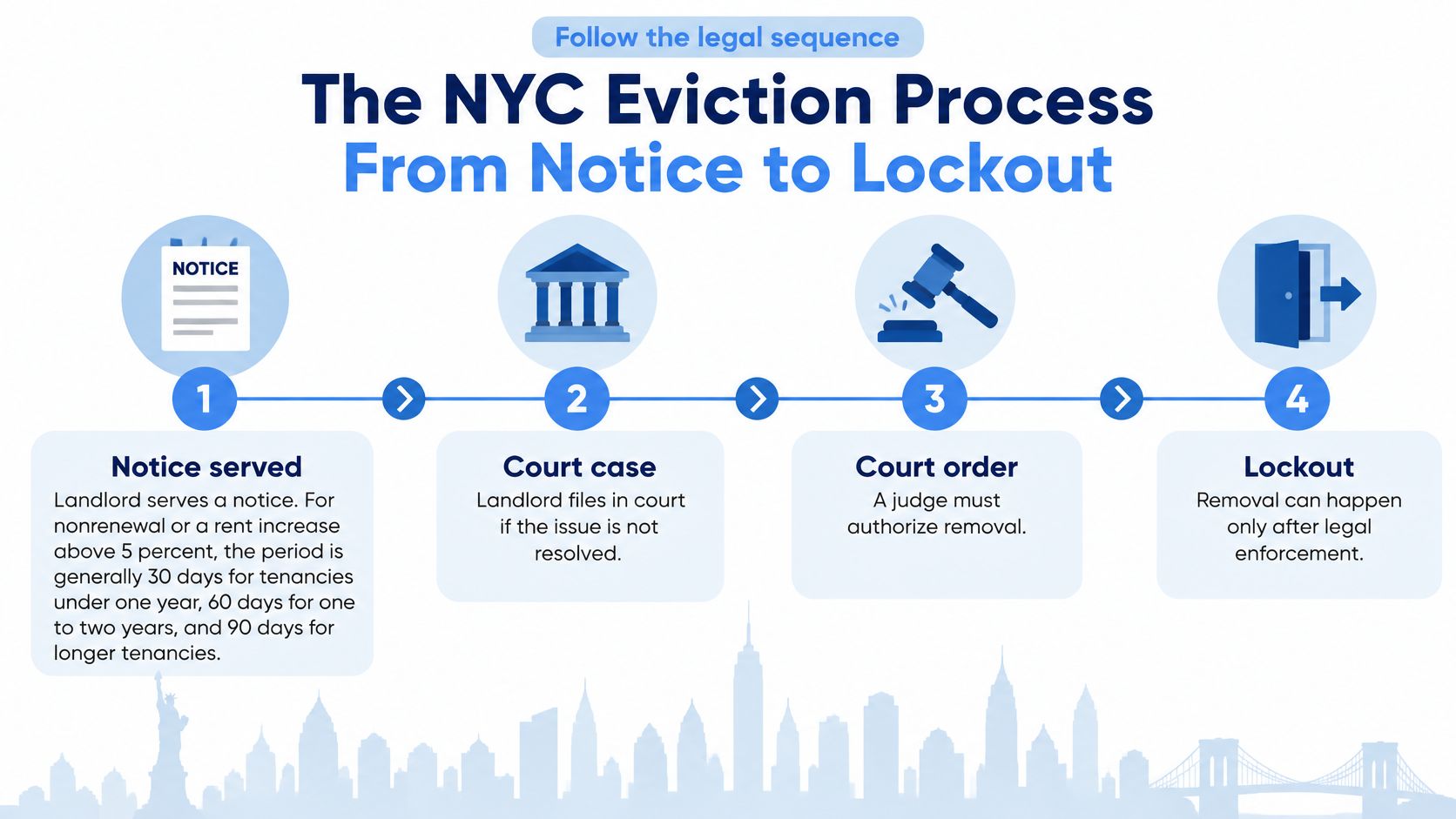
Follow the court sequence
- The landlord serves a predicate notice when required. The type of notice depends on the claim, so don't assume every demand starts the same response period.
- The landlord begins a Housing Court case. The petition and accompanying papers identify what the landlord is asking the court to do.
- The tenant answers or otherwise responds as required. Distinguish a nonpayment case from a holdover case, and confirm the response procedure with the court or counsel.
- The tenant raises applicable defenses. These may include payment, defective notice, improper service, or charges exceeding what the lease or rent regulation permits.
- The court resolves the case or enters judgment. A settlement can also impose significant obligations, so understand the terms before agreeing.
- An authorized officer executes any lawful eviction warrant. The landlord can't replace that process with a private lock change or removal of belongings.
Prepare for the appearance
Bring a chronological packet rather than an unsorted collection of screenshots. Put the petition first, followed by the notice, lease, payment evidence, and documents supporting each defense.
If you believe service was improper, explain the facts to counsel and the court. Don't assume that a service problem makes it safe to ignore the case.
A postponement request also isn't permission to miss an appearance. Confirm what the court has ordered and retain the updated date.
Before signing a settlement or surrender agreement, ask what happens if you miss a payment, whether you're agreeing to leave, and what enforcement the agreement permits. Request legal assistance if any term is unclear.
Preserve the envelope and every court paper, record service details, and attend every required appearance. If a lockout occurs outside lawful enforcement, seek urgent assistance rather than waiting for the landlord to explain it.
Free Legal Help and Where to Find It
In fiscal year 2021, 84% of tenants receiving city-funded counsel in eviction cases remained in their homes, while later testimony found that more than half of tenants served in 2023 and 2024 received only brief advice rather than full representation, according to the NYC Independent Budget Office's Right to Counsel testimony. These findings describe different service periods and populations, but together they show why renters should ask what assistance they'll receive.
Advice and representation aren't the same service. A brief consultation may help you understand a deadline or defense, but it doesn't necessarily mean a lawyer will prepare papers, negotiate, or appear with you.
Where to get free tenant help in NYC
| Resource | What it provides | How to reach it |
|---|---|---|
| Tenant Helpline | Information, enforcement assistance, mediation, and legal referrals | Dial 311 |
| Right to Counsel | Free representation in qualifying Housing Court nonpayment and holdover cases | Through the court or a city referral |
| Housing Court help centers | Guidance on court papers and procedures | In person at the courthouse |
| Legal services providers | Advice and representation for eligible tenants | Through a city referral |
Eligibility for free representation involves household circumstances, including income and household size. Ask the intake worker what documents are needed and how to submit them securely.
Make the intake call useful
- Identify the proceeding: Say whether you received a rent demand, nonrenewal, petition, or enforcement notice.
- Give the immediate date: Read the appearance or response information from the paper rather than relying on memory.
- Request the service explicitly: Ask whether the provider can offer full representation or only advice.
- Confirm responsibility: Find out whether anyone has agreed to file papers or appear for you.
Don't assume that leaving a voicemail pauses a court deadline. Continue following court instructions while pursuing a referral, and keep a record of whom you contacted.
Keep household preparation separate from legal triage. If you're organizing furnishings for a possible move, Meliusly's guide to sizing removable dining chair covers is a practical household resource, but those tasks shouldn't delay your response to court papers.
Seek help when the papers arrive, not when you're walking into the hearing. Early contact gives the provider a better opportunity to review the documents and identify urgent work.
First 72 Hours After a Notice or Court Papers
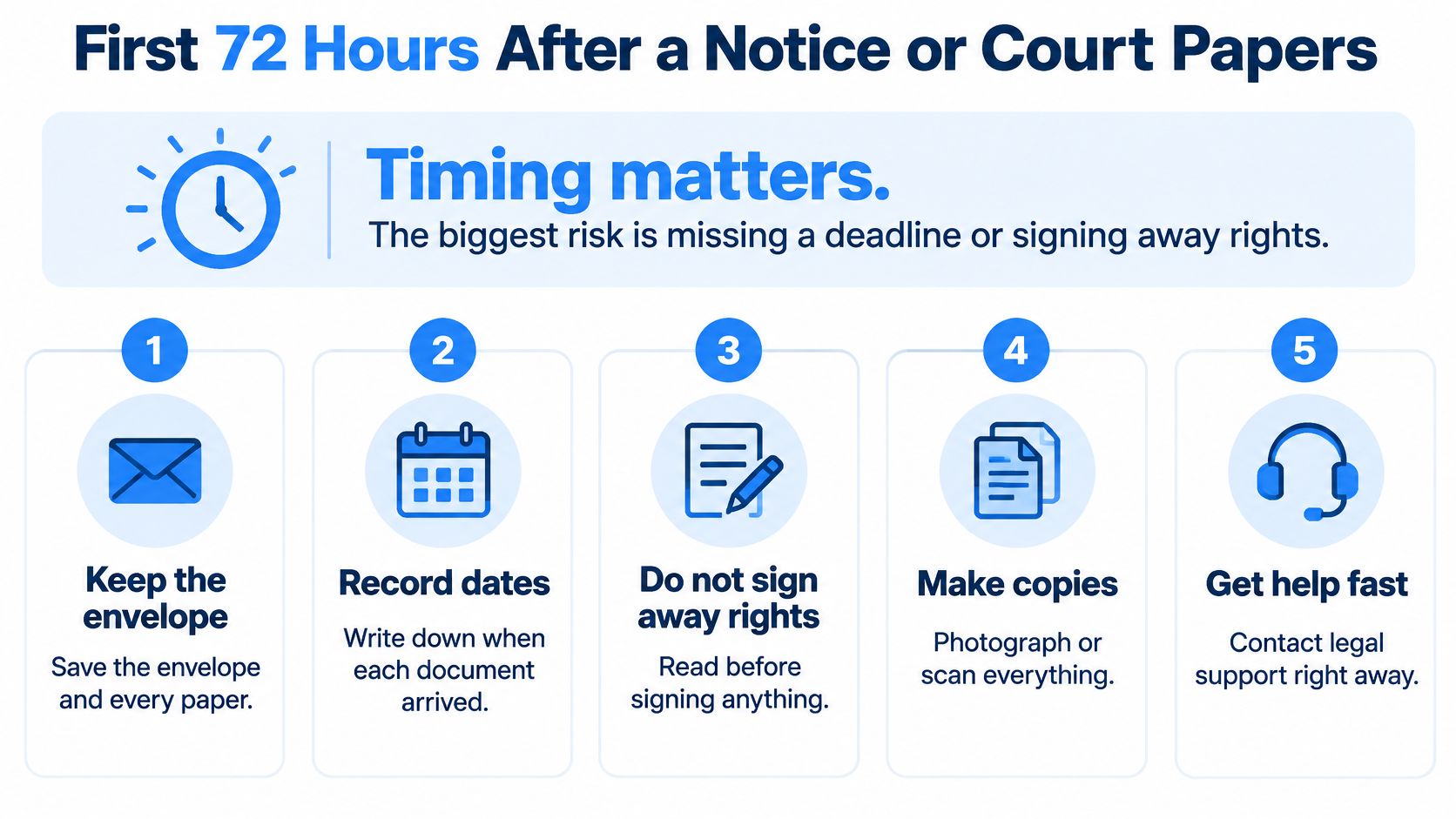
The immediate risk is missing a deadline or signing away rights. The city's tenant-protection guidance describes generally applicable 30-, 60-, or 90-day notice periods for nonrenewal or increases of more than 5%, depending on tenancy length and lease duration, and warns tenants to consult an attorney before accepting money to leave or signing an agreement.
Don't treat the time window in this heading as permission to wait. If a court date or enforcement notice is imminent, act immediately.
Use this checklist to preserve what a legal reviewer will need.
Choose the response that matches the document
- Rent demand: Check the claimed balance against your lease, ledger, and payment evidence. Confirm the applicable response date immediately, document any dispute, and get advice before withholding payment.
- Nonrenewal or rent-increase notice: Record the delivery details and ask a legal services provider to verify the required notice period and any renewal defense before the stated effective date.
- Housing Court petition: Identify the case type, follow the court's answer or appearance instructions, and request counsel immediately. Don't apply the nonpayment answer procedure automatically to a different proceeding.
- Lockout or removal of belongings: Seek urgent city assistance and legal advice immediately. Save messages, photographs, and evidence that you occupy the apartment.
Preserve evidence without making new commitments
Photograph or scan every page, including the back when it contains writing. Keep the original envelope and make a separate note describing when you found the papers, who delivered them if known, and whether anything was posted on the door.
Gather your signed lease, renewal documents, rent receipts, and relevant landlord messages. Don't edit screenshots in ways that remove dates or surrounding context.
Avoid signing a surrender agreement, accepting a buyout, or promising a move-out date before receiving advice. If someone pressures you to decide immediately, preserve the demand and tell the legal services provider about it.
Ask for language assistance if you need it, and don't rule yourself out of seeking help because of immigration status. Explain your immediate document and deadline first so the intake worker can assess urgency.
Finally, verify the apartment's status against the lease, rent history, and registration records without delaying a required court response. A lawyer should review the specific dispute, particularly when coverage, service, a settlement, or an asserted exemption is contested.
RentReboot offers apartment-search alerts, potential rent-stabilization information, and practical rental guides to help you evaluate a home beyond its asking price. Visit RentReboot to organize your search and learn which documents to verify before relying on a listing's promises.