
A useful 2 bedroom apartment Upper West Side budget starts with a limit, not a listing. Without a current, verifiable neighborhood rent distribution, a citywide figure or a single asking price can't reliably tell you what this apartment should cost. Treat the search as a choice among price bands and pockets, then check the live asking-rent distribution before setting a dollar ceiling.
The key distinction is between asking rent and the rent you ultimately pay. An advertised price doesn't include every possible fee, and a rent-stabilized label describes a regulatory status, not necessarily a discount. Set a ceiling you can sustain, then assess each apartment against its location, condition, and lease terms.
Table of Contents
- What an Upper West Side Two-Bedroom Search Covers
- Percentile Rents for Upper West Side Two-Bedrooms
- Four Upper West Side Pockets Compared
- Rent Stabilization Checks for a Two-Bedroom
- Recent Listing Trends That Change the Search
- Sample Search Criteria for This Exact Apartment
- Related Lookups Worth Opening Next
- Save Alerts for This Exact Two-Bedroom Search
What an Upper West Side Two-Bedroom Search Covers
For this search, the Upper West Side runs from West 59th Street to West 110th Street, between Central Park West and Riverside Drive. That span includes Lincoln Square, the Seventies and Eighties, the Nineties, and Manhattan Valley. A single neighborhood name therefore covers several kinds of housing and several different tradeoffs.
The search often fits couples who need a separate office or guest room, roommates dividing costs, and small families who need a second bedroom. But a listing with a second room isn't automatically a true two-bedroom: check that the room has a door and works for its intended use.
A median is the midpoint of a group of asking rents. Half of the listed rents in that group are higher and half are lower. It can help set a budget, but it doesn't predict the rent for a particular apartment, and one listing can't establish a neighborhood's typical price.
Define the boundary before comparing listings
Keep the map consistent when you compare apartments. A listing just outside your chosen boundary may look like a neighborhood match in a search tool but belong to a different local market. Decide whether your search includes every block in the stated area or prioritizes particular streets, subway access, or proximity to a park.
Room layout matters alongside location. If you're planning furniture for a compact second bedroom, compare modular setups for compact ranches for ideas on flexible arrangements. A layout that works well on paper still needs enough clear space for the furniture you use.
Set a ceiling before opening the map
Start with three decisions: the highest rent your household can carry, which features are essential, and which pocket you'd accept as a fallback. Then consult a current neighborhood rent distribution to check whether your ceiling is plausible. The useful lookup order is to set a percentile budget, compare pockets, define search filters, decide how quickly you can respond, and determine whether rent stabilization matters to you. Choose your ceiling before opening a map, so a striking listing doesn't reset your budget.
Percentile Rents for Upper West Side Two-Bedrooms
A percentile is more useful than one average when listings differ in building type, block, and amenities. Read the neighborhood page for newly listed two-bedrooms and use its distribution to set a working range. A median of new asking rents describes the midpoint of advertised rents in the selected group, not the final lease price.
| Percentile | What the new asks usually are | How to use it |
|---|---|---|
| 25th | Lower quarter: walk-ups, inconvenient blocks, or Manhattan Valley | Stretch the floor only if the tradeoff is acceptable |
| 50th | Median new asking rent; half of new two-bedrooms ask more | Use as the default working budget |
| 75th | Upper-middle: elevator, doorman, or a park-adjacent block | Use as a hard stop for most households |
Turn the distribution into three budget numbers
Copy the current 25th, 50th, and 75th percentile values for Upper West Side two-bedrooms. Use the 25th percentile as a search floor, the 50th as the working budget, and the 75th as a hard ceiling. These are planning boundaries, not promises that an apartment at a given percentile will have a particular feature.
The lower band may include a walk-up, a less convenient block, or an apartment farther from the park. That can be a sound choice if the stairs and location work for your household. A low asking rent alone doesn't establish that a listing is a bargain.
The upper-middle band is where an elevator, doorman, or park-adjacent location may become more common. Those features can justify paying more for some households, but they don't make a higher rent affordable by themselves. Keep the ceiling tied to your budget, not to a building's marketing.
Check the sample and the lease cost
A thin set of listings can make a percentile unstable: one unusual apartment can shift the apparent position of the band. Check whether the current page has enough recent examples to support a useful comparison. If it doesn't, widen your time frame cautiously or compare a nearby pocket rather than treating one value as decisive.
Asking rent also isn't the full cost of moving in. Compare any stated broker fee and other charges separately, and ask what rent would appear in the lease. Use the neighborhood distribution to decide which listings merit attention, then check the specific lease terms before committing.
Four Upper West Side Pockets Compared
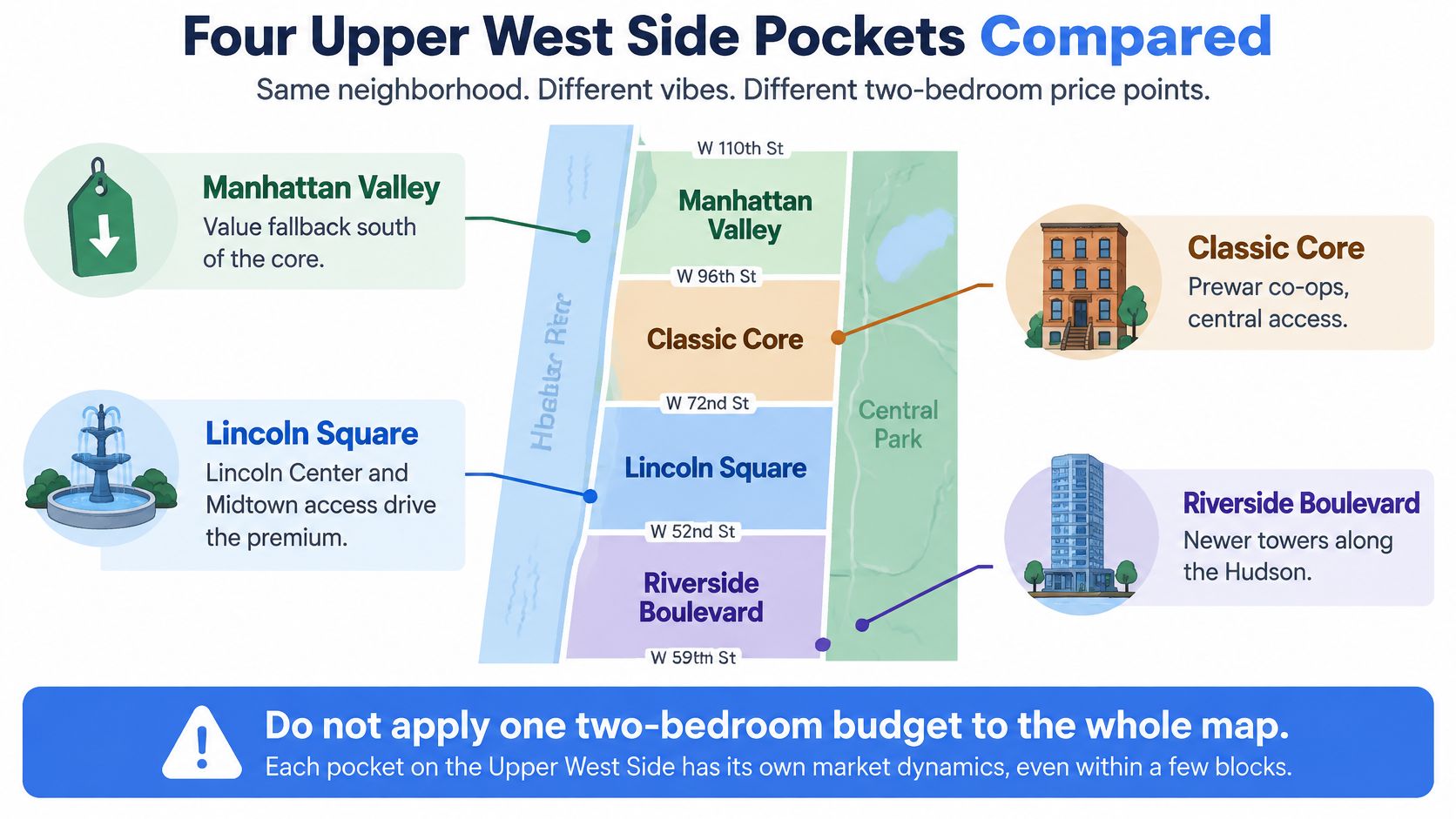
A two-bedroom budget shouldn't be applied to the entire Upper West Side as if every block offered the same housing. Lincoln Square has a strong location and more full-service towers, while Manhattan Valley is often the first fallback for renters prioritizing price. Between them, the classic core and the upper Nineties offer distinct mixes of building stock and access.
| Streets | Transit hinge | Housing stock | Rent position | |
|---|---|---|---|---|
| Lincoln Square | West 59th to West 66th | Columbus Circle and 66th Street | Postwar towers, including Lincoln Towers | Highest of the four |
| Classic core | West 67th to West 86th | 72nd and 86th Street stations | Brownstones and prewar elevator buildings | Park blocks above the median |
| Upper 80s and 90s | West 86th to West 96th | 96th Street 1/2/3 and B/C | Residential side streets and some full-service buildings | Near the median off the park |
| Manhattan Valley | West 97th to West 110th | Cathedral Parkway and 103rd Street | More walk-ups, fewer full-service buildings | Often the value pocket |
Compare what the location buys
Lincoln Square's draw is access to Lincoln Center, Midtown connections, and full-service buildings, including large complexes such as Lincoln Towers. The tradeoff is its position at the expensive end of this comparison. Choose it when commute and amenities carry real value for your household, not because a listing looks polished.
The classic core mixes brownstones with prewar elevator buildings. Park blocks and frontage near West End or Riverside can cost more than mid-block walk-ups near Amsterdam or Columbus. It offers central access and varied housing, but you may need to choose between a quieter or park-adjacent block and a lower asking rent.
The upper Eighties and Nineties are more residential in feel. The 96th Street stations act as a transit hinge, and side streets away from the park can be closer to the neighborhood midpoint. This is a useful compromise for renters who want a calmer setting but shouldn't assume that every building has a doorman or elevator.
Manhattan Valley is often the first place to look when the broader Upper West Side budget doesn't work. More walk-ups and fewer full-service buildings can mean a lower price position, with stairs as a practical cost. For another way to compare neighborhood priorities, see this guide to sought-after New York City neighborhoods.
Pick one primary pocket and one fallback before you set filters. That keeps a search focused without forcing you to treat every Upper West Side block as equivalent.
Rent Stabilization Checks for a Two-Bedroom
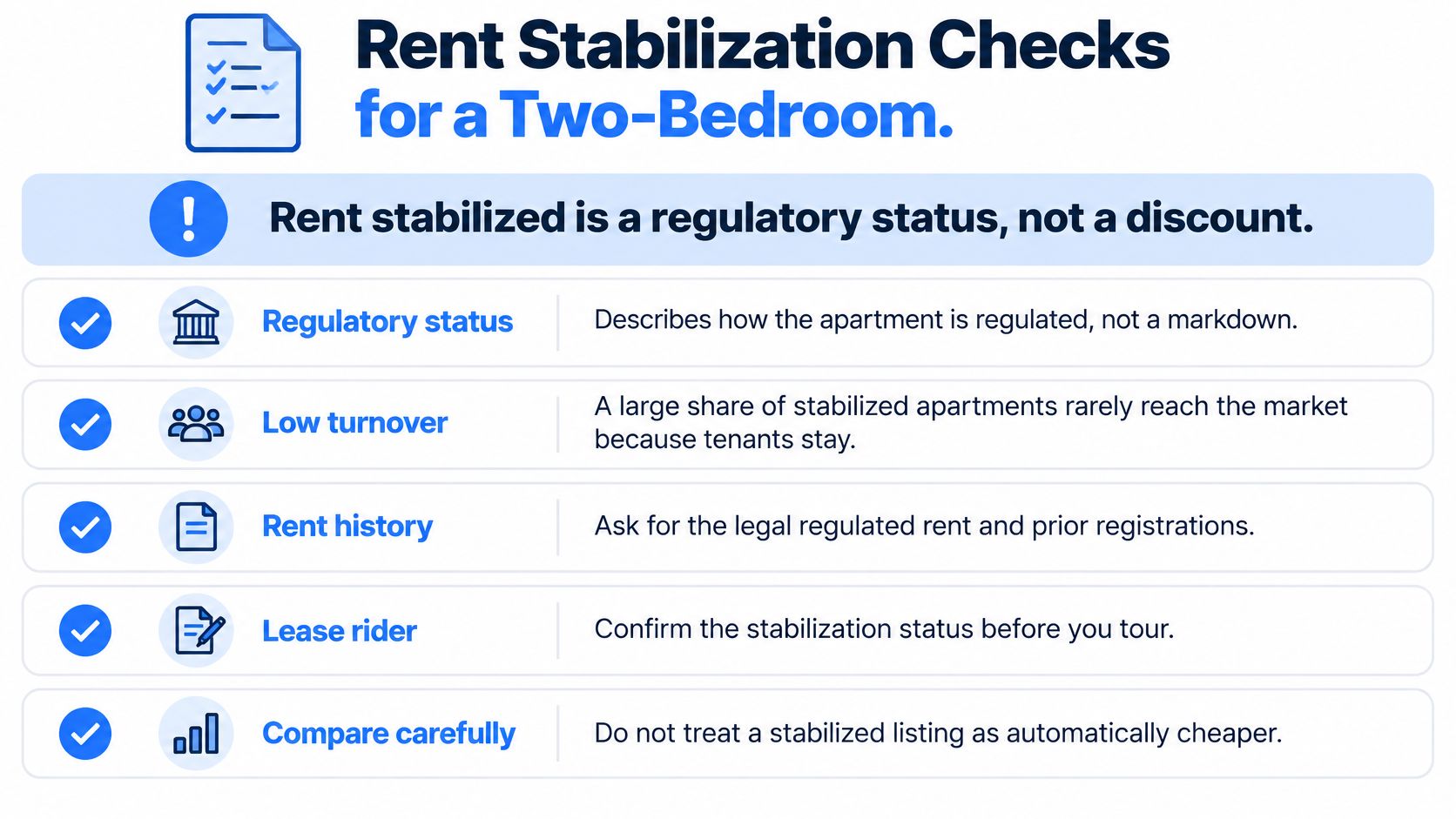
Rent stabilized describes a regulatory status, not a discount. A regulated apartment may be advertised at a rent that doesn't suit your budget. The label alone doesn't tell you whether the asking rent is below comparable local listings or whether the apartment will fit your household.
Turnover can also make the advertised group unrepresentative. In RentReboot's data, the median apartment holds a tenant a little over two years, and many regulated tenancies last much longer. As a result, the stabilized apartments that reach the market are a limited slice of regulated housing, not a reliable sample of all stabilized apartments.
A stabilization status can still matter over the life of a tenancy because renewal increases follow a regulated framework rather than a full market reset. On a lease, distinguish the legal regulated rent from any preferential rent being charged. Read the lease rider carefully; don't assume that a listing description answers questions about the rent or future renewals.
Use four checks before treating it as a bargain
| Check | Pass looks like | If it fails |
|---|---|---|
| Wording | The listing explicitly says rent stabilized | Treat it as market rate |
| Building record | The address appears in city stabilization records | Don't rely on the ad |
| Price versus median | The ask is at or below the neighborhood 50th percentile | Status without a discount |
| Second bedroom | A legal room with a door, not a flex partition | It isn't the apartment in this search |
A listing that claims stabilization and asks near the upper-middle of the local market isn't automatically a bargain. Check the advertised rent against the neighborhood median and verify the building record. For more context on the distinction between status and price, use this guide to rent-stabilized apartments in Manhattan.
Decide whether stabilization is a requirement or a tie-breaker. If it's a requirement, don't relax the verification checks to keep a promising listing in consideration. If it's a tie-breaker, compare the apartment on price, layout, and location first.
Recent Listing Trends That Change the Search
Price and listing behavior are separate questions. More new ads can give you more options without making the asking rents more affordable. Use percentiles to decide what you can pay, then treat listing freshness as a separate part of your search routine.
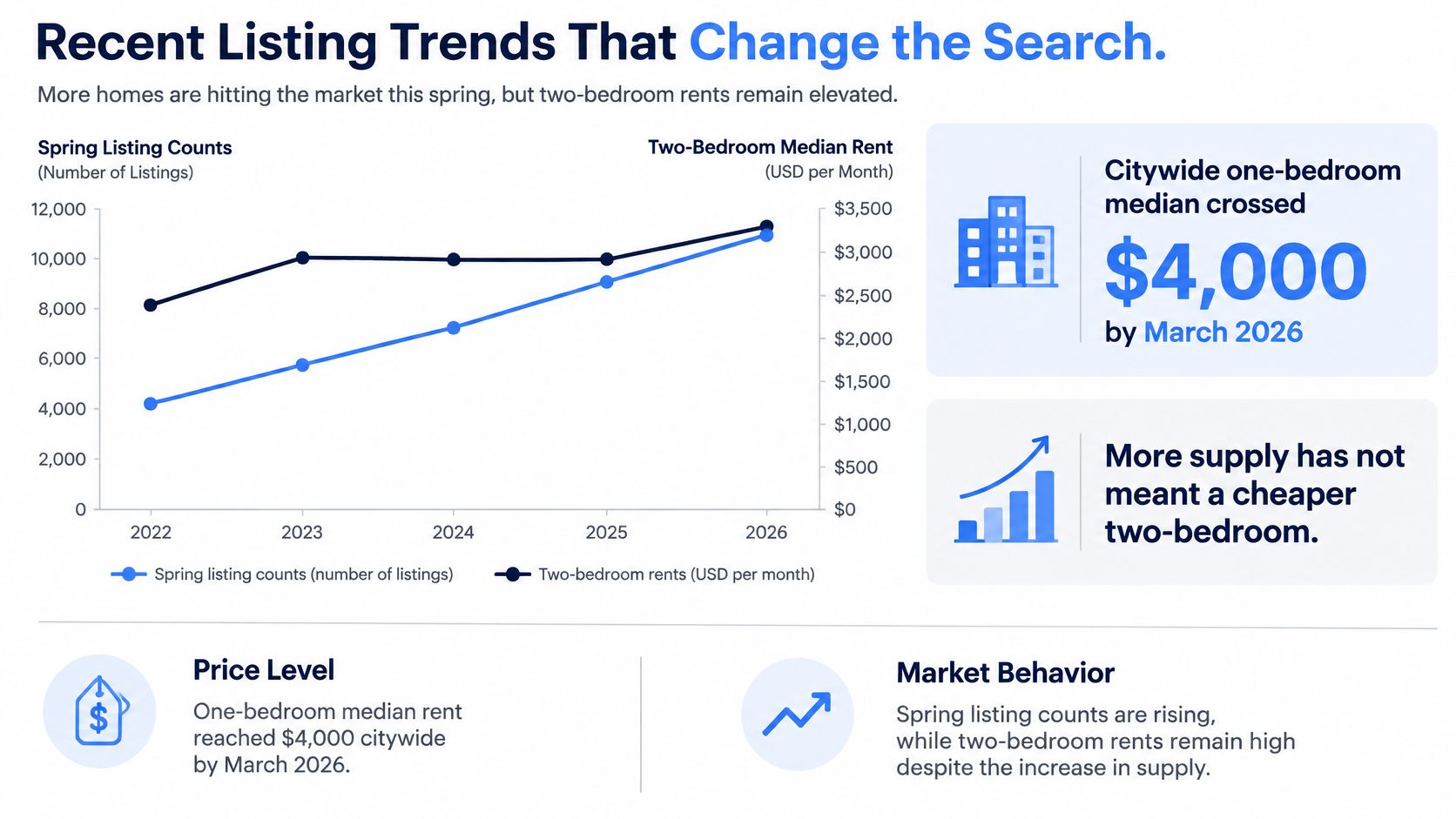
RentReboot's summer 2026 coverage study matched 50,130 New York City apartments across 20 rental platforms by building address and unit. In that study, 51.3% of apartments appeared on exactly one tracked platform. That finding means a renter checking only one site may miss listings, while a repost on several sites can still represent just one apartment.
Judge the first-seen date
A refreshed repost can look new even when the apartment has been advertised before. Compare the first-seen date when that information is available. A stale listing with an unusually low price merits extra verification: it may be outdated, already rented, or otherwise inaccurate rather than a genuine opportunity.
No single platform is first for every apartment. StreetEasy is a substantial source, but brokerage sites, building websites, and smaller marketplaces can have listings that don't appear elsewhere. RentReboot matches listings by normalized building address and unit, which helps treat copies of the same apartment as one home rather than several separate opportunities.
A useful two-bedroom may become hard to schedule quickly, particularly when its asking rent sits below the local median. Don't assume that a weekend open house will still be available. Contact the listing the same day you first see it if it meets your budget and requirements, and verify availability before making plans.
Sample Search Criteria for This Exact Apartment
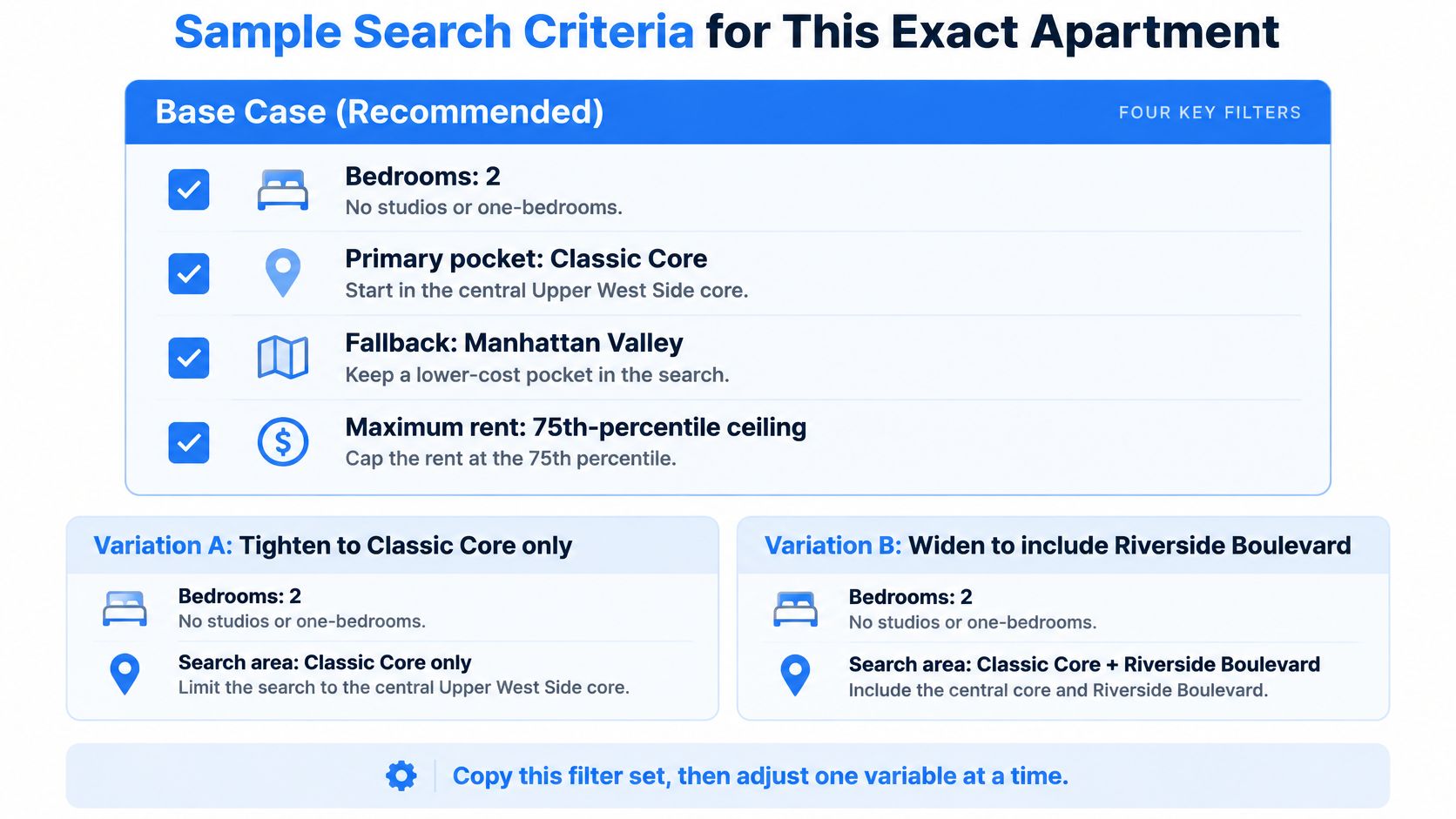
Use one base filter set and change one variable at a time. The example below starts in the classic core, keeps Manhattan Valley as a fallback, and uses the current 75th percentile as a ceiling. Copy the percentile value from a live neighborhood distribution rather than entering an unverified number.
Set the base search
- Bedrooms: Set the search to exactly two. Exclude studios and one-bedrooms so they don't muddy the results.
- Primary pocket: Start with the classic core. Keep Manhattan Valley as the fallback rather than combining every nearby neighborhood into one map.
- Rent range: Use the current 25th percentile as a review floor and the 75th percentile as the maximum. A listing far below the floor deserves a closer look, not automatic enthusiasm.
- Availability: Require a stated move-in date that fits your household's plans. A date within the next 45 days is a practical starting filter if you're ready to move soon.
- Layout and size: Look for a second bedroom with a door and enough usable space for two adults' needs. When size is listed, about 750 square feet can be a useful screening preference, not a substitute for checking the floor plan.
- Amenities: Mark laundry and an elevator as preferences unless either is essential. Keep pets, a dishwasher, and outdoor space optional when possible, so a long list of nice-to-haves doesn't exclude otherwise suitable homes.
A household choosing furniture for a smaller rental can also use these small-apartment ideas for Morris County renters to think through what can fit before treating a minimum size as absolute.
Change only the priority that matters
Variation A narrows the search to Lincoln Square and removes the fallback if commute time matters more than rent position. Keep the same ceiling: changing the pocket doesn't make an apartment affordable.
Variation B widens the map to include Riverside Boulevard if newer riverfront buildings are a priority. Treat that as a location change, not a reason to raise the budget.
Listings can appear on multiple sites, so count homes rather than posts. RentReboot matches listings to a canonical apartment primarily by normalized building address and unit. Save the five decision fields: size, pockets, ceiling, date window, and must-haves.
Related Lookups Worth Opening Next
If the two-bedroom median is outside your budget, compare a one-bedroom in the same pocket before chasing an unusually cheap two-bedroom listing. Looking at both bedroom types on the same neighborhood page keeps the location consistent and shows what changing the bedroom count might buy.
Building age is another useful fork. RentReboot has published a report comparing asking rents in prewar and newer buildings within the same ZIP code. That comparison matters on the Upper West Side because a prewar layout may offer a dining room or a larger second bedroom while giving up features such as central air or an elevator.
A regulated lottery apartment is a different search from an open-market rental. Housing Connect uses its own process and deadlines; a standard listing-site filter won't turn an open-market search into a lottery search. Decide whether you want an available rental or are willing to pursue a separate pipeline.
Separate rent from upfront costs
If fees affect your budget, compare broker-fee and no-fee listings as separate options. Add the upfront charge to the first-year cost rather than comparing advertised rent alone. A higher no-fee asking rent may cost less in the first year than a lower ask with a large fee.
For a different part of the city, open that area's own rent page instead of carrying an Upper West Side assumption into another neighborhood. RentReboot's average-rent pages cover more than 150 New York City areas. Once you've checked the relevant alternatives, make one decision: stay with the two-bedroom search, drop a bedroom, or switch to a different pipeline.
Save Alerts for This Exact Two-Bedroom Search
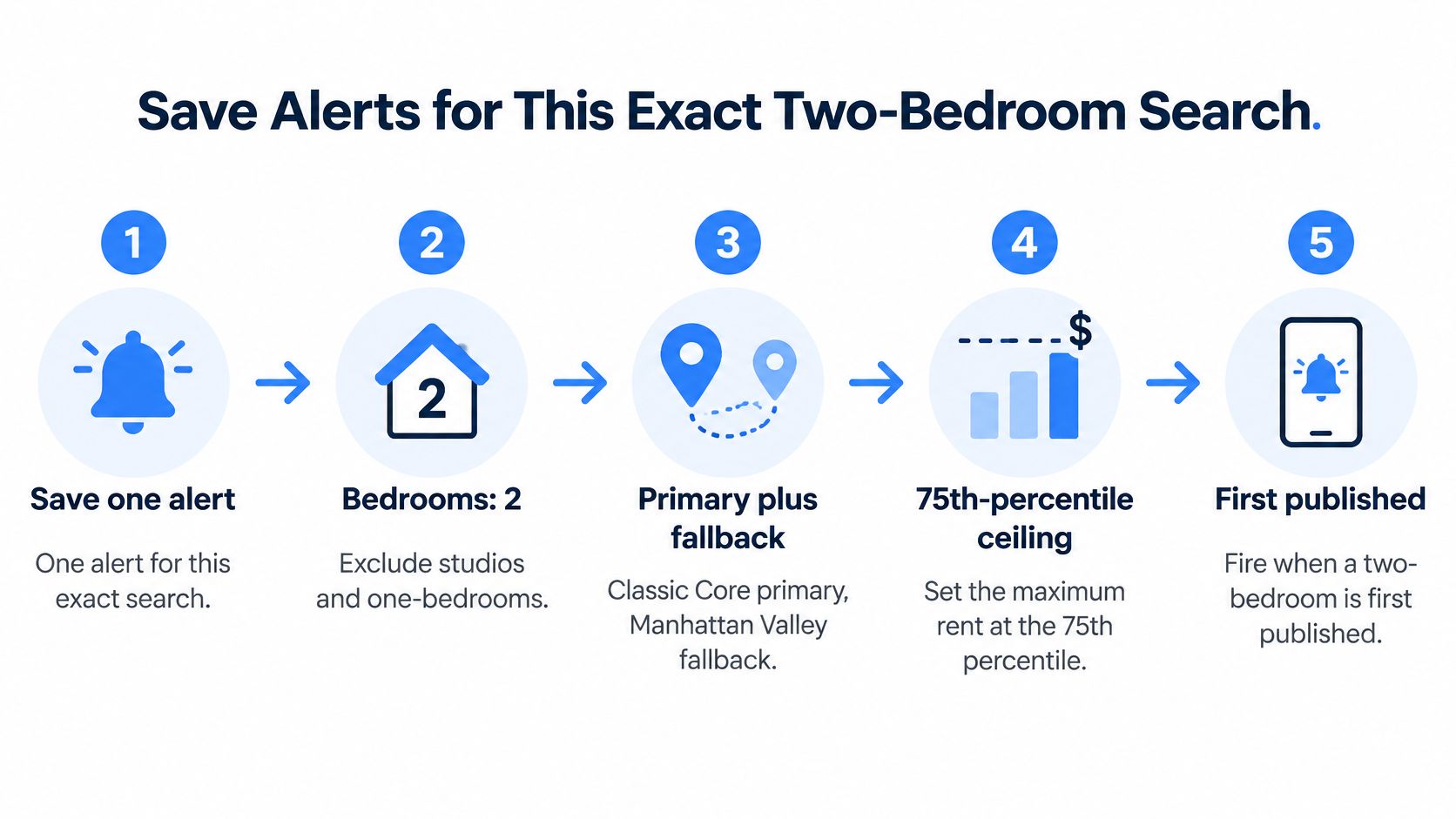
Turn the filters you've chosen into one alert that checks for new matches. RentReboot lets users customize alerts by neighborhood, price range, and apartment size, and provides real-time alerts for rent-stabilized and market-rate listings. The aim is to see a qualifying apartment when it first appears, not to keep reopening the same searches by hand.
Set and run the alert
- Save one alert. Include the bedroom count, chosen pocket, fallback, rent ceiling, move window, and must-haves.
- Choose first-seen notifications. Use email or SMS if you can respond promptly. A nightly digest may arrive after the best viewing times have passed.
- Keep stabilization optional unless it's essential. Don't raise your ceiling just to see a stabilized label. RentReboot checks potential stabilized listings against city records before they reach renters.
- Limit price-drop notices to plausible matches. Watch for changes that bring an apartment into your budget; a small reduction that leaves it unaffordable doesn't change the decision.
- Review the first results. Open each match, remove any filter that returns no suitable homes, and count one apartment once even if it appears across several platforms.
For readers who want to compare alert options, the NYC apartment alerts guide explains the available approach. If you're also planning a low-light room after the move, these low-light plant ideas for renters can help you choose plants suited to the space.
Your stopping rule is simple: the alert is working when a qualifying two-bedroom reaches you in time to contact the listing on the day it first appears. Use the current neighborhood rent distribution to set the ceiling, and keep stabilization as a requirement only if the verification and price checks both matter to your decision.
RentReboot monitors rental platforms, matches apartments to saved search criteria, and sends email or SMS alerts when relevant listings appear. For an Upper West Side two-bedroom search, use its neighborhood-level rent distributions to set a budget and visit RentReboot to explore apartment alerts.