
Nearly a million New York City apartments sit under rent stabilization, and the label in a listing is the part of that system nobody has to prove. A landlord can type the words into an ad, a broker can repeat them, and a renter can sign without ever seeing the record that decides the question. The status of an apartment lives in building records, registration filings, and a lease rider that puts two different rent figures in front of you. What follows builds the picture in the order a renter meets it: who is covered, how to verify it, what a renewal offer must contain, how far the rent can rise, and where a dispute goes.
Table of Contents
- Which Apartments Are Rent Stabilized in NYC
- Verify Status and Confirm in Writing Before You Sign
- What Your Renewal Offer Must Include
- How Much a Stabilized Rent Can Go Up
- Preferential Rent Versus Legal Regulated Rent
- How to Challenge an Overcharge or Unlawful Increase
Which Apartments Are Rent Stabilized in NYC
The 2023 NYC Housing and Vacancy Survey counted approximately 960,600 rent-stabilized apartments, compared with about 24,020 rent-controlled apartments, according to the NYC Rent Guidelines Board's rent-control FAQ. Rent stabilization therefore covers many more apartments than rent control. In either system, eligibility depends on the apartment's regulatory history, not on its asking rent.
Building age and size can offer clues, but they do not settle whether a particular apartment is stabilized. Tax benefits and a building's regulatory history can also matter. The NYC Rent Guidelines Board and New York State Homes and Community Renewal explain the rules and maintain information renters can use to investigate a building.
| Building situation | Stabilization status | What to check first |
|---|---|---|
| Building that may qualify based on its age and number of units | May be covered | Construction and regulatory history |
| Older building with a potentially covered apartment | May be covered | Apartment and building history |
| Building receiving a qualifying tax benefit | May be covered while the program applies | Tax benefit and regulatory record |
| Building that does not appear to fit these categories | Status still needs confirmation | Official rent-regulation record |
What a stabilized label in a listing actually tells you
A listing's label is a lead to investigate, not a legal finding. Two apartments in the same building can have different regulatory histories, so a building-level match does not prove that a specific unit is stabilized. The official record for the apartment is what matters.
For a renter, stabilization can mean the right to a renewal lease and rent adjustments set under applicable rules. The asking rent alone cannot tell you whether those protections apply. Before making plans around a listing, treat its status like a clue on a map: useful for choosing where to look, but not proof that you have reached the right address.
If you are moving from Boston, the 2026 Boston to New York timeline can help you plan the timing of your move. Keep the apartment's status question separate from the moving calendar.
Verify Status and Confirm in Writing Before You Sign
A listing's stabilized label is a lead, not a legal answer. The only thing it proves is that someone was willing to type it. What settles the question is a short paper trail that starts with the building record and ends with a line from the landlord, in writing, before you pay an application fee.
The sequence below is the whole workflow. It takes about half an hour once you have the address.
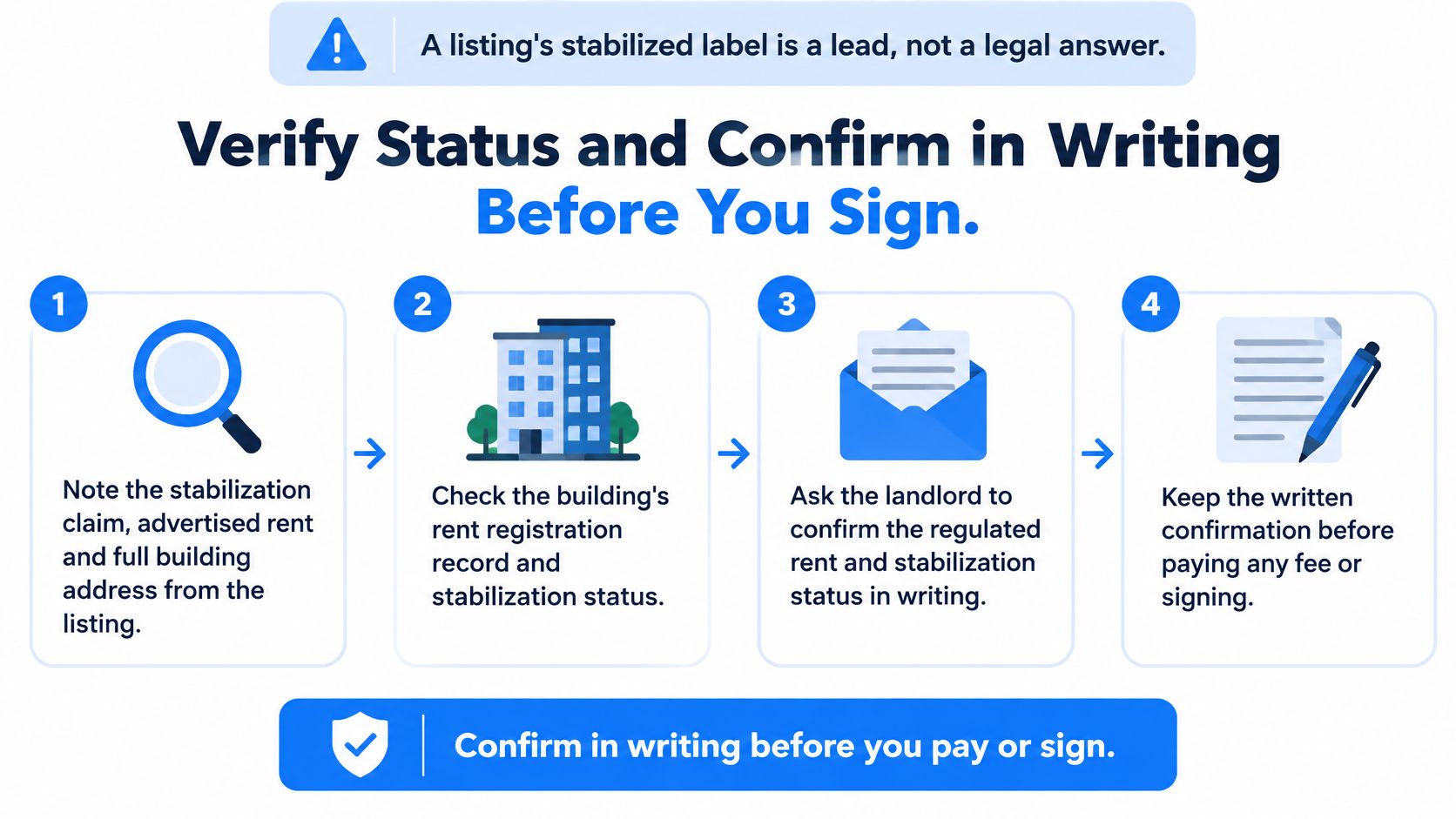
- Write down the claim, the rent and the address. Capture the advertised rent, the full building address rather than just a neighborhood, and the exact words the listing uses about stabilization. Screenshot it with the date visible, because listings get edited and deleted.
- Pull the building record. NYC directs renters with unclear leases or uncertain status to New York State Homes and Community Renewal, which runs a rent-regulated building search and a registration dashboard showing registration history, occupancy status and median legal rents (NYC Mayor's Office of Special Enforcement). An address search over those same city records, like our free rent-stabilized buildings map, narrows a shortlist in a couple of minutes without an account.
- Request the apartment's rent history from HCR when the lease terms don't match what the listing promised. The history shows the rents registered for that unit over time, which is the closest thing to a paper trail the building has.
- Compare the numbers. Put the advertised rent, the lease rent, the legal regulated rent and any preferential rent side by side. If the lease names only one figure, ask which one it is and where the other appears.
- Ask for written confirmation. A short email from the landlord or agent stating the stabilization status and the registered rent is worth more than any verbal assurance at a viewing.
- Call 311 and ask for the Tenant Helpline if the status stays unclear after the records check. A person on the phone can tell you which agency takes the next step.
- Save everything before you sign. Registration printouts, emails, the listing screenshot and the renewal dates all belong in one folder you can find again in a year.
The mistake that costs the most
Renters accept the label when the registration record and the lease disagree. That is the wrong move, because an unregistered or incomplete record does not resolve your legal position. It leaves a gap, and gaps get argued about later, when you're the one holding a signed two-year lease.
An incomplete record isn't proof you're unregulated. It's proof the paperwork has a hole, and you should know where the hole is before you commit.
We identify likely rent-stabilized units from available data and indicators, and a building-record match is useful evidence to investigate, not proof that a specific apartment is legally rent-stabilized. Confirmation comes from the landlord or agent in writing. That's why every alert we send carries a stabilization check against city records alongside the listing, and still tells you to verify before you sign.
Sign only when four things are in hand: the building match, the registration summary, a lease rider stating both the legal regulated rent and any preferential rent, and the landlord's written confirmation of status. Log the renewal notice dates on your calendar the same day.
What Your Renewal Offer Must Include
Say your lease expires June 30. Your renewal offer has to reach you by mail or in person no more than 150 days and no less than 90 days before that date, which puts the delivery window between January 31 and April 1 for that lease (New York Attorney General's residential tenants' rights guide). The deadline matters because it's the difference between a landlord-controlled turnover and a renewal you're entitled to.
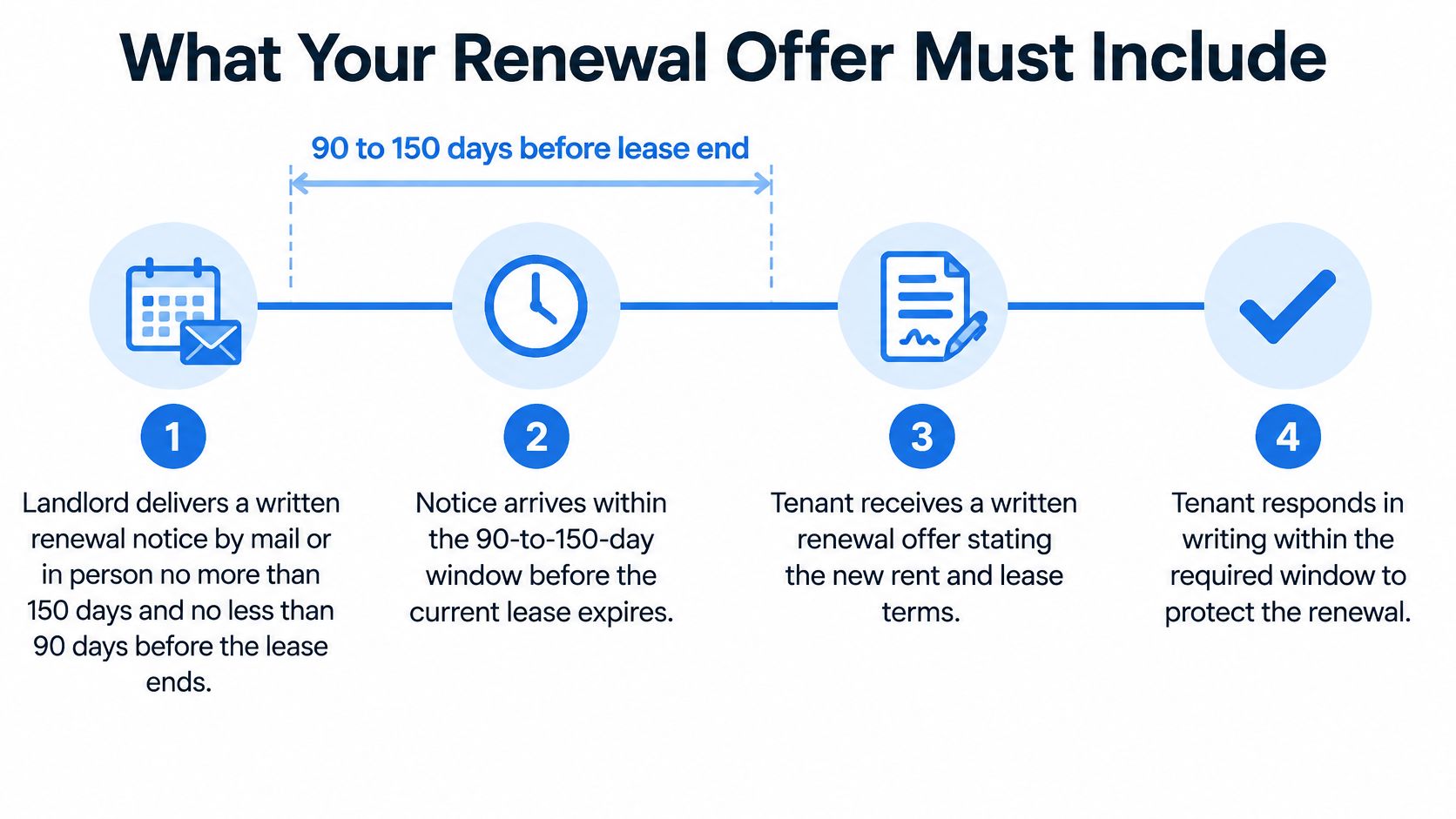
The offer itself has a shape. You choose a one-year or two-year renewal term, and the new lease keeps the same terms and conditions as the expiring one unless a specific law or regulation authorizes a change. Once the offer is in your hands, you generally have 60 days to accept.
What to keep, and why each item matters
- The envelope and delivery record. They prove when the notice arrived, which is how you show the statutory window was or wasn't met.
- The renewal form. It states the proposed rent and term, and it's the document you compare against the guideline for your lease period.
- The expiring lease. It's the baseline for the "same terms and conditions" rule, including services the owner has to keep providing.
- Payment history. Receipts and bank records show what you paid, which matters if a dispute later turns on the base rent.
If the landlord misses the notice window, request the renewal in writing and don't sign a market-rate lease or a surrender agreement before you've checked the apartment's regulatory status. The renewal right isn't immunity from eviction, since eviction can still happen on grounds the law allows. It does mean an owner can't refuse renewal because you declined an unauthorized change or because someone else would pay more.
Before you sign the renewal, work through what to look for in a rent-stabilized lease line by line. Then do the one habit that protects the whole thing: the day the offer arrives, put the 60-day acceptance deadline on your calendar with a reminder a week earlier.
How Much a Stabilized Rent Can Go Up
At renewal, the owner of a rent-stabilized apartment can't reset the rent to whatever the market will bear. The increase has to land inside the percentage the Rent Guidelines Board adopted for the period in which your new lease begins (NYC rent increase guide). Two lease-start windows govern renewals now.
| Lease start period | One-year lease increase | Two-year lease increase |
|---|---|---|
| Oct 1, 2025 to Sep 30, 2026 | 3% | 4.5% |
| Oct 1, 2026 to Sep 30, 2027 | 0% | 0% |
Reading the table takes three steps. Find the date your new lease starts, match it to the window, then compare the percentage in your renewal offer with the figure in the row. The term matters, so a one-year renewal and a two-year renewal on the same apartment produce different allowed increases.
A worked example
Say your one-year renewal begins November 1, 2025, and the offer asks for 7%. November falls inside the first window, where the one-year guideline is 3%. The proposed increase runs four percentage points above the allowed figure, so the question to put to the landlord in writing is narrow: what is the legal basis for the extra four points?
Now move the same lease two years later. A one-year renewal starting October 15, 2026 falls in the second window, where the board adopted a 0% increase for both terms, so any increase has to rest on something outside the guideline schedule. Two identical apartments, two very different answers, and the only thing that changed is the start date on the lease.
Write down two numbers before you answer any renewal offer: the date your new lease starts and the percentage the offer proposes. Those two figures tell you which guideline applies and whether the proposal fits inside it.
If the arithmetic gets tangled, this explanation of how the annual RGB increases apply sorts the schedule by lease term and start date. The percentage attaches to the rent your lease sets, which is a smaller number than most renters assume.
Preferential Rent Versus Legal Regulated Rent
A listing can print one rent while the lease carries two. In a stabilized apartment, the amount you pay and the amount the apartment may legally command are often different figures. Renewal disputes usually start in that gap.
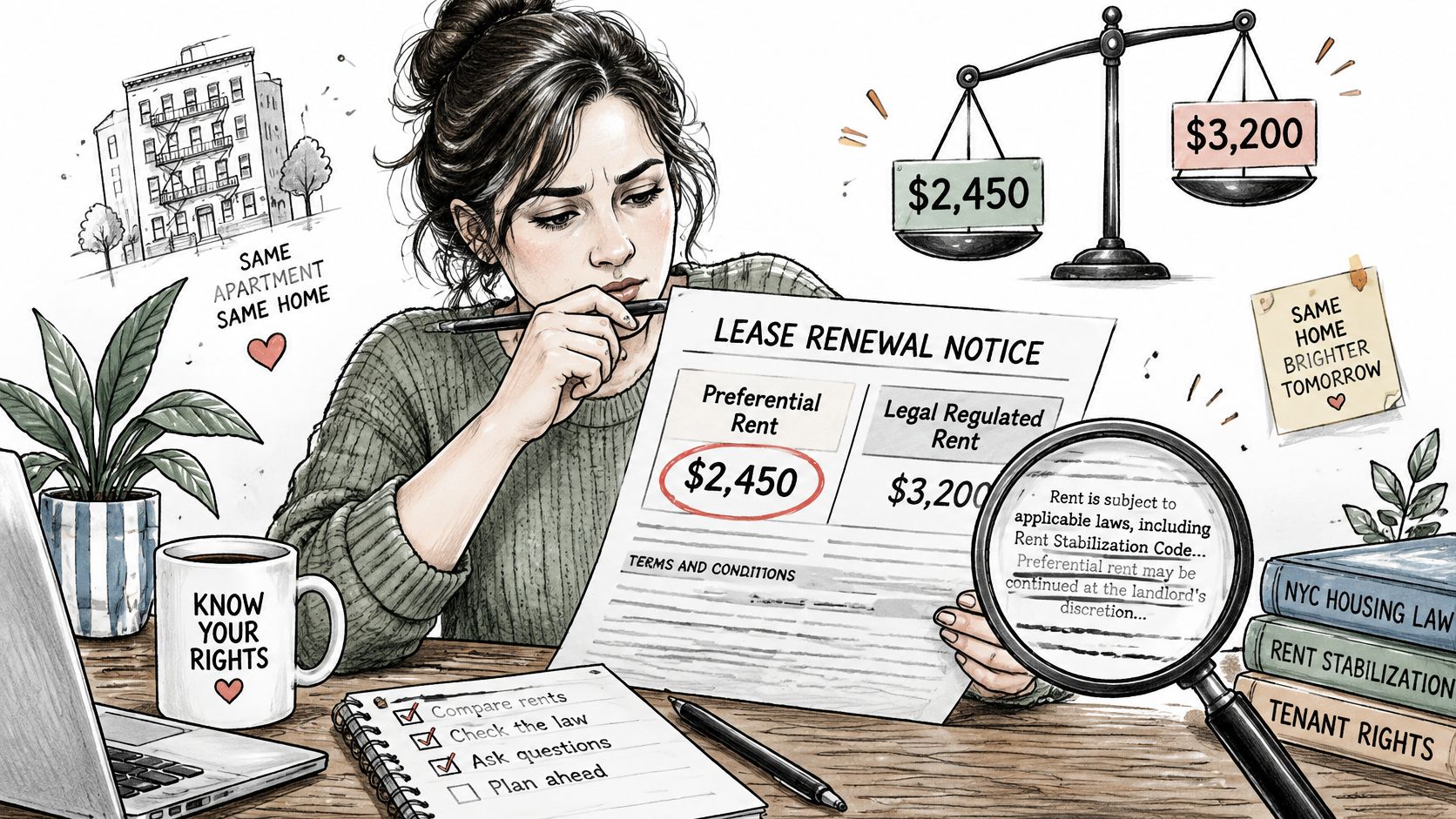
Preferential rent works like a written discount under a ceiling. You pay less than the maximum the law allows. Legal regulated rent is that ceiling, the lawful maximum base. Both numbers can appear on the same lease rider, and that rider is the page to read before you sign.
| Rent figure | What it means | Example | How it affects renewal |
|---|---|---|---|
| Advertised rent | Price shown in the listing | $2,100 in the example | Not proof of the lawful renewal rent |
| Lease rent | Amount written in the signed lease | $2,100 in the example | Must match the rider and renewal leases |
| Preferential rent | Rent below the legal regulated rent | $2,100 in the example | Base for guideline increases while the tenant stays |
| Legal regulated rent | Lawful maximum base rent | $2,800 in the example | Charged only after the tenant permanently vacates, if properly stated |
Walk the same apartment across those four rows. The ad, the signed lease, and the preferential rent all say $2,100. The legal regulated rent on the rider says $2,800. While you occupy the apartment, guideline increases and other permitted increases are generally calculated from the $2,100 figure, not from $2,800 (New York State Homes and Community Renewal). The owner may generally end the preferential rent and charge the higher legal regulated rent only after you permanently vacate, and only if that legal rent was written into the vacancy lease or the renewal lease and into the renewal leases that followed.
A "stabilized" label on a listing is a lead, not the number the lease sets. Line the four figures up before you sign: the advertised rent, the lease rent, the preferential rent, and the legal regulated rent. If the first three match and the fourth is higher, the lower figure is what you pay while you stay. Ask for the rider that names both rents, and keep every renewal lease in the same folder.
Other routes to a higher rent
Rent Guidelines Board adjustments are the ordinary path. In limited circumstances, an owner can also seek an approved Major Capital Improvement increase for building-wide work, or an authorized Individual Apartment Improvement increase for work inside the unit. Those routes require approved amounts. A lump sum added to a renewal figure with no documentation behind it is a question to raise, not a bill to pay on sight.
Regulated initial rents and later increases can be challenged. Your lease history and the apartment's registration record are the evidence that supports that challenge.
How to Challenge an Overcharge or Unlawful Increase
Three situations call for action: an increase above the guideline for your lease period, a rent that doesn't match the registration record, or a fee the lease never justified. None of them require a lawyer to start. They require documents and dates.
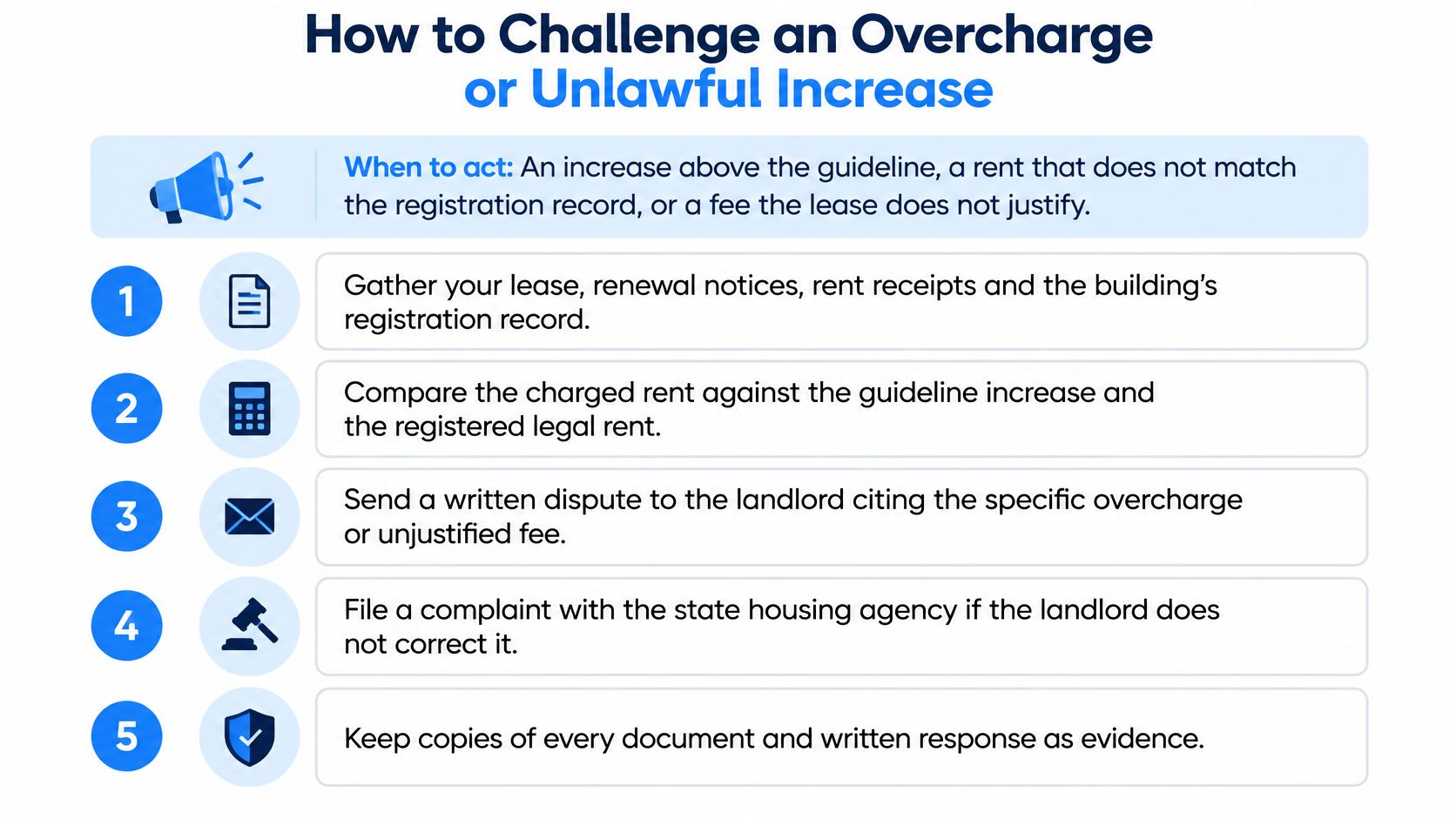
- Gather the paper. Your lease, any rider, renewal notices, rent receipts or bank records, and the building's registration history. Photograph each page with your phone so you have a dated copy.
- Do the comparison yourself first. Match the charged rent against the legal regulated rent and against the guideline for your lease period. Write the difference down as a number, not a complaint.
- Ask the landlord in writing. State the figure you were charged, the figure you believe applies, and ask for the legal basis for the difference. Keep the reply, whatever it says.
- Route the problem to the right office. New York State Homes and Community Renewal administers rent regulation and handles rent overcharge claims and registration disputes. The NYC Department of Consumer and Worker Protection handles FARE Act broker-fee questions, and for other fee or discrimination issues, ask the Tenant Helpline which office applies.
- File a rent overcharge complaint with HCR if the written explanation doesn't hold up. A complaint is stronger with the lease, the registration history and the landlord's reply attached to it.
- Call 311 and ask for the Tenant Helpline when you need a person to tell you what the next step is.
- Keep paying what your lease requires while the question is open, unless a tenant lawyer or legal aid office advises otherwise. Withholding rent can turn a good overcharge claim into an eviction case.
Which office handles which problem
- Rent overcharges and registration disputes: New York State Homes and Community Renewal, the agency that administers the rent laws.
- FARE Act broker-fee questions: the NYC Department of Consumer and Worker Protection.
- Application fees, deposits and discrimination: NYC or New York State tenant-protection agencies, routed through the Tenant Helpline.
We point renters to whichever agency administers the actual rule rather than the one with the friendliest website, because a complaint filed in the wrong place loses weeks. If you want the filing mechanics worked through step by step, this walkthrough of how to file an overcharge complaint covers the documents HCR expects.
Deadlines decide more of these cases than arguments do. A complaint backed by a complete set of leases, receipts and dated notices moves quickly. The same complaint filed a year later, with a missing renewal form and no record of the phone calls, is a much harder case to win.
RentReboot watches more than 20 listing platforms and flags apartments whose addresses match NYC rent-stabilization records before the alert reaches you, so a "stabilized" claim in an ad arrives with a building check attached. The free RentReboot rent-stabilized buildings map and address search let you run the same verification on any apartment you're considering, no account needed. Set one saved search, and you'll hear about the next covered unit by email or text instead of finding it a week late.