
Rent stabilization limits how fast a covered rent may rise and generally requires a renewal lease; it is not a freeze and not proof the apartment is affordable.
Only 0.98% of New York City's rent-stabilized apartments were vacant in 2023, according to the New York City Comptroller. That's the distinction to keep in mind before applying: a protection attached to an apartment doesn't tell you whether you can find it, qualify for it, or comfortably pay its rent.
An advertisement is the starting claim, not the proof. Your decision needs the lease, the apartment's rent history, and a comparison with similar neighborhood listings.
Table of Contents
- Rent Stabilization in Plain Terms
- How a Stabilized Lease Actually Works
- Rent Stabilization Compared with Rent Control
- Tenant Rights and Costly Mistakes
- Why the Stabilized Label Is Not a Bargain
- Verify a Unit and Sign Only When the Rent Is Knowable
Rent Stabilization in Plain Terms
Rent stabilization combines limits on rent increases with general lease-renewal protections. New York City has roughly 1 million stabilized apartments, accounting for about 41% of rental apartments and 27% of all housing units, according to the New York City Independent Budget Office's housing-stock analysis, which also documents the coverage rules and historical increases summarized below.
NYC rent stabilization at a glance
| What it tells you | Figure | How to read it |
|---|---|---|
| Stabilized apartments | About 1 million | About 41% of rental apartments and 27% of all housing units |
| Core building profile | 6 or more apartments, mostly built before 1974 | Later laws also cover some newer and subsidized buildings |
| Who sets the annual cap | Rent Guidelines Board | Not the landlord and not household income |
| One-year increases, 2022–2025 | About 3% on average | The rent usually rises; the step is limited |
| One-year increases, 2014–2021 | 0% to 1.5% | The allowed step changes by period |
| Legal starting point | Emergency Tenant Protection Act of 1974 | Modern framework after earlier rent control |
The practical model is a speed limit, not a parked car. The rent can move upward, but the landlord must follow the applicable rules rather than substitute whatever a new neighborhood listing might command.
That matters when you're comparing apartments with similar asking rents. A market-rate apartment and a stabilized apartment might cost the same today while exposing you to different renewal risks.
What the protection actually covers
The Emergency Tenant Protection Act established the modern framework after earlier wartime and postwar rent-control systems. Building age and apartment count remain useful screening clues, but later coverage laws mean neither clue can settle every apartment's status.
The protection has distinct parts, illustrated below.
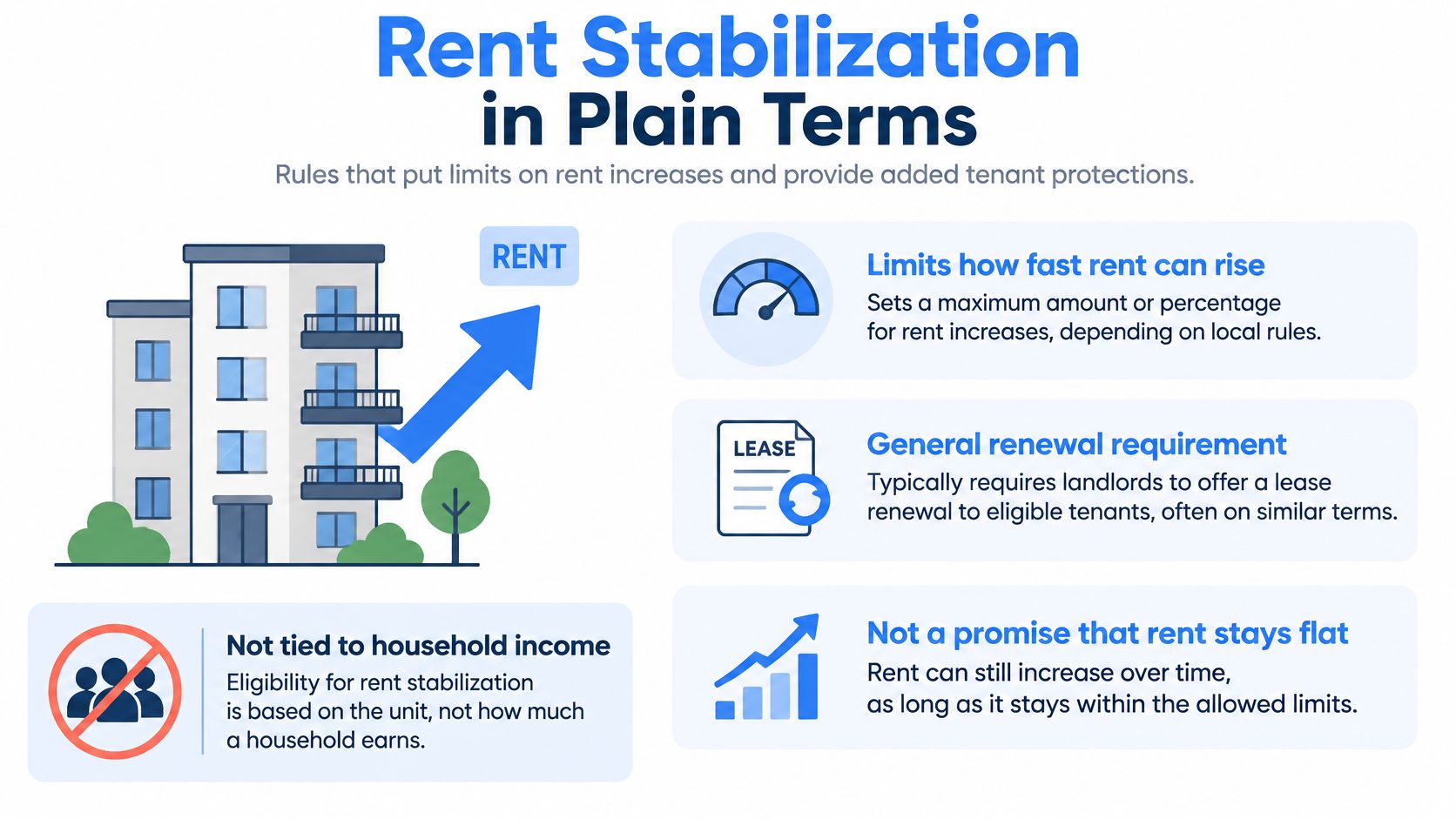
A capped increase governs the rent path. A renewal requirement generally protects continuity of occupancy. Neither establishes whether your current income can support the initial payment.
Practical rule: Evaluate the starting rent and the renewal protection separately. A manageable increase on an unaffordable rent still leaves you with an unaffordable apartment.
For someone asking what is rent stabilization, the useful answer is therefore a legal arrangement, not a price category. A low asking rent doesn't establish coverage, and the word stabilized in an advertisement doesn't replace apartment-specific documentation.
How a Stabilized Lease Actually Works
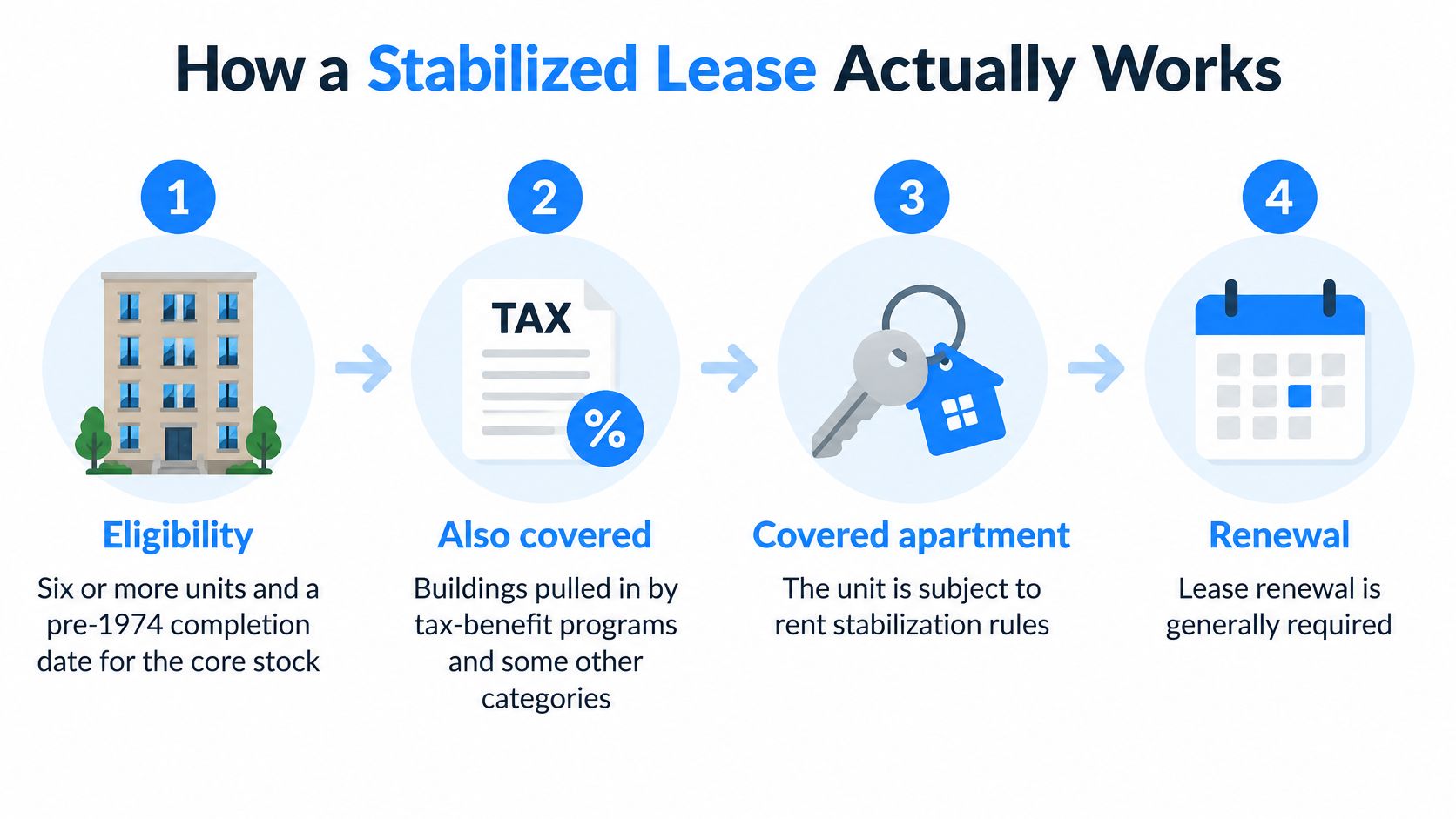
Follow the apartment through coverage, rent documentation, renewal, and vacancy. Each stage answers a different question, and an agent's answer at one stage doesn't settle the others.
Start by identifying why the apartment would be covered. The building's physical profile may suggest stabilization, while a tax-benefit program or another regulatory arrangement may explain coverage in a newer property. Ask for the program or coverage basis by name rather than accepting a general assurance that the building is regulated.
This process separates a promising building match from a documented covered tenancy.
Separate the amounts before doing the math
An advertisement can collapse several different amounts into one attractive monthly number. Keep these terms separate:
- Legal regulated rent: The regulated amount recorded for the apartment, subject to whether the registration and underlying adjustments are lawful.
- Preferential rent: A rent below the legal regulated rent that the owner agrees to charge. Its treatment in your tenancy must be clear in the lease and rider.
- Asking rent: The amount advertised to applicants. It isn't, by itself, evidence of either of the other amounts.
The distinction matters because a renewal calculation needs a lawful starting point. Don't accept a percentage calculation until the landlord identifies the rent to which that percentage applies.
Ask for any claimed improvement adjustment or surcharge in writing, including its basis and supporting documents. A verbal explanation that the owner renovated the kitchen isn't enough to establish what you owe.
Read renewal and vacancy as different events
At renewal, compare the proposed lease with the applicable Rent Guidelines Board order, the correct rent base, and the lease term. Historical averages aren't a substitute for the order governing your particular renewal.
A preferential-rent provision deserves especially careful reading. Ask the landlord to state in writing what amount will serve as the renewal base, rather than assuming the higher registered amount can automatically become your payment.
A rent calculation is only useful when both the percentage and the starting amount are legally correct.
Vacancy raises a separate question: what rent can the owner lawfully charge the next tenant? Don't assume either that the departing tenant's payment must continue unchanged or that turnover permits an unrestricted market reset.
If the landlord says coverage has ended, request the specific exemption and its effective date. An assertion that the apartment is expensive, renovated, or newly available doesn't identify a lawful exit.
For an additional visual explanation, use this video alongside the apartment's actual documents.
Before accepting the lease calculation, you should be able to identify the legal rent, any preferential rent, the lease length, and any dated exemption. If the paperwork doesn't answer those questions, request clarification before treating the advertised payment as dependable.
Rent Stabilization Compared with Rent Control
Rent stabilization versus rent control in New York
| Question | Rent stabilization | Rent control |
|---|---|---|
| Who sets the increase | NYC Rent Guidelines Board | Housing agency sets Maximum Base Rent and Maximum Collectible Rent |
| How the formula moves | Board percentages for covered renewal terms | Maximum Base Rent adjusted every two years for operating costs |
| Typical building | Core older multifamily stock, plus some newer regulated properties | Older buildings with qualifying controlled tenancies |
| Who can hold the lease | Current tenants and new tenants while the apartment remains stabilized | Qualifying existing tenants and lawful successors |
| Means test | No general income-qualification test | No general income-qualification test |
| Scale | Broad citywide program | Small remaining stock |
Rent control uses an apartment-specific Maximum Base Rent and Maximum Collectible Rent, with the base adjusted every two years to reflect operating costs, as explained by New York State Homes and Community Renewal's rent-control guide. Those are not alternative names for the Rent Guidelines Board's renewal percentages.
The names get blurred because both programs regulate rent and protect qualifying occupants. But a renter needs the actual program name to evaluate a proposed increase, understand occupancy rights, and identify the correct agency process.
Different formulas require different checks
Under rent stabilization, the starting question is which board order and renewal term govern the apartment. Under rent control, the inquiry includes the apartment's administratively established rent amounts and allowable adjustments.
That difference changes the documents you should request. A landlord's statement that an increase is standard doesn't tell you whether the calculation follows the correct system.
The same distinction applies to future occupancy. An apartment with a protected incumbent tenant isn't necessarily an apartment that an unrelated newcomer can rent under identical terms. Don't interpret a reference to an existing controlled tenancy as a promise that a new applicant can receive that same protection.
For an apartment-search comparison, the guide to rent-stabilized versus rent-controlled apartments provides a way to distinguish the labels before pursuing a listing.
A platform flag is a question to investigate
Search platforms often compress complex records into a badge. That badge may identify a building associated with regulation without resolving the status or collectible rent of the particular apartment advertised.
Use it to organize questions:
- Which program applies? Ask whether the apartment is stabilized, controlled, or subject to another affordability arrangement.
- Which record supports that answer? Request agency records and the relevant lease documents.
- Which calculation applies? Have the owner identify the formula and any claimed adjustment.
Neither label should be interpreted as a household-budget assessment. Income eligibility for a separate housing program is a different question from whether an apartment falls under rent regulation.
Also, don't transfer New York terminology wholesale to another city. Local ordinances may handle vacancy, exemptions, and renewal differently. The useful comparison is not regulated versus unregulated, but which rule governs this apartment and this tenancy.
Tenant Rights and Costly Mistakes
A tenant's protection needs to appear in an enforceable lease outcome: the correct renewal, a lawful rent calculation, and a documented route to contest a disputed charge. A friendly email from a broker doesn't establish any of those things.
Keep application approval separate from the apartment's legal status. A building's regulation doesn't tell you whether your application meets the owner's screening criteria, and approval doesn't prove the proposed rent is lawful.
Match each protection to the paperwork
A renewal protection matters when the owner offers the next lease. Check the term, rent base, and claimed adjustment rather than treating the mere arrival of a renewal form as proof of compliance.
An overcharge concern calls for a different file: the lease, rider, payment records, registration history, and written explanations of disputed additions. Preserve those documents together so a tenant adviser can trace what the owner charged and why.
Avoid these costly shortcuts:
- Treating broker correspondence as registration: Save the correspondence, but request the underlying apartment records.
- Accepting unexplained extras: Ask which charges are mandatory, who receives them, and whether they are permitted.
- Assuming a roommate becomes the successor: Qualifying succession requires a legal test, not just a shared address or informal agreement.
- Ignoring an exemption rider: Ask what event could end coverage and what notice or documentation supports it.
Repairs should not become an informal bargain in which you surrender a regulated lease for ordinary maintenance. If an owner proposes that exchange, get tenant-specific advice before signing anything.
An attractive listing can describe different deals
Say a one-bedroom is advertised below nearby new listings. It could involve a genuine preferential rent, a market-rate apartment incorrectly labeled as stabilized, or an advertised payment that excludes material charges.
Those possibilities look similar on a search-results page. The rider, rent history, and written fee schedule help distinguish them.
Before paying: Resolve disagreements between the advertisement and the lease in writing. Don't rely on a promise that the paperwork will be corrected later.
Prepare your screening documents in parallel. Superior Credit Repair's explanation of credit requirements for renting can help you organize questions about credit screening, but it cannot determine the apartment's regulated status.
Use the guide to tenant rights in rent-stabilized apartments to prepare more specific questions about renewal, succession, and disputed charges. Where the answer turns on your household's occupancy or an unusual rider, ask a tenant clinic or housing attorney to review the actual documents.
Why the Stabilized Label Is Not a Bargain
Stabilized vacancy was just 0.98% in 2023, down from 4.57% in 2021, according to the New York City Comptroller's analysis of stabilized vacancies, which documents the vacancy, rent, and deregulation measures below. A large regulated housing stock can coexist with very few apartments available to applicants.
Scarcity and rent levels inside the stabilized stock
| Measure | Figure | Reading |
|---|---|---|
| Citywide net rental vacancy, 2023 | 1.41% | Down from 4.54% in 2021 |
| Stabilized vacancy, 2023 | 0.98% | Down from 4.57% in 2021 |
| Median rent, stabilized and built before 1974 | $1,511 | Older stabilized stock |
| Median rent, stabilized and built after 1973 | $2,307 | A $796 gap; the older-stock median is about 35% lower |
| Units deregulated since 1994 | At least 328,714 | Cumulative reported removals |
| High-rent vacancy deregulation | 170,386 | Path closed by the 2019 law |
| High-rent vacancy or co-op/condo conversion | 222,907 | Includes overlapping exit categories, not an additional total |
The rent comparison uses the newer-stock median as the denominator. Calling that same gap a roughly equivalent percentage increase from the older-stock median would misstate the comparison.
More, neither median is an offer you can apply for. A median describes occupied housing as well as the broader stock being measured, not the price distribution of available listings in your search.
Price protection and search access are different benefits
An incumbent tenant evaluates whether the payment remains sustainable. A new applicant must also find an opening and determine whether its asking rent compares favorably with alternatives.
That's why the regulated label cannot establish a bargain. A stabilized apartment may offer useful protection while costing more today than an unregulated apartment that better fits your budget.
The distinction between rent protection and affordability is the point to retain when reviewing housing charts.
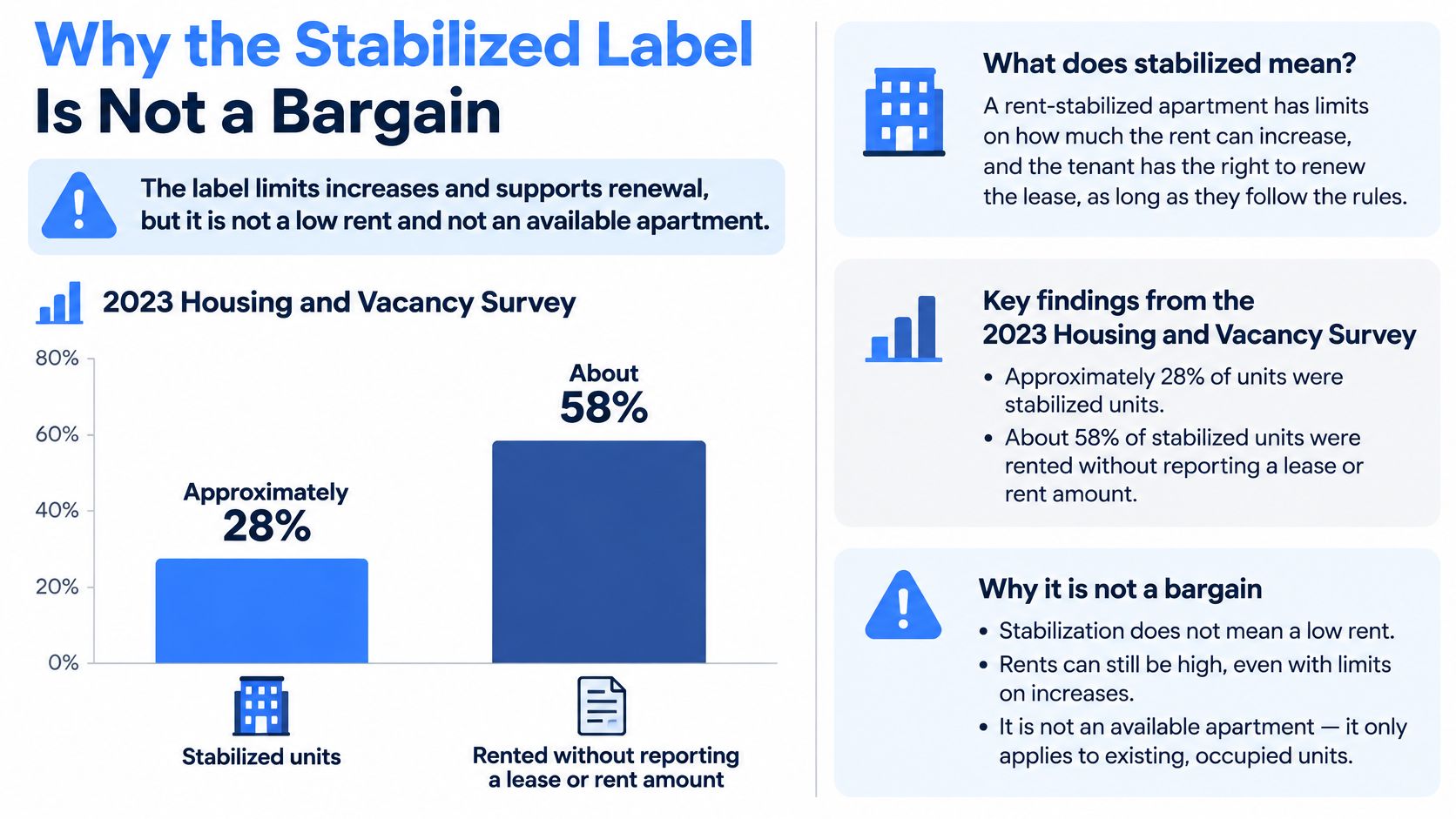
The historical deregulation totals also need careful reading. They describe removals over time, not a rule that currently allows every expensive stabilized apartment to leave regulation.
For your application, compare the full recurring payment with similar neighborhood apartments, then evaluate the protection attached to that payment. Don't stretch your budget merely because the advertisement uses a regulated label.
If your immediate problem is an unpaid rent balance rather than apartment discovery, Homes By Carmen's guide can help you find emergency rent relief. Check each assistance program's current eligibility separately from the apartment's rent status.
Verify a Unit and Sign Only When the Rent Is Knowable
Treat the listing as a claim to test, not a document to trust by default. Build a small application file that lets you reconcile the advertised payment, the proposed lease, and the agency record.
Set your monthly ceiling first. Include utilities and mandatory recurring charges so a promising rent doesn't distract you from an unsustainable total.
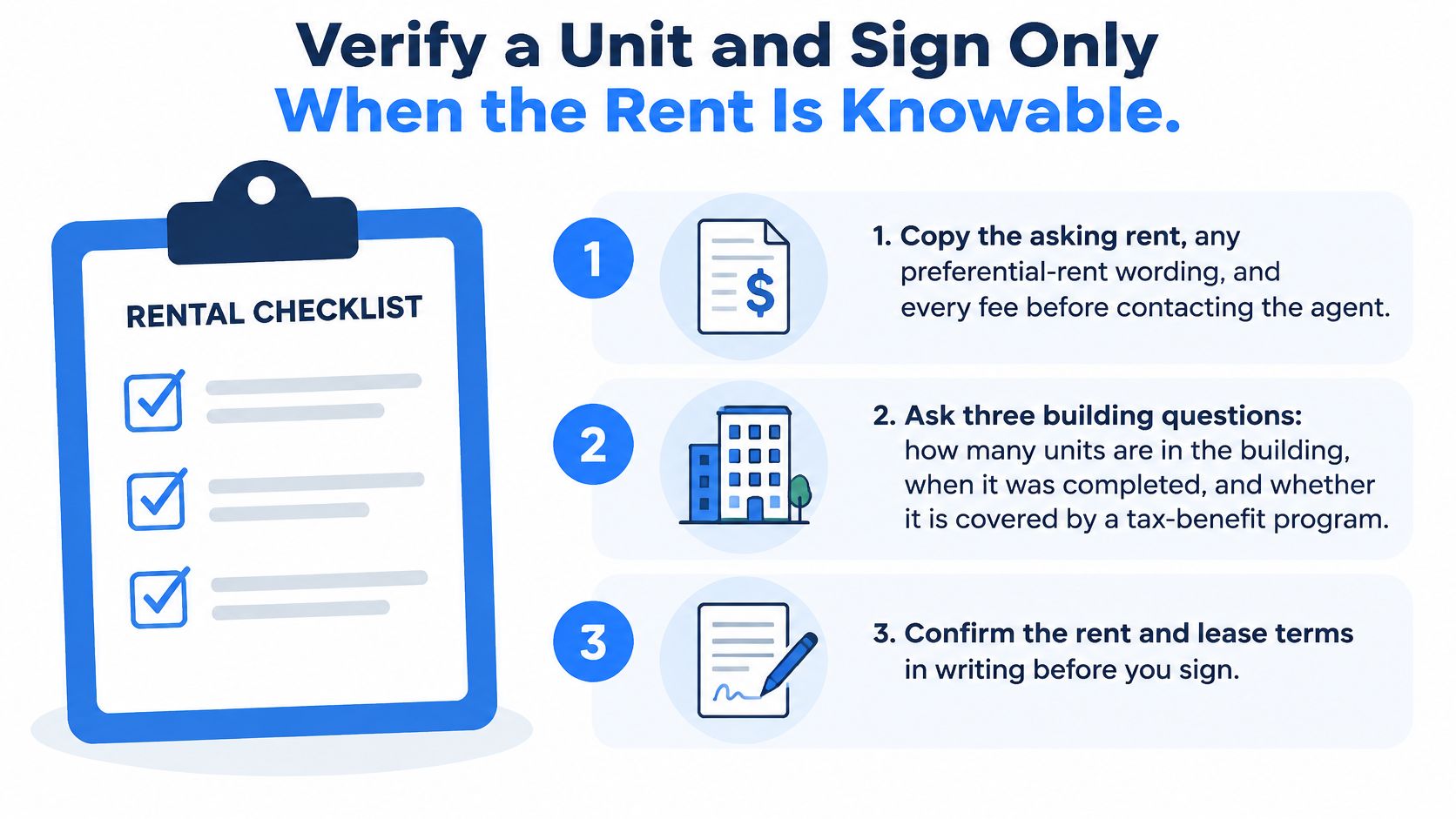
Use the checklist as a document-gathering sequence, not merely a way to confirm building age.
Build a record before committing money
Save the complete advertisement. Copy the asking rent, any preferential-rent language, concessions, required fees, apartment number, and agent's contact information. Keep a dated copy so later edits don't erase the original representation.
Ask the building questions. Request the apartment count, completion year, and any tax-benefit or other regulatory program the owner says applies. The useful output is a named coverage basis, not merely a yes to whether the building is stabilized.
Request the proposed documents. Ask for the lease, applicable stabilization rider, legal regulated rent, and any preferential-rent provision. If the agent says those are available only later, record what remains unresolved rather than treating the omission as confirmation.
Review the agency rent history. Follow Homes and Community Renewal's process for obtaining the apartment's history, including any access requirements. Applicants may need the owner's cooperation or guidance from the agency; a cropped listing screenshot isn't an adequate substitute.
A registration entry is part of the evidence, not an instruction to overlook an unexplained jump or missing document. Make a list of discrepancies and ask for the basis of each adjustment.
The guide to preferential rent versus legal rent can help you frame questions when the advertisement and proposed lease use different amounts. Keep the inquiry specific: which amount is payable now, and which amount governs the proposed renewal calculation?
Test the price and resolve disagreements
Use discovery tools as leads. A stabilization flag or city-data match can identify a building worth investigating. It cannot, on its own, determine the status of every apartment or validate the proposed charge.
Compare like with like. Review neighborhood rent distributions and current listings for the same bedroom type. Separate monthly rent from concessions and recurring fees, then consider location, condition, and included utilities before deciding that the regulated offer is competitive.
Pause when the records disagree. If the history, rider, and advertisement point to different answers, ask the owner for a written reconciliation before paying a deposit. Where the explanation remains unclear, bring the documents to HCR or a tenant clinic and ask which amount is collectible and why.
Save a search using your budget, neighborhoods, and bedroom count, with alerts enabled. Keep unresolved listings separate from apartments whose documents you've reviewed, so urgency doesn't turn an unverified claim into an assumed fact.
A building match helps you decide where to investigate. Apartment records help you decide whether to sign.
Your sign-off test should fit in a sentence: I can name the legal rent, whether a preferential rent applies, the renewal rule, and any exemption date. If you can't, keep looking while you resolve the missing information.
RentReboot offers saved-search alerts, potential stabilization flags cross-checked against official city datasets, and neighborhood rent distributions. Set up a search around your actual budget and bedroom needs, then use those leads to request the lease and rent history before you commit.